
 30 June 2026
  11 min
  2 views
 Entrepreneurs interested in launching an online poker business in the Philippines often begin by studying regulations and market reports — and usually end up even more uncertain than before. On paper, the market looks complicated, contradictory, and difficult to evaluate.
In this article, I want to look at the Philippines from a slightly different angle, relying not only on official data and industry analytics, but also on personal observations and practical experience working in the poker industry.
Regulation: From Offshore Hub to Restricted Market
For years, the Philippines was considered one of Asia’s key iGaming hubs. The market is regulated by Philippine Amusement and Gaming Corporation (PAGCOR), a state-owned corporation responsible for licensing and supervising gambling operations in the country.
The system became especially attractive after the launch of the Philippine Offshore Gaming Operator (POGO) model. Under this framework, foreign-facing operators — many of them targeting players across Asia — could legally base their operations in the Philippines while serving overseas markets.
However, the situation changed dramatically in the mid-2020s. Amid growing concerns around money laundering, cybercrime, tax violations, and human trafficking allegedly connected to parts of the offshore gambling sector, the Philippine government began tightening control over POGO operations. What started as increased scrutiny eventually turned into a full-scale regulatory reversal.
In 2024, authorities announced the shutdown of offshore gaming operations. In 2025, this policy was formalized through Republic Act No. 12312, also known as the “Anti-POGO Act,” which permanently banned offshore online gambling operations in the country, revoked existing licenses, and prohibited issuing new ones.
As of 2026, the Philippines officially positions itself as effectively “POGO-free,” while law enforcement agencies continue targeting illegal operators that remain in the market. For poker businesses, this radically changes the picture.
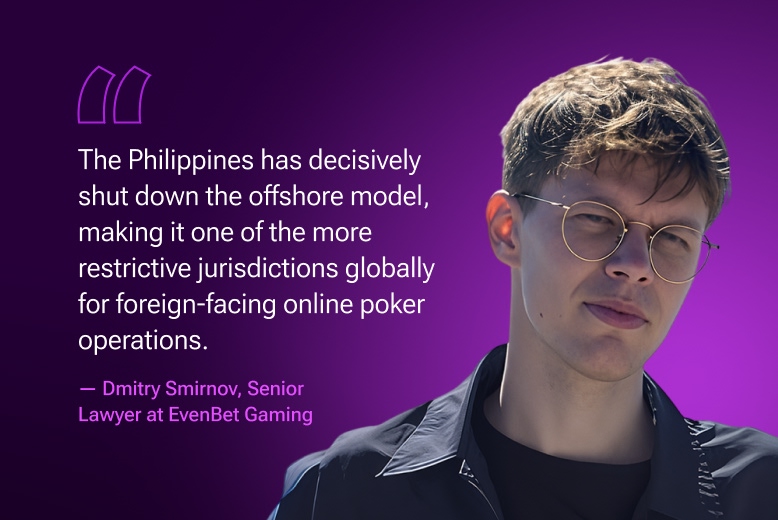
Dmitry Smirnov, Senior Lawyer at EvenBet Gaming:
For foreign operators, the environment has gone from permissive to essentially closed. It is no longer possible to legally establish or run an offshore online poker room from within the Philippines, and attempting to do so now carries significant criminal risk.
Domestically, gambling remains legal but tightly controlled through PAGCOR and largely limited to licensed land-based casinos and selected local online offerings, while many international gambling sites are actively blocked by regulators.
In short, the Philippines has decisively shut down the offshore model, making it one of the more restrictive jurisdictions globally for foreign-facing online poker operations.
Market Overview
Despite recent regulatory changes, the Philippines remains one of Asia’s most experienced iGaming hubs. For years, the country attracted gambling operators thanks to its developed infrastructure, English-speaking workforce, relatively low operating costs, and strong operational expertise in servicing Asian markets.
However, the market itself has historically been casino-first. Slots, live casino products, sportsbook offerings, and fast-paced local card games have traditionally been far more popular than online poker.
This is also reflected in the available data. Reliable poker-specific analytics for the Philippines are extremely limited. Most research aggregates poker into broader “online casino” or “iGaming” categories, making it difficult to estimate the actual size of the online poker segment or evaluate its long-term growth potential.
Importantly, this lack of transparency is itself a meaningful signal. In many cases, the absence of standalone poker data suggests that poker still occupies a relatively niche position within the country’s broader gambling ecosystem rather than functioning as a major vertical on its own.
Risks and Opportunities for the Online Poker Business in the Philippines
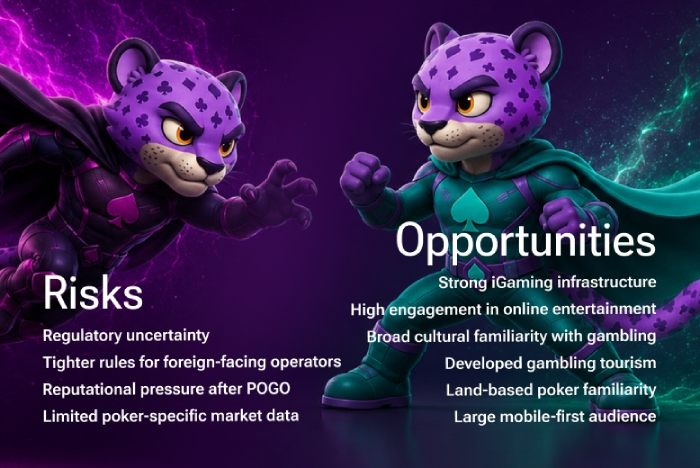
The Philippine market presents both clear risks and potential opportunities for online poker businesses. Let’s briefly weigh the pros and cons.
Risks
The first is regulatory uncertainty. The collapse of the POGO model showed that the Philippine government can change its stance toward parts of the gambling industry relatively quickly under political and social pressure. While domestic gambling remains legal and regulated through Philippine Amusement and Gaming Corporation, foreign-facing operations now face a much more restrictive environment.
There are also reputational considerations connected to the recent controversies around offshore gambling. Even though poker itself was not at the center of these issues, the broader industry climate became more cautious as a result.
Another challenge is the lack of reliable poker-specific analytics. Most available reports combine poker with broader casino or iGaming segments, making it difficult to estimate the true scale of the market with confidence.
Opportunities
The Philippines remains one of Asia’s most experienced gambling markets, with strong operational infrastructure, a well-developed gambling tourism sector, and a large audience already familiar with poker through land-based casinos and poker rooms. Even without precise market data, this alone suggests that poker as a game is neither foreign nor unfamiliar to local players.
The country also has a highly mobile and internet-active population with strong engagement in online entertainment and gaming. This creates a potentially favorable environment for modern mobile-oriented poker products.
Equally important is the country’s broader cultural familiarity with gambling. In the Philippines, betting and card games have long existed not only in casinos or formal gaming venues, but also in everyday social settings. One of the most remarkable examples is the well-documented practice of gambling during wakes, where card games and small wagers can become part of the communal vigil around the deceased.
Konstantin Shelikhov, Content Architect at EvenBet Gaming:
Funeral customs are often among the oldest and most emotionally conservative cultural practices, as they deal with sensitive matters such as death, family memory, and beliefs about the afterlife. In this context, the Philippine tradition of gambling during wakes is especially revealing. It suggests that gambling is not perceived only as commercial entertainment, but can also function as a social practice embedded in community life — helping keep mourners together and, in some cases, financially supporting the deceased’s family.
This does not mean that gambling is universally accepted without criticism. Still, it points to an important cultural signal: card-based gambling is already familiar, socially recognizable, and relatively natural for many local players. For online poker businesses, this may indicate a lower cultural barrier to entry than official market data alone would suggest.
So, Is Online Poker in the Philippines Worth It After All?
Direct public data on online poker in the Philippines remains limited, but I still think there are several indirect signals worth paying attention to.
For example, major international operators such as GGPoker continue to maintain a visible presence in the market. Of course, this alone does not prove massive commercial success, but to me it does suggest that the overall environment remains workable for at least certain poker business models.
Another thing that stands out to me is how developed the country’s land-based poker ecosystem actually is. Live casinos, poker rooms, and gambling tourism are all very visible in the Philippines. So despite the rather cautious picture painted by dry market reports, it is obvious that there is a large audience of players here who know poker, understand poker, and — most importantly — genuinely enjoy playing it.
At the same time, the country has a highly mobile and internet-active population that actively engages with online entertainment and gaming. Because of this, online poker rooms could potentially collaborate more closely with land-based casinos through satellite tournaments, hybrid online-offline promotions, or similar mechanics. However, there are still very few publicly documented success stories in this area, so for now this should probably be viewed more as a promising hypothesis than a proven strategic direction.
Personally, though, I see even more potential in approaches built around local card game culture.
In other Asian markets, familiar national card games have already proven capable of acting as an entry point into broader poker ecosystems. At EvenBet Gaming, for example, we observed this firsthand in India, where online Rummy products — a game deeply embedded in local culture — successfully introduced players to more traditional online poker formats while poker was still legal in the country.
I believe a similar approach could potentially work in the Philippines through culturally familiar games such as Pusoy (also known internationally as Chinese Poker), Pusoy Dos (Big 2 or Big Two), and Tongits, which shares similarities with Rummy-style card games.
 Windows
  macOS
macOS  iOS
iOS  Android
 Another reason for optimism, in my opinion, is that poker products themselves have changed significantly in recent years. Modern poker increasingly focuses on shorter sessions, lower entry barriers, and gameplay mechanics that feel much closer to casino entertainment than traditional long-form poker.
At EvenBet Gaming, for example, we developed products such as One Click Poker specifically to create a faster and more accessible experience for players who may not be interested in classic poker room ecosystems.
In conversations with Filipino iGaming business representatives, I also repeatedly noticed particularly strong interest in more casual and casino-like poker mechanics rather than traditional “hardcore” poker formats.
Because of this, I would argue that poker’s relatively small role in Philippine gambling statistics may indicate not only market limitations, but also how much of the market’s potential still remains unexplored.
Conclusion
The Philippines is clearly not the easiest market for launching an online poker business. At the same time, the market still shows many signs of significant untapped potential.
A deeply rooted gambling culture, a large mobile-first audience, and growing interest in more accessible and casino-oriented poker mechanics all create opportunities for operators willing to adapt to local realities.
In the end, success in the Philippines will likely depend on a combination of careful market understanding, flexible strategy, and strong technology partners capable of supporting localized and experimental approaches to online poker.