
 4 June 2026
  13 min
  467 views
 No one can prove it — but it’s widely accepted as true: social mechanics are one of the keys to online casino performance. And yet, when you look for concrete evidence, the picture becomes less clear.
From what I’ve seen, there is surprisingly little public data that directly links social features to core business metrics such as retention or LTV. Operators and suppliers rarely share controlled experiments or detailed breakdowns of impact. At the same time, the industry talks about social mechanics constantly — as a driver of engagement, loyalty, and long-term value — and these claims are rarely questioned.
The reason may be simple. The idea fits too well with what we already know about human behavior.
In practice, the issue is often not whether social mechanics work, but how they are implemented. In many products, they remain surface-level — reduced to a set of disconnected features rather than a coherent system — which limits their actual impact despite the underlying potential.
This article takes a closer look at that assumption. We will explore the psychological foundations behind social behavior, examine the main types of social mechanics used in online casino products, and break down how these elements function in practice.
From Human Nature to Product Design
Across disciplines — from classical literature to anthropology — one idea consistently emerges: a human needs a human.
This is not a metaphor. Human development depends on interaction. Individuals isolated from society lose essential behavioral and cognitive traits. In extreme documented cases — unfortunately, such real-life examples do exist — children raised without social contact fail to develop language, social understanding, and even basic motor patterns such as upright walking.
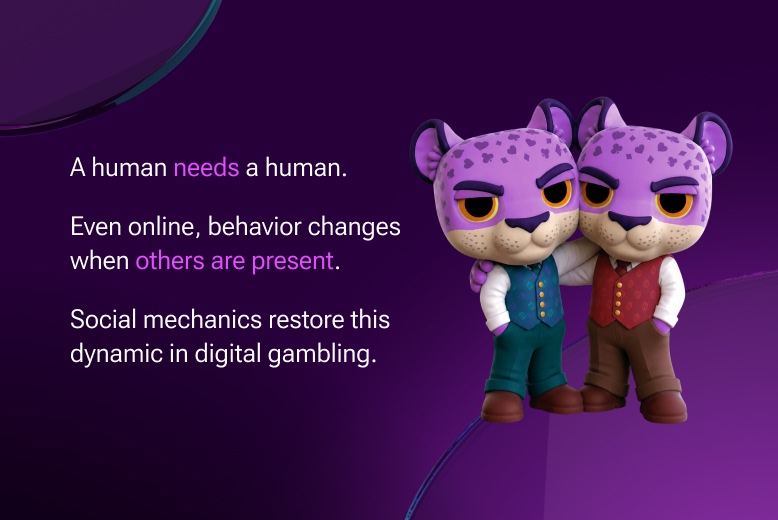
In other words, interaction is not an added layer to human experience, it is a prerequisite.
This fundamental principle translates directly into digital environments. Even when engaging with systems designed for individual use, people naturally seek the presence of others. They look for signals that someone else is there, has been there, or is reacting in parallel.
Online casino products are no exception. Historically, digital gambling shifted the experience toward individual play: a user, a screen, and a game. But this format removed a critical dimension that has always been part of gambling in its offline form — the social context. Social mechanics reintroduce that missing layer.
What Research Says About Social Behavior in Gambling Contexts
While publicly available data on the impact of social mechanics remains limited, some academic research does support the idea that gambling is not purely an individual activity, even in digital environments.
Studies on online gambling communities show that players actively seek interaction with others for information exchange and emotional engagement. Players share wins, discuss outcomes, and participate in collective experiences that extend beyond the game itself.
Research on virtual communities in gambling and gaming environments also demonstrates that social identification plays a measurable role in behavior. When individuals perceive themselves as part of a group, their level of engagement increases, and their actions begin to align with group norms.
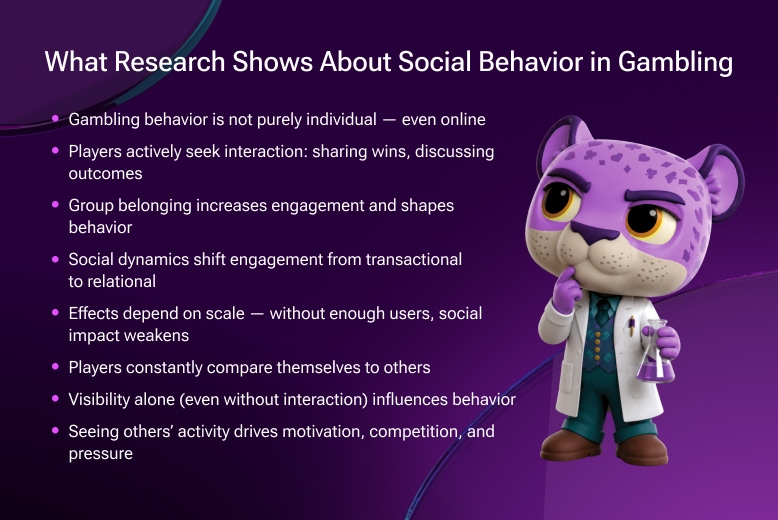
This has several implications:
- Behavior becomes socially reinforced rather than individually driven
- Participation is sustained not only by outcomes, but by belonging
- Engagement shifts from transactional to relational
At the same time, all of this is highly dependent on scale. Without a sufficient number of active users, social dynamics tend to weaken — or fail to form at all.
Another important factor is social comparison. Psychological studies consistently show that people evaluate their performance relative to others rather than in isolation. In gambling environments, this translates into a continuous awareness of how one’s results compare to peers.
Visibility — even without direct interaction — is enough to influence behavior.
Seeing that others are winning, progressing, or participating creates a reference point. It introduces motivation, competition, and, in some cases, pressure.
Why This Matters for Online Casino Products
From a product perspective, social mechanics are not simply engagement features. They operate at the level of fundamental human behavior. For product teams, this means they should not be treated as optional add-ons, but as a core part of the product itself.
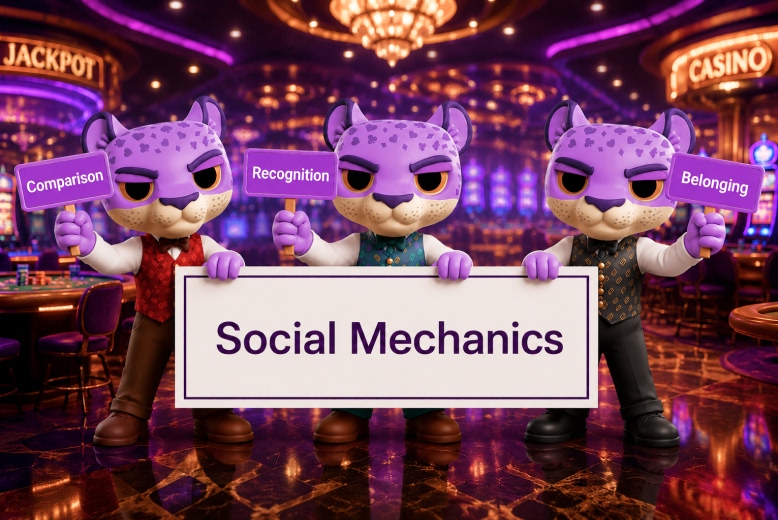
Social mechanics introduce three core dynamics:
- Comparison — players measure themselves against others
- Recognition — players seek visibility and validation
- Belonging — players become part of a shared environment
These dynamics change how the product is experienced. A game is no longer just a system of probabilities and outcomes. It becomes a social space where actions are observed, interpreted, and responded to — even if indirectly.
This shift has direct implications for engagement. Without social context, interaction with the product tends to remain functional and episodic. With social context, it becomes continuous, emotionally reinforced, and, in many cases, habitual.
This is why social mechanics matter. They do not add complexity for the sake of differentiation. They restore a core dimension of human experience that digital gambling environments initially removed — and, in doing so, fundamentally reshape how players engage with the product.
Types of Social Mechanics in Online Casinos
In practice, many operators approach social mechanics as a checklist: add chat, introduce leaderboards, launch tournaments — and assume the social layer is in place.
From what I’ve seen, this rarely works as intended.
For example, features like chat or leaderboards often fail in low-activity environments, where they instead highlight the absence of other players.
Social interaction in a product is not the result of isolated features. It emerges from a system. What matters is not which tools are present, but whether they form an environment where players can recognize each other, take on roles, and feel part of something ongoing.
In this sense, a well-designed social layer functions like a theater. Players are not just interacting with the system — they are performing within a shared setting. They compare, react, signal status, and, over time, build a recognizable presence.
Without this structure, features remain disconnected. With it, they begin to work together as a system.
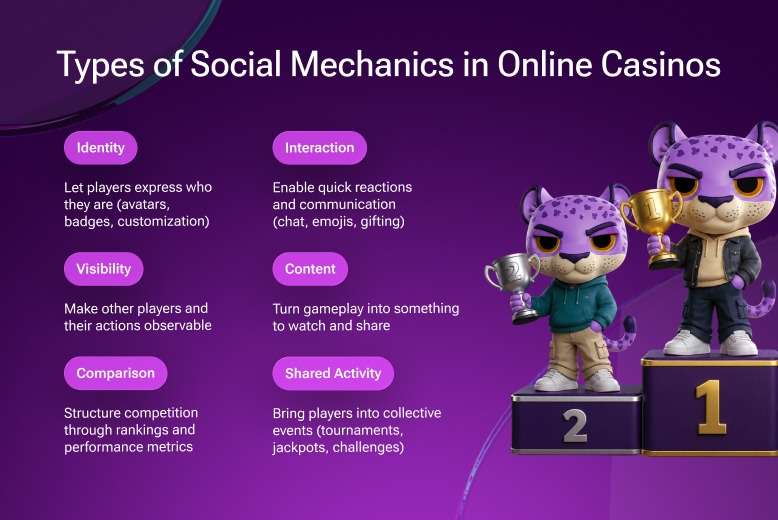
Identity Mechanics: Giving the Player a Persona
For interaction to feel meaningful, players need more than presence — they need a way to define who they are within the system. Identity mechanics serve this purpose. They allow users to project an image, adopt a role, and associate themselves with a particular style or status.
Typical elements include:
- avatars and profile customization, including collectible or NFT-based avatars
- visible achievements, badges, or status indicators
- public history of wins, milestones, or progression
These features go beyond representation. Their role is to let players embed a chosen identity into their account — not just who they are, but who they want to be within the game.
This has a direct effect on engagement. When a player sees their account as an extension of themselves — or as a persona they are invested in — the connection to the product becomes more personal. The account is no longer just functional. It becomes something to maintain, develop, and return to.
Over time, identity evolves from a layer of customization into a retention factor in its own right. Players are not just returning to the product — they are returning to themselves within it.
Visibility Mechanics: Making Other Players Present
The most fundamental layer of social interaction is visibility.
These mechanics do not require direct communication. Their role is to make other players observable within the product.
Common examples include:
- notifications about wins or achievements
- live feeds of player activity
- indicators of how many users are in a game or at a table
- “hot” or trending games based on participation
Their function is simple: they answer the question “what is happening around me?”
Without this layer, all other social mechanics lose effectiveness. Visibility is what turns an individual experience into a shared environment. Even simple observation — without any direct interaction — can significantly influence player behavior.
Comparison Mechanics: Structuring Competition
Once players can see each other, comparison naturally follows.
These mechanics introduce structure to that comparison by ranking, grouping, or measuring performance.
Typical implementations:
- leaderboards (global, local, or segmented)
- tournament standings
- progress-based rankings or levels
- “you vs others” performance indicators
Their role is not only to show results, but to contextualize them.
A win or loss gains additional meaning when placed within a broader competitive frame.
Interaction Mechanics: Enabling Direct Response
Interaction mechanics allow players to respond to each other explicitly.
They introduce communication, but often in lightweight forms.
Examples:
- live chat during gameplay
- reactions (emojis, likes, quick responses)
- gifting or resource exchange between players
These features vary in depth, but they share a common purpose: they make interaction immediate and low-effort.
Importantly, full conversations are not required. Even minimal interaction is enough to reinforce the presence of others.
Shared Activity Mechanics: Creating Collective Experiences
Some mechanics go beyond visibility and interaction to create shared participation.
These features bring players into the same event or process.
Examples include:
- tournaments with common goals or timelines
- community challenges or milestones
- shared jackpots or pooled rewards
- team-based or group-based formats
Here, the player is not just observing or reacting — they are participating in something that exists at the group level.
This changes the perception of gameplay from individual sessions to collective activity. In practice, this shift is often reflected in longer session durations and a higher likelihood of players returning to the product.
Content Mechanics: Turning Gameplay into Shareable Moments
A newer category of social features focuses on content creation within the platform.
Examples:
- short-form highlights of wins or gameplay moments
- in-platform “stories” or feeds
- streamer-style tables or spectator modes
These mechanics shift part of the experience toward observation and sharing.
Gameplay becomes not only something to do, but something to watch and react to.
Conclusion — Social Mechanics as a System, Not a Feature
Social mechanics work not because they add more features, but because they change how players engage with the product. Instead of relying solely on internal motivation, they introduce external triggers — visibility of others, ongoing activity, and real-time signals that make the experience reactive rather than isolated.
They also extend the lifecycle of interaction. A product with no social layer is session-based: players enter, play, and leave. A product with social dynamics becomes continuous. There is always something happening — someone progressing, competing, or participating — and this creates reasons to return beyond the core gameplay.
Individually, most social features are simple. Their impact comes from how they work together. When visibility, feedback, and shared activity are aligned, they form a system where player behavior reinforces itself. At that point, the product is no longer just a set of games — it becomes an environment that stays active even when the player is not.