
 7 July 2026
  10 min
  368 views
 We need to apologize on behalf of all B2B poker software providers. Including ourselves.
When we market poker software, we often talk about features. It is understandable: features are tangible, easy to demonstrate, and often visually impressive. Throwables, Bomb Pot, Cash Drop, and other mechanics look great in presentations, product videos, and conference demos. They help show that the platform is modern, flexible, and engaging. But this creates a problem.
For operators without deep poker experience, these features may start to look like the main reason a poker room succeeds. They may seem game-changing, as if adding the right mechanic can instantly fix low activity, grow revenue, or turn a quiet room into a busy one.
In reality, this is rarely how poker works. When operators overestimate the role of product features, they may start focusing on the wrong priorities. As a result, they lose time, spend resources, and postpone the work that actually drives growth.
An apology is not enough, of course. We also need to correct the misunderstanding.
In this article, I want to explain what attractive and fun poker features really influence, where their value begins and ends, and what actually makes a poker room successful.
First of All, You Need Players
We will never get tired of saying this: unlike casino games, poker cannot function without players.
A slot game does not need another person on the other side of the screen. A player opens the game, places a bet, and gets the result from the system. Poker is different. It is built around competition between real people. To play a hand, a player needs opponents. To enjoy the room, they need enough opponents.
This is why traffic is not just one of many growth factors for a poker room. It is the foundation that makes the product work at all.
The more players you have, the more valuable your room becomes for everyone already inside it. Every new player creates two layers of value:
- Direct value: the player joins games, generates rake, and contributes to revenue.
- Network value: the player improves the experience for others by making tables fuller, games easier to find, and the room feels more alive.
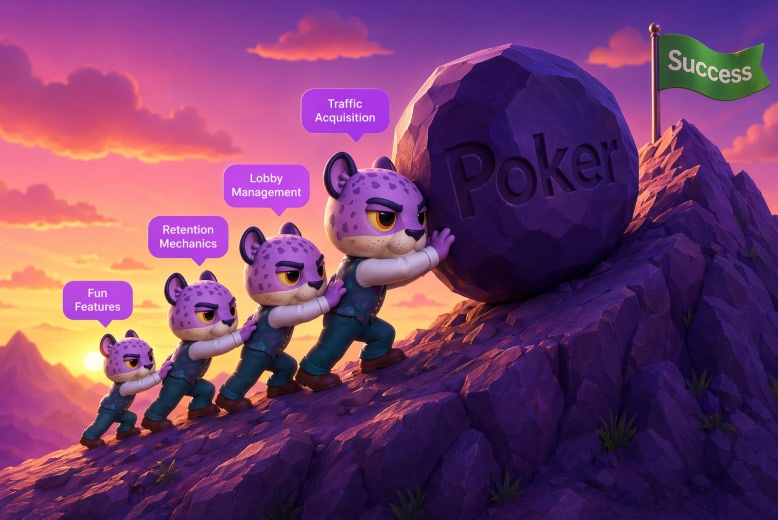
For poker rooms that have already survived the launch stage, work on traffic and liquidity should still take more than half of all strategic effort. For rooms that are just entering the market, it may need to take almost all of it.
Acquisition and retention mechanics can support this work, but they cannot replace it. Rakeback, leaderboards, deposit promotions, missions, tournaments, and loyalty programs may help attract players, reactivate them, or keep them more engaged. However, they do not create traffic on their own.
These mechanics work best when they multiply the effect of a real acquisition or retention effort. For example, if an affiliate partner says,“My players need rakeback. If your room has this feature, I can bring them to you,” the value of the feature becomes clear. That is when a poker feature becomes a business tool, not just another option in the back-office.
This may sound harsh, especially when everyone wants to discuss product innovation, gamification, and new formats. But the main question is usually much simpler: do you have enough players to make the room feel playable?
Then, Keep Players in the Right Places
Once traffic starts coming in, another priority moves to the front: lobby management, or table management.
At this stage, the operator’s task is to find the right balance between variety and concentration. A poker room needs enough choice to feel active and attractive, but not so much choice that players become scattered across too many tables, limits, and formats. This is another area where software providers may unintentionally create the wrong impression.
When we present a poker platform, we naturally show the full range of available games and formats. Texas Hold’em, Omaha, tournaments, cash games, fast-fold poker, private tables, exotic formats, different limits, and feature-based tables all look strong in a product portfolio. They demonstrate that the platform is flexible and technically ready for different business models. But this does not mean that every operator should launch everything at once.
For a new poker room with a limited player base, too much variety can become a problem. Players enter the lobby, see many available tables, but each of them has too few opponents. Instead of feeling rich and dynamic, the room starts to feel empty. The operator may think they are offering more choice, while the player experiences the opposite: fewer real opportunities to play.
That is why table selection should be planned carefully. Operators need to decide which poker types, formats, limits, and feature-based tables should be active at each stage of growth.
For many new rooms, it makes sense to start with a focused selection of Texas Hold’em tables. Omaha can be added if there is already enough traffic to support it. As player concentration grows, the operator can gradually introduce more formats, more limits, more feature-based tables, and, eventually, more experimental options.
The key principle is simple: a poker room should not look bigger than its liquidity can support. A smaller but active lobby is usually healthier than a large but empty one. Players do not judge a poker room by how many formats are technically available. They judge it by whether they can quickly find a game that feels alive.
So, Were We Lying About Fun Features Making Money?
No. We were telling the truth. Bomb Pot, Cash Drop, Insurance, Rabbit Hunting, and similar features generate more revenue. But again, they do not do this on their own. They can make the game more dynamic, create extra emotional moments, increase player engagement, and open additional monetization scenarios.
These features work best when the room already has the basics in place: enough players, stable liquidity, a healthy player ecology, and regular activity across the right tables and limits. In this context, fun features can help the operator generate more value from an existing audience. They can support retention, make sessions more entertaining, and improve monetization around games that are already active.
This is an important distinction. Fun features are not usually the reason a room becomes alive. They are one of the ways to make an already active room more engaging and commercially effective.
Of course, there is nothing wrong with launching a feature simply because it is exciting, unusual, or different from what competitors offer. It is your business, and no one can forbid you from experimenting.
We only recommend checking two things first: whether you have enough traffic for the feature to work, and whether launching and testing it will not take resources away from more urgent business priorities.
What If You Don’t Want to Deal With All This?
Poker is not always added as a standalone business. Some operators come to it because they want to enrich an existing online casino or sportsbook with stronger social mechanics, higher engagement, and more variety for their audience. In this case, they may not want to invest heavily in separate poker acquisition, deep lobby management, or a dedicated poker operations team. And this raises a fair question: will poker generate enough value to justify that level of effort?
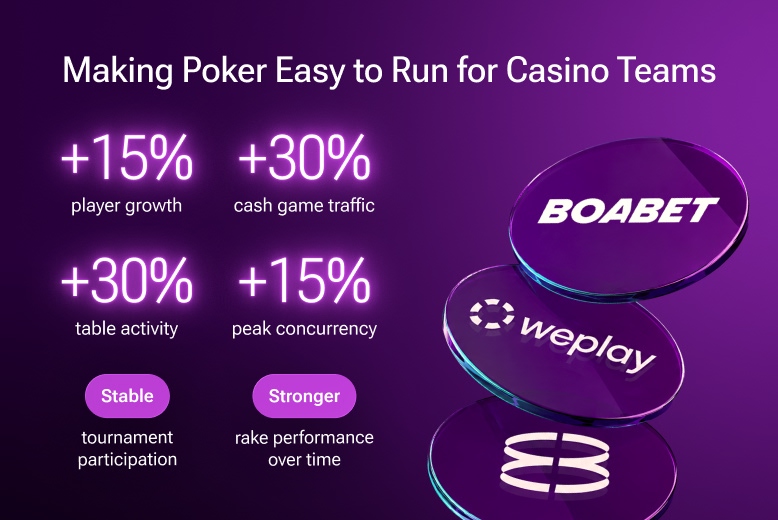
Fortunately, there is another option: joining a poker network. This can help solve the two most difficult tasks at once: liquidity and lobby management. You can see how this approach works in the BoaBet case study, where a casino-focused project successfully added online poker without building a separate poker operations team.
Conclusion
When we proudly talk about the impressive results that 1win Poker achieved after introducing features like Bomb Pot and Bad Beat Jackpot, we do not see it as the achievement of the features. First of all, it is the achievement of our valued partners at 1win Poker: their strategy, their audience knowledge, their traffic work, and their ability to use our product in the right way.
So when we say that our platform has a powerful new feature, we are not selling success. We are saying that we are ready to give operators more tools to achieve it. At EvenBet Gaming, we sell a quality product and build reliable partnerships based on trust.
The result comes when the right software meets the right business strategy.