BoaBet’s audience was primarily focused on casino and betting entertainment, rather than poker. This meant that the poker product needed to be accessible and engaging for recreational players who were not necessarily familiar with poker as a regular activity.
For poker to become sustainable, BoaBet needed an environment where casual players could stay active over time and would not be quickly discouraged by stronger, more experienced opponents.
Poker depends heavily on the quality and balance of the player environment. If recreational players feel that the games are dominated by more advanced users, they are less likely to continue playing.
BoaBet therefore needed a network structure that could protect recreational traffic, support fairer player dynamics, and create the right conditions for long-term engagement.
Poker is more operationally demanding than many casino products. It requires ongoing management across cash games, tournaments, promotions, player support, anti-fraud, and product optimization.
For a casino-focused operator, this creates a practical concern: launching poker may appear to require a dedicated in-house poker team before the vertical can perform effectively.
BoaBet joined WePlay to avoid building poker liquidity from scratch. By becoming part of an existing poker network, the operator could offer players a more active environment from the start, with access to cash games, tournaments, and a broader player pool.
This helped create the foundation needed for faster poker adoption and more stable activity over time.
Since BoaBet’s audience was primarily casino-oriented, the poker environment needed to be suitable for recreational players rather than only experienced poker users.
WePlay provided a managed network structure designed to support healthy player ecology. The goal was to create conditions where casual players could enjoy poker, stay engaged, and avoid being quickly discouraged by stronger or more professional opponents.
Poker requires continuous expert management across cash games, tournaments, player ecology, support cases, fraud prevention, and product optimization.
Instead of building a dedicated in-house poker department, BoaBet was supported by experienced poker operations, support, and anti-fraud teams. This helped the operator manage the day-to-day complexity of poker while keeping the product stable and efficient.
The partnership also helped BoaBet’s team build poker understanding over time.
Through documentation, educational materials, guidance on poker and network functionality, regular meetings, check-ins, and ongoing operational support, the operator’s team could become more confident with poker without needing deep expertise at the beginning of the cooperation.
WePlay supported player acquisition and engagement through network tools and campaigns, including rakeback contribution, freerolls, rewards, tournament tickets, live tournament packages, and access to a broader guaranteed tournament lobby.
These tools helped BoaBet stimulate activity across the poker vertical and give recreational players more reasons to return.
For casino-oriented operators, early poker success is less about immediate revenue and more about player behavior: whether users try poker, stay engaged, and return over time. In this context, the results show not just growth, but sustainable engagement within a healthy player environment.
Poker and casino players typically exhibit different behavioral patterns. Poker players tend to keep funds in their accounts for longer periods, whereas casino players are generally more likely to withdraw their balances immediately after a winning session. Operators offering all three verticals—poker, sportsbook, and casino—benefit from a significant competitive advantage over operators without poker. This is primarily driven by stronger cross-selling opportunities, improved player retention, and higher conversion rates across the different product verticals.
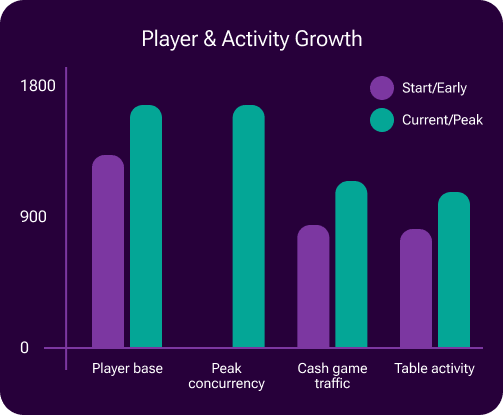
After the first two months, which were strongly influenced by BoaBet’s promotional activity, player growth continued at a more stable pace. From September 2025 to April 2026, BoaBet’s poker player base grew by approximately 15%, increasing from around 1,400 to 1,650 players.
This showed that the growth was not limited to a short-term promotional effect. Instead, poker activity continued to develop over time within BoaBet’s existing recreational audience.
BoaBet’s poker vertical became active across both major poker segments. The current player base includes around 1,200 cash game players and approximately 450 tournament players.
Cash games became the stronger pillar of the poker offer, while tournament participation remained stable and continued to support overall engagement.
Cash game traffic grew from 970 players in the first month to 1,277 players in March 2026, representing approximately 30% growth.
This became one of the strongest indicators of sustainable poker activity, as cash games are a key driver of recurring engagement and revenue in online poker.
Tournament participation remained relatively stable across both stronger and softer seasonal periods, staying within the range of approximately 420 to 500 players.
While tournaments were not the main growth driver, this stability showed that BoaBet’s poker product maintained healthy engagement beyond cash games and continued to serve different types of poker players.
Peak concurrent players increased by approximately 15%, with 1,650 peak concurrent players recorded in the month following a seasonal drop.
This was a positive signal of resilience, showing that the poker vertical was able to recover and maintain strong activity even after a softer period.
One of the most important results was that recreational traffic did not decline over the course of the partnership. Combined with the growth in player activity, cash games, table activity, and revenue performance, this suggests that the player environment remained healthy and attractive for BoaBet’s audience.
For a casino-oriented operator, this is one of the strongest outcomes: poker did not simply generate short-term activity, but continued to engage a recreational, non-poker-native player base over time.
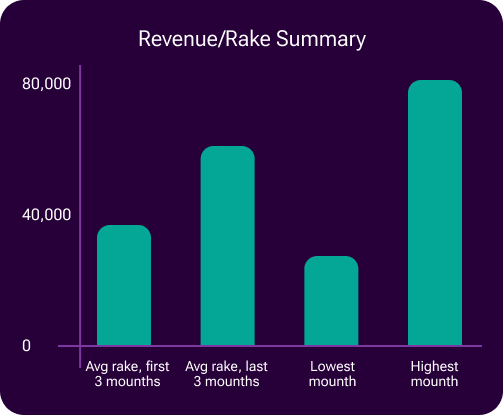
Revenue performance improved significantly as the partnership matured. The average rake increased from around $38,000 in the first three months to around $60,000 in the last three months.
The lowest month was September 2025, shortly after the initial promotional period, at around $31,000. The highest month was March 2026, reaching around $78,000 — an increase of almost 150% from the low point to the high point.
Table activity also increased significantly, growing from around 950 to 1,250 active tables over the period. This represented another increase of approximately 30%.
Together with cash game growth, this reinforced the picture of a more active and sustainable poker environment over time.
The results were achieved without BoaBet needing to build a dedicated in-house poker department. Poker operations, support, and anti-fraud teams supported the product on a day-to-day basis, helping maintain quality, stability, protection, and optimization across the poker offering.
This confirmed one of the key messages of the case: with the right network partner, a casino-oriented operator can grow poker successfully without solving every poker-specific operational challenge internally.
“When we first discussed adding poker at BoaBet, I was skeptical. Not because poker lacked potential, but because of the operational complexity it usually brings: tournament management, table health, player support, fraud cases, and constant product oversight.
With WePlay, that complexity never became our internal burden. Their team treated our poker room as their own product, supporting the operational side, helping with promotions, and guiding us whenever poker-specific expertise was needed.
As a result, we added a new revenue vertical and grew poker performance significantly without adding a single person to our operational team.
For other casino operators, this is the main takeaway: with the right partner, poker does not have to become a burden. We did not need to become a poker company to make poker work — we needed a partner that allowed us to stay focused on being better casino operators.”