
 6 May 2026
  23 min
  425 views
 Your players don’t trust you. This is a fact confirmed by multiple studies — even in the most strictly regulated markets. And this is exactly why damaging an iGaming operator’s reputation is surprisingly easy.
In an environment where skepticism is the default, even minor issues, emotional reactions, or isolated complaints can quickly turn into public narratives. Add to this the speed of online discussions, review platforms, and social media and reputation becomes highly vulnerable to both random and deliberate negative signals.
This is why reputation management in iGaming cannot be left to chance. In this article, we break down the key risks operators face and share practical approaches to building a system that helps protect trust and respond effectively when it is challenged.
What ORM Really Means in iGaming — and Why It Directly Impacts Business
Online Reputation Management (ORM) in iGaming is often misunderstood as a reactive function — something that starts when negative reviews appear. In reality, it is a core business discipline that shapes how players, partners, regulators, and payment providers perceive your brand at every touchpoint.
ORM as a Business Function, Not a Support Task
At its core, ORM is about managing trust at scale. And in iGaming, trust is not a “nice to have” — it is the product itself.
This becomes especially clear when looking at industry data. The EGBA, for instance, consistently highlights trust-building as a core priority in its reports.
This is a telling signal: even in a heavily regulated environment, operators recognize that perception often carries as much weight as compliance itself. Without trust, regulatory adherence alone does not convert into revenue.
ORM, therefore, extends far beyond communications. It is shaped by:
- product transparency
- payment reliability
- customer support quality
- consistency of messaging across channels
Every operational decision leaves a reputational footprint — and ORM is the system that manages how those signals are perceived.
The Specifics of Reputation Management in iGaming
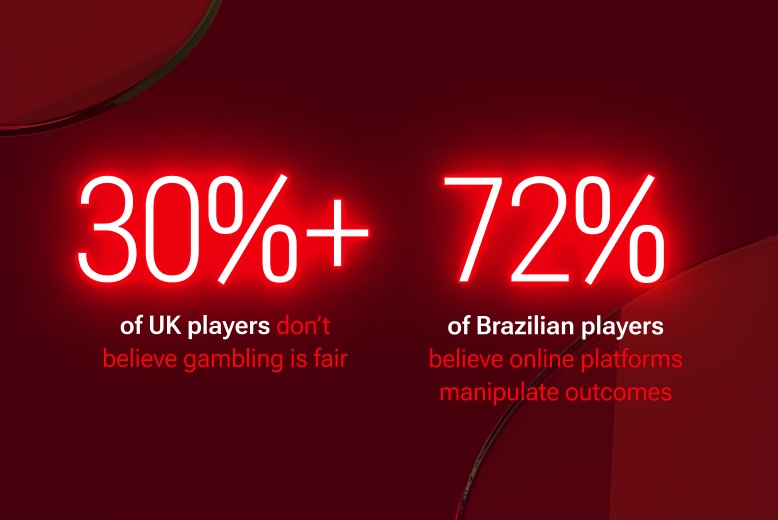
The challenge is that iGaming operates with a built-in trust deficit. According to the UK Gambling Commission, only 31% of respondents on average believe that gambling is conducted fairly — and longitudinal data tracked since 2016 shows a clear decline in trust toward the industry.
This pattern is not limited to a single market. In Brazil, for example, 72% of respondents believe that online platforms are manipulated to prevent players from winning.
This creates a highly asymmetrical environment:
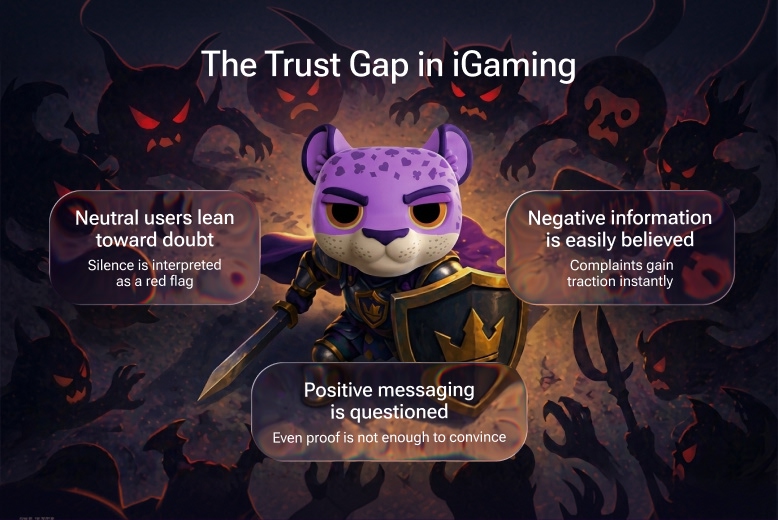
- Negative information is easily believed
- Positive messaging is met with skepticism
- Neutral users tend to default to doubt
In practice, this means that any reputational signal — a review, a forum thread, a comment — carries disproportionate weight. Once doubt is introduced, it spreads faster than any marketing message can counter it.
At the same time, trust in iGaming is strongly experience-driven. Customer support plays a pivotal role in shaping this perception. Various studies show that nearly half of respondents view fast and effective support as a decisive factor when choosing a gaming platform.
This makes reputation extremely sensitive to operational friction:
- A delayed response becomes a public complaint
- A strict or unclear KYC process turns into a “scam” accusation
- A payout delay is interpreted as malicious intent
Unlike many other industries, iGaming does not get the benefit of the doubt. Operators must continuously prove fairness, reliability, and transparency — and even then, skepticism remains.
What Happens When ORM Fails
Failures in reputation management rarely stay confined to “image problems.” In iGaming, they quickly translate into measurable business risks.
First, there is an immediate impact on acquisition and conversion. Negative search results, low review scores, or unresolved complaints reduce trust at the very first interaction. Potential players either hesitate or choose a competitor.
Second, trust erosion affects retention. Players who already operate in a low-trust mindset are highly sensitive to friction. Any unresolved issue — especially around withdrawals or account verification — reinforces suspicion and accelerates churn.
Third, reputational issues create systemic risks beyond players:
- Regulatory friction — difficulties in obtaining or maintaining licenses
- Payment disruptions — increased scrutiny from banks and PSPs
- Partnership risks — affiliates and B2B partners avoiding association with a “risky” brand
Finally, there is a compounding effect. As negative content accumulates across reviews, forums, and media, it begins to dominate search results.
At this stage, ORM is no longer about optimization — it becomes damage control.
For operators, the key takeaway is clear: reputation is not something you fix after a crisis. It is something you either build continuously — or lose progressively.
Key Sources of Reputation Risk in iGaming
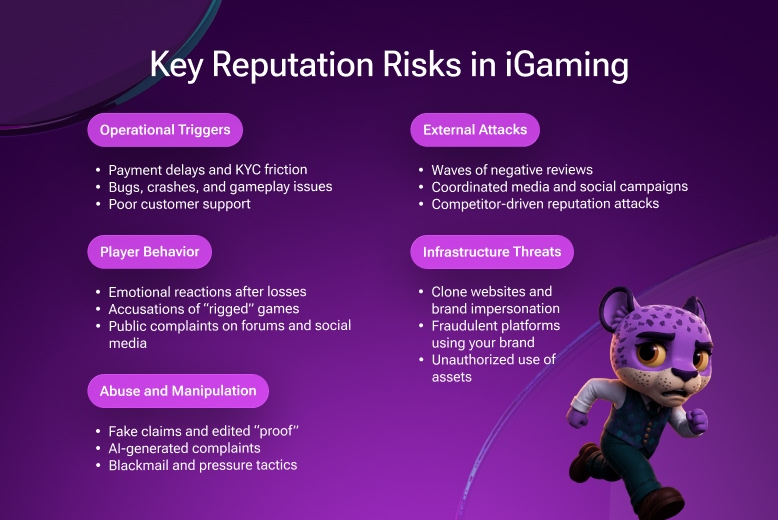
Reputation risks in iGaming rarely come from a single source. More often, they emerge at the intersection of operational issues, player psychology, opportunistic abuse, and a highly reactive information environment.
What makes the industry unique is not just the number of risk factors — but how quickly they amplify each other. A minor issue can escalate into a public accusation, and a single complaint can shape the perception of thousands of potential players.
Operational and Product-Driven Triggers
At the core of most reputation issues are real operational factors. Even well-managed platforms inevitably face technical imperfections — and in iGaming, these imperfections are rarely perceived neutrally.
The most sensitive triggers include:
- gameplay interruptions, bugs, and connection issues
- withdrawal delays and payment friction
- KYC requests and verification processes
- unclear bonus terms and wagering conditions
These issues are often interpreted not as technical or procedural realities, but as intentional manipulation.
Customer support becomes the key pressure point. It can either resolve the issue — or amplify it.
Typical escalation drivers:
- slow response times
- generic or scripted replies
- lack of clear resolution
Even minor problems can quickly turn into reputational risks — because players react not only to what happens, but to what it seems to imply.
Player Psychology and Emotional Behavior
iGaming operates in a highly emotional environment. Losses are frequent, expectations are often unrealistic, and reactions tend to be public.
This creates a structural bias: negative experiences are shared more often — and more loudly — than positive ones.
After a loss, players often:
- attribute outcomes to external factors rather than probability
- suspect manipulation (“rigged games”)
- reinforce beliefs through cognitive biases
These reactions are rarely contained. As a result, emotionally driven narratives can shape perception at scale — regardless of their factual accuracy.
Opportunistic Abuse: Blackmail and Fabricated Claims
Not all reputation risks come from real issues. Some are deliberately manufactured. Operators increasingly face cases where negative feedback is used as a pressure tool.
Typical tactics include:
- edited screenshots or fake balances
- fabricated claims of withheld winnings
- AI-generated “evidence” and complaints
In more aggressive cases:
- users demand compensation
- threaten to publish negative content
- attempt to escalate publicly
This changes the nature of ORM.
It is no longer just about communication — it becomes part of risk and fraud management.
External Attacks and Information Warfare
Reputation risks in iGaming are not always organic. In some cases, they are the result of deliberate and coordinated attacks.
Operators may face situations where negative content is not driven by real user experience, but by external actors attempting to damage the brand. This often takes the form of mass negative signals appearing simultaneously across multiple channels.
Typical attack patterns include:
- waves of negative reviews on platforms like Trustpilot or AskGamblers
- coordinated discussions on forums and social media
- sponsored or planted negative articles in niche or industry media
- repeated accusations such as “scam” or “refusing to pay” across different platforms
In some cases, the threat goes beyond content. Fraudulent “clone” platforms may appear online, copying the design, branding, and user experience of a legitimate casino. These clones are used to deceive players, collect deposits, and then disappear — leaving users to associate the negative experience with the original brand.
Such activity may be driven by straightforward fraud, but it can also function as a form of reputational attack, deliberately undermining trust in the operator.
These campaigns are designed to create the illusion of a systemic issue — even when the underlying problem is minor or entirely fabricated.
The key risk lies not in individual pieces of content, but in their scale and consistency. When the same narrative appears across multiple sources, it begins to look credible — regardless of its origin.
As a result, reputation in iGaming can be weaponized. Managing it requires not only responding to genuine feedback, but also recognizing and countering coordinated information pressure.
How to Build a Resilient Reputation Management System in iGaming
In iGaming, reputation cannot be managed reactively. By the time a problem becomes visible, it has often already spread across multiple channels.
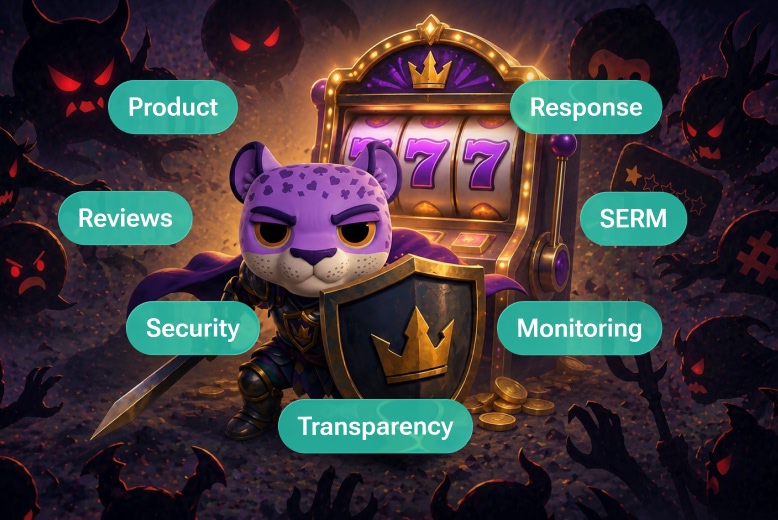
Effective ORM is not a single action, but a system — combining product positioning, communication, monitoring, and active control over the information environment.
Clear Product Positioning
Reputation starts long before the first review appears. It begins with how clearly the product is positioned.
If players do not understand how your platform works, they will fill the gaps with assumptions — often negative ones.
To reduce this risk, operators must focus on:
- simplifying communication
- making core mechanics transparent
- explaining complex concepts such as RTP, volatility, or wagering rules
Clarity reduces friction. And in iGaming, less friction means fewer reputational triggers.
Continuous Monitoring and Early Detection
You cannot manage what you do not see. Reputation management requires constant monitoring of all key channels where perception is formed.
This includes:
- search engine results (SERP)
- review platforms
- forums, social media, and industry media
The goal is not just to track mentions, but to identify patterns:
- emerging complaints
- repeated narratives
- coordinated spikes in negative content
Early detection allows operators to respond before an issue escalates into a broader reputational problem.
Fast Response and Issue Containment
Speed is critical. In a fast-moving information environment, delayed responses allow negative narratives to take hold and spread.
Effective response includes:
- addressing reviews and complaints quickly and professionally
- clarifying misunderstandings before they escalate
- working with platforms to remove or challenge false or harmful content
Not every piece of negative content can be removed — but it can be contextualized, challenged, or diluted. The key is to act before the narrative becomes dominant.
Search Engine Reputation Management (SERM)
For most users, reputation is defined by what they see in search results. This makes SERP control a critical trust factor.
Key priorities include:
- managing the visibility of negative content
- working with TOP-10 and TOP-30 search results
- ensuring that authoritative, positive content ranks higher
The objective is not to hide reality, but to ensure balance. If negative content dominates the first page of search results, it shapes perception — regardless of the actual quality of the product.
Systematic Work with Reviews
Responding to reviews is necessary, but not sufficient. ORM requires a systematic approach to managing feedback at scale.
This includes:
- increasing the share of real positive reviews
- maintaining stable ratings across key platforms
- encouraging satisfied users to share their experience
At the same time, operators must be prepared to:
- detect and neutralize coordinated “toxic waves”
- distinguish between genuine complaints and manipulation
The goal is not to eliminate negativity, but to prevent it from becoming the dominant narrative.
Eliminating Clone Sites and Brand Impersonation Threats
Some risks cannot be managed through communication alone. Fraudulent clones, fake websites, and brand impersonation directly damage trust and require technical and legal action.
Key measures include:
- identifying and removing clone platforms
- working with hosting providers and domain registrars
- monitoring unauthorized use of brand assets
These threats must be addressed quickly. Otherwise, they not only harm users — but also generate long-term reputational damage for the legitimate operator.
Proactive PR and Content Strategy
Reputation is not only about defense. It is also about building a strong, positive presence that can withstand negative signals and external pressure.
Operators should actively shape their narrative rather than rely on reactive communication.
Build Visibility and Industry Credibility
A strong media presence helps anchor perception and create trust signals that go beyond product experience.
Key tools include:
- publications in industry media
- expert commentary and thought leadership
- participation in industry events
- industry awards and recognitions
Awards remain a meaningful credibility shortcut. Even if industry insiders treat them cautiously, for a wider audience they still serve as a visible marker of legitimacy and recognition.
Humanize the Brand
iGaming platforms are often perceived as complex and opaque systems. This makes them harder to trust. Making founders and key team members visible helps reduce this barrier.
What matters here:
- demonstrating expertise
- showing accountability and transparency
- building a consistent public presence
People trust people more than systems. A visible and credible team makes the brand more relatable and trustworthy.
Strengthen Reputation Through CSR
Corporate social responsibility initiatives help position the company as more than just a profit-driven business.
Examples include:
- social impact and community projects
- educational initiatives
- broader contributions to the ecosystem
Such efforts shape a more balanced perception and reinforce long-term trust.
Approach Responsible Gaming with Credibility
Responsible gaming is both a regulatory requirement and a reputational factor. It signals that the operator is committed to sustainable and ethical practices.
However, it comes with a challenge. A significant share of the audience perceives responsible gaming initiatives as a PR-driven effort to reduce the stigma of the industry, rather than an effective player protection tool.
This makes authenticity critical. Operators who treat responsible gaming as a formal requirement risk reinforcing skepticism. Those who integrate it into real processes — and communicate it transparently — can strengthen trust over time.
How to Handle Reviews in iGaming: Practical Tips
In iGaming, reviews and public discussions are one of the most visible layers of reputation. Players actively share their experiences on review platforms, Reddit, forums, and social media — and these conversations often shape perception more than official communication.
Working with reviews is not just about responding to complaints. It is about managing public dialogue in an environment where every interaction is visible and contributes to trust.
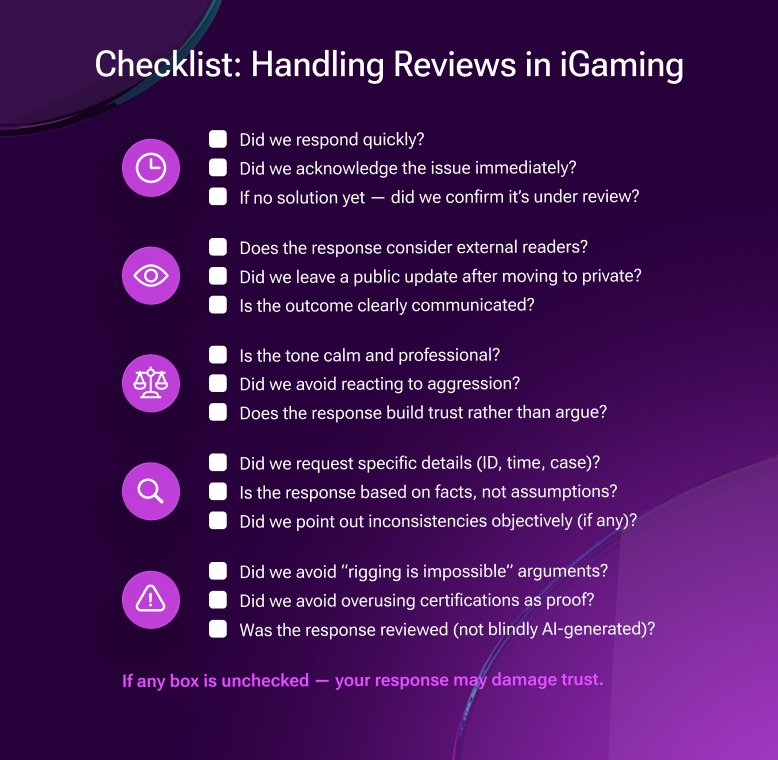
Tip 1: Respond as Quickly as Possible
Speed directly impacts perception. The longer a negative comment remains unanswered, the more users will see it without context — and form their own assumptions.
If a full response is not immediately available, it is better to acknowledge the issue than to remain silent.
Effective interim responses include:
- “We are already looking into this issue.”
- “The case has been taken into review.”
Even a brief acknowledgment signals that the operator is responsive and engaged. Silence, on the other hand, is often interpreted as indifference — or worse, as confirmation of the complaint.
Tip 2: Always Think Beyond the Original Author
Public responses are not one-to-one communication. The primary audience is not the author of the complaint, but everyone else who is observing the conversation.
Even if the issue is resolved privately, it is important to document progress publicly.
Best practices include:
- posting status updates after moving the conversation to private channels
- confirming when the issue has been resolved
- summarizing the outcome in a neutral and transparent way
This demonstrates accountability and shows that problems are not ignored or hidden.
Tip 3: Maintain a Calm and Professional Tone
Tone is as important as content. Negative reviews are often emotional, sometimes aggressive or offensive. Responding in the same tone will only escalate the situation.
A calm, structured, and respectful response creates a clear contrast.
The goal is not to “win” the argument but to demonstrate professionalism to the audience observing the exchange.
A composed tone:
- reduces tension
- increases credibility
- shifts perception in your favor
Tip 4: Rely on Verifiable Facts
Reputation discussions should always be grounded in facts, not assumptions. Avoid making immediate judgments about the validity of a complaint. Instead, focus on collecting the information needed to verify it.
Request specific details such as:
- date and time of the session
- transaction or ticket ID
- account-related information
If inconsistencies are identified — including in cases of fabricated or AI-generated “evidence” — address them carefully and objectively.
Rather than making accusations, highlight discrepancies:
- mismatched timestamps or time zones
- incorrect currency formats
- inconsistencies in UI elements or layout
A fact-based approach strengthens credibility and avoids unnecessary escalation.
Tip 5: Do Not Try to Prove That Rigging Is Impossible
In public discussions, arguments about why game manipulation is technically impossible rarely work.
The problem is not that such explanations are too complex. The real issue is that people who already believe the platform is unfair are unlikely to trust them. In practice, these arguments often make the situation worse by sounding defensive and dismissive — which only fuels more anger and suspicion.
Licenses, certifications, and software audits can support credibility, but they should be used with caution. In disputes about fairness, they are unlikely to serve as decisive arguments on their own.
Instead of trying to “prove” that rigging cannot happen, it is usually more effective to focus on:
- the specific case
- verifiable facts
- a transparent review process
This approach is less confrontational and far more convincing to the wider audience following the discussion.
Tip 6: Use AI Responses with Caution
AI can support response workflows — but it should not replace human judgment. Template-like replies, repetitive phrasing, or an inappropriate tone can quickly damage credibility.
Common risks include:
- responses that feel generic or automated
- lack of contextual understanding
- tone mismatches in sensitive situations
AI is best used for drafting. Final responses should always be reviewed and adjusted by a human to ensure:
- accuracy
- relevance
- appropriate tone
Conclusion
Reputation management in iGaming has its own specifics. It operates in an environment where trust is limited, emotions are high, and negative narratives spread quickly.
Player perception is shaped not only by real experience, but also by discussions, assumptions, and external signals — some of which may be inaccurate or deliberately misleading.
This means ORM requires a structured and consistent approach: clear communication, continuous monitoring, fast responses, and active work with public perception.
In iGaming, reputation is not just about what happens on the platform — but about how it is interpreted and shared.