
 10 June 2026
  17 min
  137 views
 Online poker is easy to describe as a funnel — acquire, convert, retain, reactivate. The description is tidy and mostly incomplete. Every decision that shapes one player’s experience also touches the broader ecosystem: table liquidity, game quality, the balance between recreational players and regulars that determines whether the room feels alive or predatory. Poker is a multiplayer environment where players create value for each other, which means the player journey is never really individual. A new player who enjoys their first session might stay for years. A beginner who immediately runs into experienced professionals might never come back — and their absence makes the game slightly worse for everyone still at the table.
In poker, keeping a single player active matters less than maintaining an ecosystem healthy enough that players at every level find a reason to return. For operators and platform providers, optimizing the online poker customer journey reframes the task entirely. The goal is lifecycle management — continuous, interdependent, and considerably more complex than the standard acquisition playbook tends to account for.
Understanding the Poker Player Lifecycle
The online poker player journey runs through several interconnected stages. Each stage builds on the previous one, shaping whether a player leaves after one session or remains engaged over the long term.
- Acquisition
- Onboarding
- Activation
- Engagement
- Retention
- Reactivation
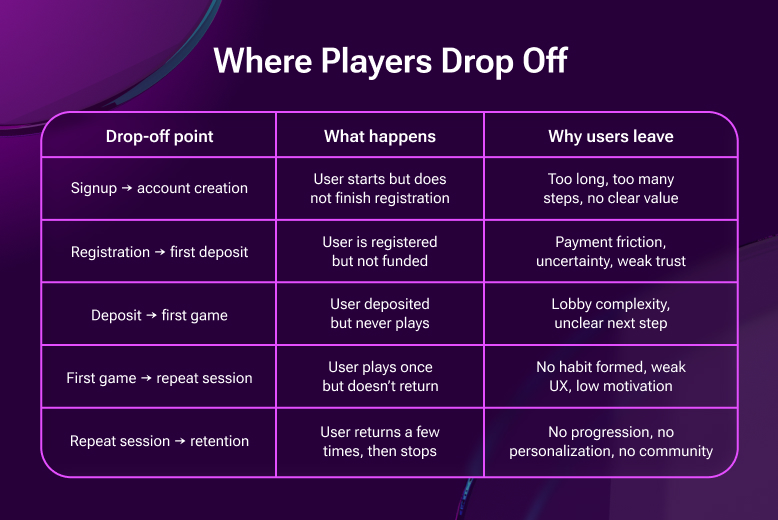
The connections between them matter as much as any individual stage. Improving acquisition without improving activation simply increases acquisition costs. Strong retention strategies lose effectiveness when onboarding creates unnecessary drop-off early in the journey. The goal is a natural progression: from discovering the platform to becoming a long-term contributor to its ecosystem. Each stage sets the conditions for the next one.
Acquisition: Finding Players Who Fit the Ecosystem
Traffic volume without quality segmentation is the wrong metric to optimize for in poker. Most iGaming verticals perform well regardless of who joins the platform. Poker is different. An ecosystem weighted too heavily toward experienced professionals becomes inhospitable to recreational players, who lose quickly and leave. Fewer recreational players means fewer opportunities for everyone else, liquidity thins across the network, and the room starts a slow decline that’s difficult to reverse. Successful acquisition in poker is more about getting the mix right — enough recreational players to keep the ecosystem healthy, enough experienced ones to keep the games interesting.
Key metrics include:
- Cost per acquisition (CPA)
- First-time deposit (FTD) conversion
- Lifetime value (LTV)
- Traffic quality by acquisition source
- Recreational versus experienced player ratios
Regional differences also matter. Mobile-first markets such as Brazil often attract casual players with different behaviors and expectations than mature poker markets dominated by experienced users. Acquisition strategies should reflect these differences rather than applying a universal approach.
Onboarding: Lowering Barriers Before the First Hand
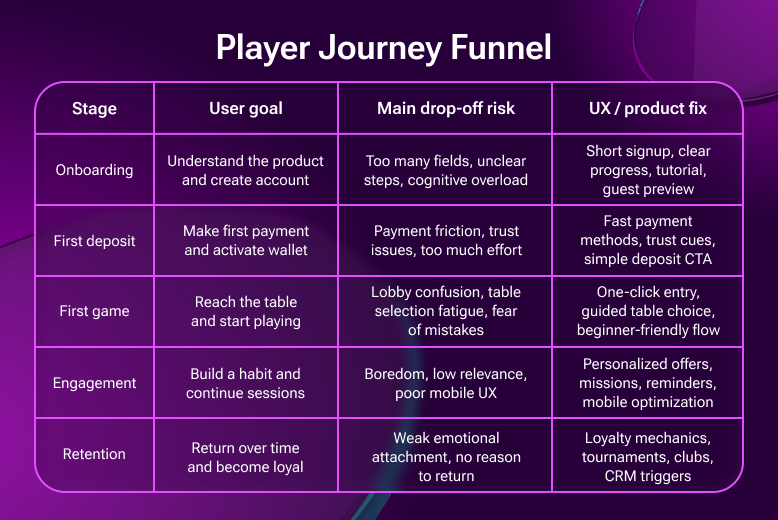
The first challenge is getting players into the game before they change their minds. Registration forms, KYC requirements, payment verification, complicated navigation — each step adds distance between the moment someone decides to try the platform and the moment they actually play a hand. Every additional screen is an opportunity to lose them.
Poker adds a layer that casino games largely avoid: complexity. A new player might understand that poker is entertaining and still feel intimidated by unfamiliar rules, betting structures, or the process of finding an appropriate table. That hesitation sometimes looks like someone who never quite got started.
Effective online poker onboarding addresses both problems simultaneously. Strong platforms typically provide:
- Simple registration and verification flows
- Local payment methods such as Pix or regional e-wallets
- Beginner-oriented tutorials
- Clear recommendations for appropriate tables
The objective is straightforward: minimize the time between registration and the player’s first meaningful game. A successful onboarding experience improves conversion and builds the foundation for long-term retention and lifetime value.
Activation: The First Session Determines the Future
Activation begins when a player actually sits down and plays. That moment — more than registration, more than first deposit — tends to determine whether acquisition spending becomes long-term revenue or immediate churn.
The quality of the first session defines the online poker player experience and depends on factors that operators can influence: table selection, matchmaking, waiting times, the win-loss experience, and whether the player finishes the session feeling capable rather than outmatched. The biggest risk is a predictable one. Inexperienced players matched against skilled opponents lose quickly, feel the gap immediately, and rarely come back. The professional benefits in the short term. The ecosystem absorbs the cost.
Many successful operators address this through protected beginner pools (when properly managed to prevent abuse and smurfing), intelligent matchmaking, and fast formats that reduce waiting times and keep newer players in motion rather than sitting out. The underlying logic is simple: a player who completes registration but never reaches a satisfying first session has not been activated. The acquisition cost was real, but the revenue wasn’t.
Activation performance doesn’t stay contained to the activation stage. Players who reach a meaningful first session — enough hands played, sufficient session length, an experience that didn’t feel immediately discouraging — are more likely to remain active in the early retention window. That connection shows up clearly in Day 1 and Day 7 cohort data, which is why activation KPIs read more accurately when tracked alongside downstream retention indicators rather than evaluated on their own.
Engagement: Turning Occasional Players into Regular Players
Once activation succeeds, the objective shifts from individual sessions to habit formation. Players rarely return to poker because of bonuses alone. They return because something kept them — a sense of progress, a rivalry, an achievement that felt earned, a table where they knew the regulars. Over time, those motivations carry more weight than any promotional incentive, and the platforms that understand this build for them deliberately.
An effective engagement strategy combines multiple elements:
- Cash games and tournament variety
- Fast-fold and alternative formats
- Missions and achievement systems
- Leaderboards and progression mechanics
- Clubs, chat functions, and private tables
- Personalized recommendations based on player behavior
The goal is an ecosystem rather than a feature list — multiple reasons to return that reinforce each other rather than competing for the same player attention. Operators track session frequency, ARPU, gameplay diversity, and progression across stakes to understand whether engagement is deepening into something durable or plateauing at a level that precedes churn.
Predictive analytics earns its place at this stage of the lifecycle. Behavioral patterns that precede churn — declining session frequency, stalled stake progression, narrowing engagement with game variety — tend to appear in the data before the player actually leaves. Operators who track these signals can intervene early with personalized offers or content, shifting the strategy from responding to churn after it happens to preventing it before it does.
Progression: Helping Players Grow Within the Platform
One of poker’s more useful characteristics, from an operator’s perspective, is that players evolve. A typical recreational journey moves through predictable stages — freerolls into micro-stakes cash games, then regular cash games, small tournaments, and eventually higher-value events and loyalty programs. The path isn’t identical for every player, but the direction is consistent: skill develops, stakes increase, and engagement deepens along with it.
Supporting that progression matters more than most operators initially account for. Players who feel they’re improving stay active longer, explore new formats more readily, and tend to increase their value over time in ways that flat retention strategies can’t replicate. Educational content, appropriate game recommendations, achievement systems, and gradual exposure to more advanced formats all contribute — the point being to move players forward without pushing them into water that’s too deep before they’re ready for it.
Retention: Managing an Ecosystem
Retention is where the player journey generates most of its value and in poker, that value extends well beyond any individual customer metric. Every retained player contributes to table availability and game quality for everyone else. The network effects run in both directions: a healthy roster of active recreational players makes the room better for regulars, which keeps regulars engaged, which keeps tables full. Losing one active recreational player doesn’t simply reduce one customer’s LTV. It fractionally degrades the experience for everyone they would have played with and that degradation compounds across dozens of participants over time.
Common retention tools include:
- VIP and loyalty programs
- Rakeback systems
- Predictable tournament schedules
- Personalized promotions
- Behavioral segmentation
The goal is to keep players coming back while maintaining a healthy and sustainable player base. Operators typically evaluate retention through cohort analysis — D7 and D30 retention rates, repeat deposit behavior, and long-term LTV — to understand whether the players who arrive are actually staying, and in what condition.
Reactivation: Understanding Why Players Leave
Even well-run platforms lose players. The question is what happens next. The most effective reactivation campaigns start with diagnosis rather than discounts. A bonus sent to the wrong segment at the wrong moment is a budget spent on a problem it won’t solve. Players leave for different reasons — repeated losses, an inability to find suitable games, format fatigue, a better offer elsewhere, payment friction that was never resolved and the response needs to reflect that.
Behavioral segmentation makes this possible. Some players come back for tournament invitations. Others respond to personalized offers tied to their previous activity. The communication that works for someone who drifted away after a bad run looks different from what works for someone who simply found the lobby too complicated.
Not all players are equally worth reactivating. From a business perspective, reactivation strategies should be guided by the expected lifetime value (LTV) of recovered players relative to the cost of re-engagement. High-value players or those with strong historical engagement justify more aggressive incentives, while low-value segments may require lighter-touch or automated campaigns. Treating reactivation as an economic decision rather than a purely marketing one allows operators to allocate budgets more efficiently and avoid over-investing in low-return segments.
Timing matters as much as message. The probability of successful reactivation drops meaningfully as inactivity extends, which means the window for a well-targeted intervention is shorter than most reactivation calendars assume.
Technology That Powers the Player Journey
Modern poker platforms rely on integrated technology rather than isolated tools. That difference shapes how the entire operation performs, even if it looks minor in a feature comparison.
The critical components include:
- CRM systems for lifecycle marketing
- Real-time behavioral analytics
- Matchmaking engines
- Anti-fraud, bot detection, and collusion prevention
- Payment infrastructure adapted to local markets
- AI models for churn prediction and personalization
AI is becoming an increasingly important part of this technology stack, helping every other system work more efficiently. Identifying players at risk of leaving before churn occurs, recommending appropriate tournaments based on behavioral patterns, personalizing engagement at a level that broad demographic segmentation can’t reach. The operators extracting the most value from these tools tend to be the ones who’ve built them into a unified decision-making framework rather than running them in parallel as separate systems.
For operators, these technologies enable precise execution across the player lifecycle, from segmentation and personalization to retention and reactivation campaigns. For platform providers, however, they define product competitiveness. The depth of analytics, flexibility of CRM integration, and sophistication of matchmaking or anti-fraud systems directly influence how effectively operators can manage their ecosystems.
Market-Specific Considerations
Player behavior varies enough between regions that a single product configuration rarely travels well. Brazil runs heavily on mobile and has built expectations around instant payment through Pix. Parts of Southeast Asia operate through local wallets and agent-based ecosystems that require a fundamentally different infrastructure approach. Other jurisdictions place greater demands on compliance and payment flexibility before a player can meaningfully engage with the product at all.
Localization shapes the online poker user journey and goes well beyond translating the interface. It shapes onboarding flows, payment options, promotional mechanics, tournament schedules, and in some markets, the game formats that resonate in the first place. Operators who take regional behavior seriously tend to build smoother player journeys and stronger retention, not because they offered more, but because what they offered actually fit.
Best Practices for Poker Operators
Strong poker ecosystems share a recognizable set of characteristics:
- Minimize friction between registration and first play
- Protect inexperienced players during activation
- Use behavioral data to personalize experiences
- Support natural player progression across stakes and formats
- Balance recreational and professional populations
- Continuously optimize through experimentation and analytics
- Prioritize long-term ecosystem health over short-term acquisition volume
No single feature creates a healthy poker ecosystem on its own. Long-term success comes from how these elements work together throughout the player journey.
From Marketing Funnel to Ecosystem Strategy
The player journey in online poker runs deeper than a sequence of marketing events. It’s a dynamic ecosystem where acquisition influences activation, activation shapes retention, and retention determines the quality of every game that follows. Operators who approach this as ecosystem management rather than funnel optimization tend to build something more durable: healthier liquidity, higher lifetime value, and a platform that gets more competitive over time rather than more expensive to maintain. Every stage — onboarding, matchmaking, personalization, reactivation — contributes to the long-term stability of what comes after it.
This is why modern poker software needs to do more than deliver game mechanics. It needs to equip operators with the tools to manage the full poker player lifecycle: flexible tournament management, intelligent matchmaking, CRM integrations, analytics, and localization capabilities that actually reflect how players behave in different markets.
At EvenBet Gaming, we help operators build sustainable player ecosystems. In online poker, long-term retention matters more than short-term registration numbers. Success is measured by how many players keep finding balanced games, meaningful progression, and reasons to return long after their first session. If that’s the kind of poker platform you want to build, contact us to see how we can help.
FAQ
What is the player journey in online poker?
The player journey in online poker refers to the complete lifecycle of a user’s interaction with a poker platform—from the moment they first discover the brand to becoming a long-term, loyal player or returning after inactivity. It includes every touchpoint such as registration, first deposit, initial gameplay, ongoing engagement, and retention efforts. For operators, understanding this journey is essential to optimizing user experience, improving retention rates, and maximizing lifetime value (LTV).
What are the main stages of the online poker player journey?
The online poker player journey typically consists of six main stages: acquisition (attracting new users), onboarding (registration and initial setup), activation (first gameplay experience), engagement (building regular playing habits), retention (keeping players active long-term), and reactivation (bringing back inactive users). Each stage requires specific strategies, tools, and performance metrics to ensure a smooth and profitable player lifecycle.
Why is the online poker user journey important for operators?
The online poker user journey directly influences player retention, table liquidity, and lifetime value. Every stage, from acquisition and onboarding to engagement and reactivation, affects whether players continue using the platform or churn. By optimizing the user journey, operators can create a healthier poker ecosystem, improve the overall player experience, and generate more sustainable long-term revenue.
How does online poker onboarding affect retention?
Effective online poker onboarding helps new players reach their first game quickly by reducing friction during registration, verification, and payments. It also introduces players to the platform through intuitive navigation and beginner-friendly guidance, making the first experience less intimidating. A smooth onboarding process increases activation rates and significantly improves the chances that players will return for future sessions rather than abandoning the platform after signing up.