
 10 July 2026
  21 min
  183 views
 Casino and poker cross-sell remains one of the most underused growth levers in iGaming and the evidence for it is hard to ignore. Multi-product players stay longer, generate higher lifetime value, and build more sustainable revenue than users anchored to a single vertical. Converting existing slot traffic into poker players deepens customer relationships, diversifies revenue streams, and extracts more long-term value from an audience the operator has already paid to acquire.
From Single-Vertical Slots to Multi-Product Value
Cross-selling moves existing customers from one product to another through personalized offers, targeted journeys, and relevant incentives. In this case, it means introducing slot players to poker as a natural extension of their gaming experience instead of relying solely on new player acquisition.
Casino players deliver higher future value than sports bettors, while players engaging with multiple verticals generate higher average future value than single-vertical sports players. Multi-product customers generate more revenue and remain active longer than players who stay within a single product category.
Despite these advantages, many operators continue to manage casino, poker, and sports betting as separate businesses. This limits opportunities to retain players when engagement with one vertical naturally declines. A unified cross-sell strategy supported by behavioral segmentation, integrated bonuses, and shared loyalty programs helps transform casual slot users into long-term multi-product customers.
Why Slot-to-Poker Cross-Sell Is Strategically Attractive
Slots generate a significant share of revenue for most online casinos thanks to their accessibility, high play frequency, and strong margins. Expanding into poker gives operators another high-value engagement channel while reducing dependence on a single product category.
Poker complements slots in several important ways. It typically encourages longer sessions, creates social interaction between players, and introduces skill-based gameplay that appeals to different motivations. As a result, poker broadens the overall entertainment offering while helping operators build a more balanced gaming portfolio. The strategic opportunity extends beyond diversification. Cross-sell research consistently shows that multi-product players deliver higher lifetime value and lower churn because they continue exploring other products as their interests evolve.
Slot vs Poker Player Profiles: Who Is Convertible?
Slot players typically prefer fast gameplay, simple mechanics, and instant rewards. Poker attracts players looking for strategic decision-making, competition, social interaction, and long-term progression.
Between these audiences lies a valuable “poker-curious” segment. These players already display behaviors associated with more strategic or social gaming experiences. They may spend more time in live casino, choose card-themed slots, or engage more readily with tournaments and competitive mechanics.
Industry experts also note that the line between casino and poker continues to narrow. Skill-based slots, hybrid poker-inspired casino games, live dealer experiences, and gameshow-style tables introduce concepts such as betting strategy, hand evaluation, and competitive play within familiar casino environments. These products create a natural progression toward peer-to-peer poker and provide operators with accessible entry points for future cross-sell campaigns.
The Business Case: LTV, Retention, and Churn
The business value of casino and poker cross-sell extends well beyond increasing poker traffic. Its primary impact comes from improving customer lifetime value and extending player engagement across the operator’s ecosystem. Players who engage with multiple products tend to outperform single-product users in both future value and retention. The same principle applies to casino and poker. A well-timed poker offer gives slot players another way to stay engaged when interest in slots begins to decline, reducing the likelihood that they leave the platform altogether.
Cross-selling also improves acquisition economics. Every converted poker player comes from an audience the operator has already paid to acquire, making expansion into poker significantly more cost-effective than building poker traffic entirely through new acquisition campaigns. Combined with shared loyalty programs and lifecycle marketing, cross-sell becomes an efficient strategy for increasing long-term player value. Transitioning players into poker requires more than attractive offers. Success depends on removing friction throughout the player experience.
UX and Platform Prerequisites for Casino → Poker
A seamless user experience is the foundation of successful casino-to-poker conversion. Players are far more likely to explore poker when they can access it through a unified account, a shared wallet, and a consistent loyalty program without additional registration or payment steps. Effective casino and poker integration starts with frictionless access across both verticals. Unified accounts, shared wallets, and centralized player data allow operators to deliver a consistent experience while supporting personalized cross-sell journeys.
Equally important is a centralized customer data platform (CDP) that combines behavioral data across every product. Unified data allows operators to understand how players move between verticals and trigger personalized campaigns based on real-time activity.
Discoverability also influences conversion. Poker should feel like another part of the casino ecosystem: clear navigation, visible lobby placement, and contextual recommendations encourage exploration at moments when players are already engaged with the platform.
Product design can further reduce adoption barriers. Fast, casino-native formats such as One Click Poker remove traditional friction by letting players join games almost instantly, making poker feel as accessible as slots. Short-session experiences such as Spins Poker provide another natural entry point for slot audiences, combining quick gameplay, simple onboarding, and high engagement in sessions that last only a few minutes. Live dealer games, Casino Hold’em, and other poker-inspired formats can complement these products by introducing betting concepts and hand rankings before players transition to peer-to-peer poker. Together, these capabilities create a practical framework for poker integration for online casino platforms that want to expand player engagement without disrupting the existing casino experience. Building this foundation makes it possible to focus on the next challenge: identifying the players who are most likely to convert.
Behavioral Segmentation: Finding the Right Slot Players
Successful cross-sell starts with precise audience selection. Treating every slot player the same leads to generic campaigns that rarely deliver meaningful results. Behavioral segmentation provides a much stronger foundation by grouping players according to factors such as playing frequency, stakes, session length, preferred game themes, device usage, and engagement with live or table-style games.
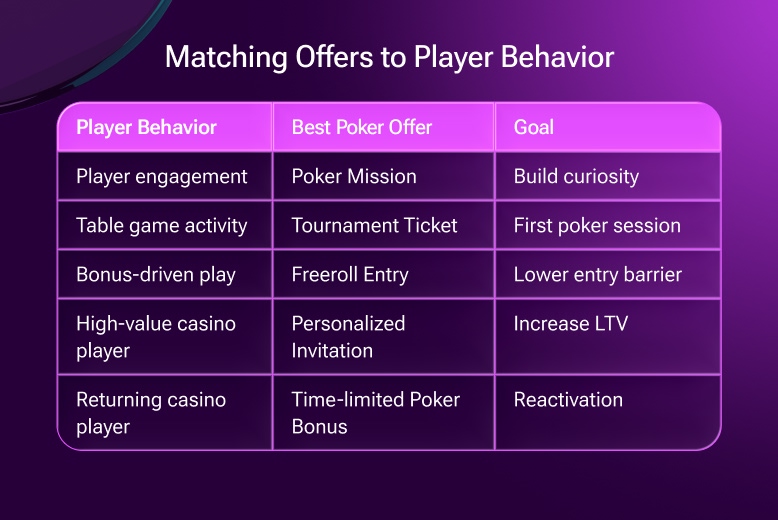
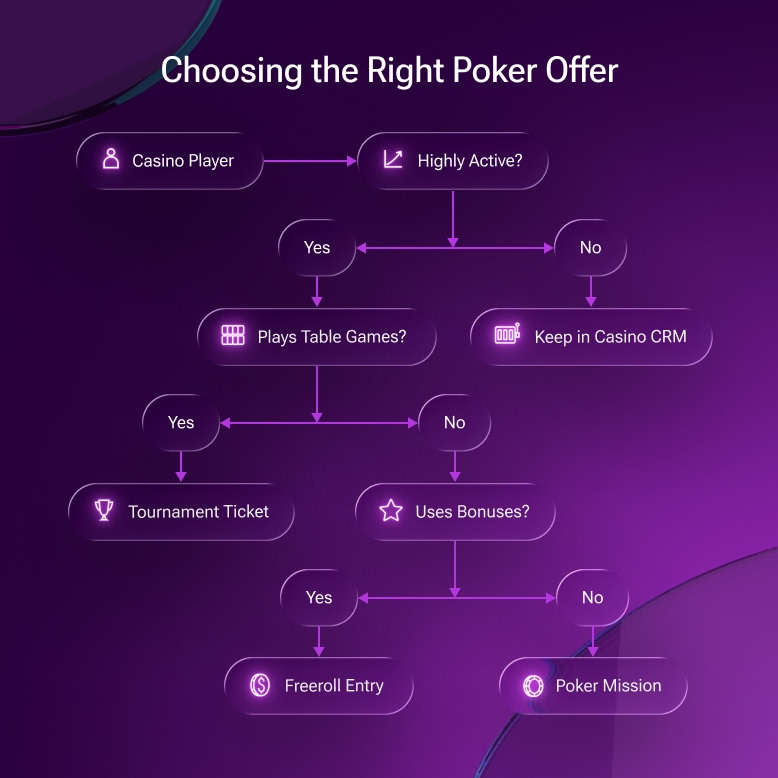
These patterns help identify players with genuine poker potential. For example, jackpot-focused users who prefer short, high-volatility sessions may respond best to simple promotional incentives such as an occasional poker ticket. Players who regularly spend time in live casino, enjoy tournament mechanics, or engage with strategic games are often better candidates for guided onboarding and beginner poker formats.
Modern CRM platforms can refine these audiences even further through micro-segmentation and affinity analysis. Detecting behaviors associated with poker curiosity allows operators to deliver highly relevant offers instead of broad promotional campaigns. This targeted approach makes the cross-sell of casino players to poker significantly more effective by focusing marketing efforts on audiences with genuine conversion potential. Selecting the right audience is only the first step. Conversion rates also depend heavily on reaching players at the right moment.
Timing Matters: Moments That Convert
Even the most relevant offer can fail if it appears at the wrong time. Effective cross-sell campaigns rely on behavioral triggers that match a player’s current context instead of fixed promotional schedules. For slot players, natural transition points include completing a mission, finishing a bonus round, celebrating a significant win, or reaching the end of a gaming session. These moments create opportunities to introduce a different experience while engagement remains high.
The same principle appears across other verticals. Industry experts have observed that sports bettors are particularly receptive to cross-sell during halftime and other inactive periods. Similar timing works well in casino environments, where session-end screens, loyalty milestones, and completed challenges provide natural opportunities to recommend poker.
Real-time decision engines further improve campaign performance by selecting the most appropriate offer for each player. Based on recent activity, deposits, preferred games, and engagement history, AI-driven systems can recommend a beginner tutorial, a free tournament ticket, or a fast poker format that best matches the player’s profile. The next step is turning these triggers into structured, personalized customer journeys.
From Designing Casino to Poker Cross-Sell Journeys
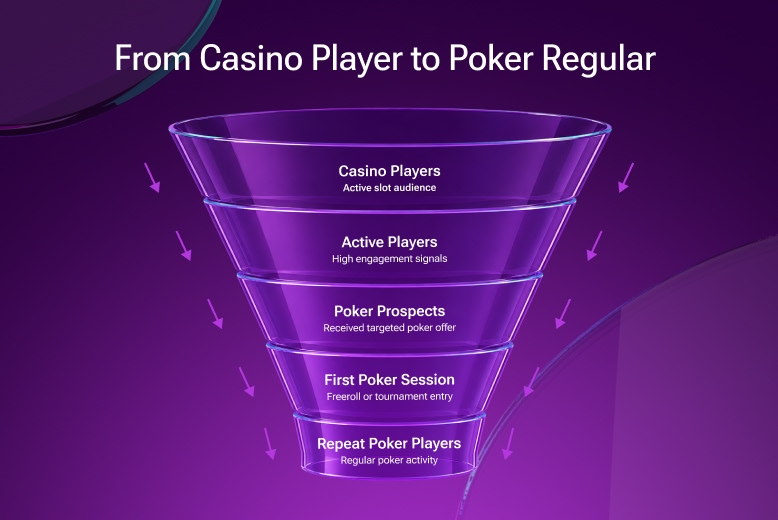
Once the target audience and key conversion moments are defined, operators can build cross-sell journeys that gradually introduce poker through increasingly personalized experiences. The objective is to convert slot players to poker players through a sequence of relevant interactions rather than a single promotional message.
There is a practical roadmap for this progression.
- At the basic level, selected slot segments receive broad poker offers that introduce the product without relying on extensive personalization. Examples include free tournament tickets, beginner sit-and-go events, or simple messages encouraging players to try poker for the first time.
- The intermediate level uses behavioral insights to match offers with demonstrated player interests. Slot players who frequently choose card-themed games or spend time in live casino may receive invitations to beginner tournaments, fast poker formats, or low-stakes cash games positioned as an accessible next step in their gaming journey.
- At the advanced level, recommendation engines continuously optimize offers based on recent activity. Machine learning models determine which poker format, incentive, and delivery time are most likely to convert each individual player. Short-session slot users may receive invitations to fast poker variants, while players who prefer longer sessions can be directed toward tournaments or deeper cash-game experiences.
These journeys work best across multiple touchpoints. On-site recommendations, in-app notifications, email campaigns, and push messages reinforce one another while keeping communication consistent throughout the player lifecycle. Multi-product campaigns can further strengthen engagement by rewarding participation across both slots and poker within the same promotional journey. Well-designed journeys introduce poker at the right pace. Long-term engagement, however, depends on giving players meaningful reasons to continue exploring multiple products.
Bonuses, Missions, and Loyalty Across Verticals
Integrated rewards are one of the strongest drivers of successful cross-sell. Shared loyalty programs encourage players to view casino and poker as parts of a single ecosystem where activity across multiple products contributes to the same progression.
- Mission-based mechanics create clear pathways between verticals. A slot challenge can unlock a beginner poker tournament ticket, award chips for a fast sit-and-go, or open access to exclusive poker events. These incentives make poker feel like a natural continuation of casino play instead of a completely separate experience.
- Shared loyalty structures reinforce the same behavior over time. Unified tiers, points, and rewards recognize engagement across both casino and poker, while additional bonuses for multi-product activity encourage players to broaden their play instead of concentrating on a single vertical.
- Gamification adds another layer of engagement. Progress bars, badges, seasonal campaigns, and cross-product challenges create ongoing reasons to explore different formats and maintain activity throughout the platform.
As operators expand cross-sell initiatives, player protection should remain embedded in every stage of the experience.
Responsible Gambling
Casino-to-poker cross-sell should always operate within a responsible gambling framework that prioritizes player well-being alongside commercial objectives. Unified responsible gambling tools are essential in a multi-product environment. Deposit limits, reality checks, self-exclusion settings, and risk scoring should apply consistently across every vertical, allowing CRM systems to suppress or adjust campaigns for players showing signs of elevated risk.
Clear communication also supports responsible engagement. Players should understand that poker differs from slots in both gameplay and time commitment, allowing them to make informed decisions before participating. Hybrid products such as live dealer games and poker-inspired casino formats can introduce players to poker mechanics in a gradual, accessible way. Their role is to expand entertainment options, not to maximize gambling intensity. Combined with transparent messaging and consistent safeguards, these experiences support sustainable cross-sell strategies that balance commercial performance with player protection.
KPIs and Measurement
Effective measurement focuses on incremental business impact rather than raw activity. Holdout groups, A/B testing, and accurate attribution help operators determine whether cross-sell campaigns genuinely improve long-term performance.
Core KPIs include:
- Conversion rate from targeted slot segments to first-time poker play.
- Share of active users who become multi-product casino and poker players.
- Lifetime value uplift for converted players compared with similar slot-only cohorts.
- Changes in churn and reactivation rates following conversion.
Performance analysis should continue well beyond the initial conversion. Cohort tracking over weeks or months reveals whether players remain active in poker, increase engagement across multiple products, and deliver sustained revenue growth. Sharing these insights across CRM, product, and marketing teams creates a continuous optimization cycle where journeys, incentives, UX improvements, and recommendation models evolve based on measurable outcomes rather than assumptions.
Practical Playbooks for Operators
Operators don’t need a fully mature CRM ecosystem to launch effective casino-to-poker cross-sell. A phased approach allows teams to validate ideas, measure results, and scale what works.
Stage 1: Build the foundation
- Enable unified accounts, wallets, and loyalty programs across casino and poker.
- Ensure poker is easy to discover from the casino lobby.
- Connect behavioral data through a CRM or CDP to support event-based campaigns.
Stage 2: Identify high-potential audiences
- Segment players by session length, stakes, preferred game themes, and engagement with live or table games.
- Prioritize “poker-curious” players instead of targeting the entire casino audience.
- Define the poker format best suited to each segment, such as Spins Poker for short-session players or beginner tournaments for strategy-oriented users.
Stage 3: Launch targeted journeys
- Introduce poker through missions, tournament tickets, and personalized recommendations.
- Trigger offers after meaningful behavioral events, such as completed slot missions, significant wins, or session-end screens.
- Test messaging, incentives, and timing through controlled A/B experiments.
Stage 4: Optimize and scale
- Measure conversion, retention, LTV uplift, and multi-product adoption.
- Expand successful journeys across email, push notifications, in-app messaging, and on-site recommendations.
- Introduce AI-driven recommendations that automatically match players with the most relevant poker products and incentives.
Operators can gradually progress from simple promotional campaigns to highly personalized cross-sell programs without redesigning their platform all at once. Each stage builds on the previous one, creating a scalable framework for long-term player engagement.
Next Steps for Casino Operators
Operators looking to strengthen casino-to-poker cross-sell can begin with a few practical initiatives before expanding into more sophisticated automation.
- Build the right foundation. Ensure players have access to unified accounts, shared wallets, integrated loyalty programs, and a CRM or CDP capable of supporting behavioral segmentation and event-driven campaigns.
- Identify poker-curious audiences. Use behavioral data to define player segments based on preferences, playing patterns, and engagement with strategic or live casino content.
- Launch focused cross-sell journeys. Start with one or two onboarding scenarios—such as beginner tournaments, mission-based rewards, or fast poker formats—and measure different incentives, messaging, and timing through A/B testing.
- Measure, learn, and scale. Track conversion, retention, LTV uplift, and multi-product adoption to identify the strongest-performing journeys. Use those insights to expand personalization and gradually introduce more advanced automation.
Casino-to-poker cross-sell is most effective when it becomes part of a broader player engagement strategy rather than a standalone promotion. Operators that combine seamless UX, behavioral intelligence, personalized journeys, and integrated loyalty programs can increase player lifetime value while building a stronger and more resilient multi-product ecosystem.
Casino-to-poker cross-sell is no longer simply a retention tactic. It is a practical growth strategy that helps operators increase player lifetime value, strengthen loyalty, diversify revenue, and maximize the return on existing acquisition spend.
The strongest results come from combining behavioral intelligence, seamless UX, integrated loyalty, and personalized customer journeys. Operators that make poker easy to discover and easy to join create more opportunities for players to engage across multiple products instead of leaving the platform when interest in one vertical declines. Successful casino and poker integration combines technology, behavioral intelligence, and lifecycle marketing into a single player experience that supports sustainable growth.
For operators looking to accelerate this strategy, EvenBet Gaming provides the technology to support every stage of the journey. From One Click Poker, which minimizes onboarding friction, to Spins Poker, designed for fast, mobile-first engagement, the platform enables operators to build poker experiences that fit naturally within the modern casino ecosystem. Combined with flexible integration options, CRM-ready architecture, and extensive customization capabilities, EvenBet Gaming helps operators turn cross-sell from a marketing initiative into a sustainable engine for long-term growth.
FAQ
What is casino and poker cross-sell?
Casino and poker cross-sell is the practice of promoting a poker product to existing casino players (and vice versa) so they engage with multiple verticals instead of just one. Instead of acquiring new traffic from scratch, the operator uses targeted campaigns, bonuses and journeys to move current slot or casino users into poker, increasing their overall lifetime value and engagement. Done well, cross-sell turns a single‑product player into a multi‑product customer who sees the brand as a broader entertainment destination, not just a place to play one game.
How can online casinos convert slot players into poker customers?
Online casinos typically convert slot players into poker customers through three main levers: segmentation, timing and tailored offers. First, they identify “convertible” slot segments (for example, players who enjoy card‑themed slots or live tables) using behavioral data and CRM analytics, instead of pushing poker to everyone. Second, they trigger poker invitations at natural breakpoints in the slot journey, after a bonus round, at session end, or after a milestone – using banners, missions or in‑app messages rather than random pop‑ups. Third, they tie poker into casino loyalty with integrated bonuses and missions (e.g., “complete this slot quest to unlock a beginner poker tournament ticket”), making poker feel like a progression step in the same ecosystem instead of a completely separate game. Fast‑format products like One Click Poker, which remove complex lobbies and offer one‑click entry into real‑money tables, further reduce friction for casino audiences trying poker for the first time.
Can poker help improve casino player retention?
Yes. Multiple industry sources now position poker as a retention engine rather than just a niche standalone vertical. Poker’s social, skill‑based structure encourages longer sessions, recurring play and community attachment, which means satisfied poker players are more likely to return regularly and reinvest their winnings across the operator’s portfolio.