
 14 July 2026
  Upd: 24 July 2026
  18 min
  218 views
 For years, compliance in online gambling was treated as something bolted on after the product was built — KYC, AML, and responsible gambling tools viewed as regulatory boxes to tick rather than design considerations. That model is disappearing. Across major regulated markets, authorities now expect these controls embedded into everyday product workflows from the ground up, and poker platforms, combining financial transactions, peer-to-peer competition, and continuous player interaction — face that requirement at its most demanding.
Why compliance is reshaping poker platforms
Online poker presents a unique combination of regulatory and operational challenges. While all gambling products must comply with KYC, AML, and responsible gambling requirements, poker introduces risks that are far less common in traditional casino environments. Because players compete directly against one another, poker ecosystems can be exploited to disguise financial transactions through activities such as chip dumping, collusion, multi-accounting, or coordinated play. At the same time, regulators increasingly expect operators to detect harmful gambling behaviour early and intervene before it escalates.
As a result, poker platform compliance is no longer managed solely by legal or back-office teams. Product managers, architects, and engineers are expected to build systems that continuously verify player identity, monitor financial activity, assess behavioural risk, and enforce market-specific rules throughout the player lifecycle. Rather than asking whether a platform is compliant, operators increasingly ask whether compliance has been built into the product itself.
KYC as the foundation of the player lifecycle
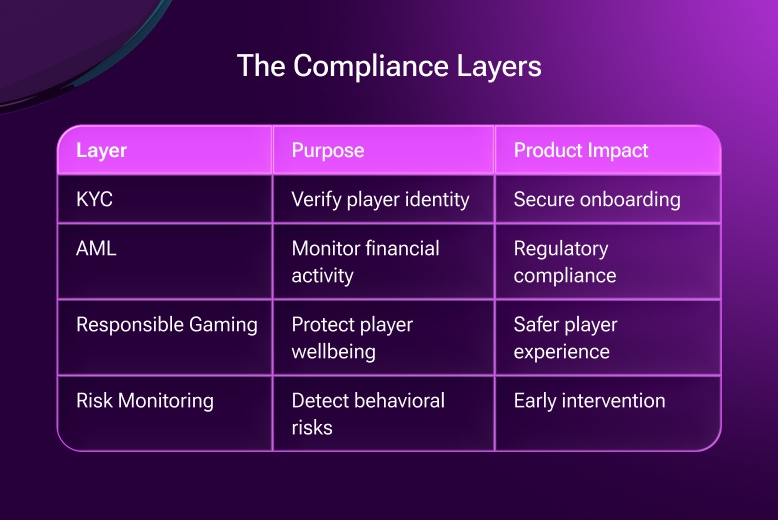
Historically, KYC was often viewed as an inconvenient verification step completed during registration or before a player’s first withdrawal. Modern AML gambling frameworks have fundamentally changed that approach. Identity verification now influences what players can access, how much they can deposit, and which features become available throughout their relationship with the platform.
Many operators now rely on progressive KYC, where verification grows alongside player activity instead of requiring every customer to complete the same level of due diligence on day one. A typical progression might allow basic verification for low-stakes play while requiring additional document checks, biometric verification, or source-of-funds validation before granting access to higher deposit limits, premium tournaments, or VIP programmes. For poker products, this creates a direct connection between verification status and gameplay rather than treating KYC as a separate compliance workflow.
Designing onboarding
One of the biggest product challenges is reducing verification friction while still satisfying regulatory requirements. Modern onboarding experiences increasingly rely on automated document recognition, biometric liveness checks, and mobile-first verification flows that allow legitimate players to complete identity checks within minutes.
Verification can then expand dynamically when predefined risk triggers appear, including:
- unusually large deposits;
- rapid increases in spending;
- frequent payment method changes;
- activity from higher-risk jurisdictions;
- sudden movement from micro-stakes to high-stakes games.
Instead of interrupting every player with the same lengthy process, the platform applies stronger verification only when behaviour justifies additional scrutiny. This approach improves both conversion and compliance by matching the level of due diligence to the level of risk.
AML as the operating logic of the poker economy
Modern AML gaming frameworks increasingly rely on continuous monitoring rather than one-time reviews. If KYC establishes who the player is, AML determines whether their financial behaviour remains consistent with legitimate play. Unlike many casino products, poker involves continuous movement of funds between players, making transaction monitoring significantly more complex. Regulators increasingly expect operators to identify suspicious financial activity not only through payment flows but also through gameplay itself. This means AML directly influences how the poker economy operates.
Looking beyond transactions
Effective AML relies on analysing patterns rather than isolated events. Current AML gaming guidance also recommends combining financial and gameplay signals into a single risk model. Instead of flagging a single large deposit, modern monitoring systems evaluate player behaviour over time by combining financial, technical, and gameplay data.
Common indicators include:
- rapid deposit-withdrawal cycles with little actual play;
- multiple accounts sharing devices or payment methods;
- repeated small withdrawals across linked accounts;
- activity originating from high-risk jurisdictions;
- suspicious betting patterns or sudden changes in betting behaviour.
Poker platforms also need to monitor game-specific risks such as chip dumping, collusion, coordinated losses, and other behaviours that may indicate attempts to transfer funds rather than participate in genuine competition. Because these patterns develop gradually, AML systems increasingly rely on continuous risk scoring instead of one-time rule checks.
How AML influences product decisions
AML requirements increasingly shape product design rather than simply generating alerts for compliance teams. Verification tiers often determine how much players can deposit, which payment methods they can use, whether peer-to-peer transfers are available, and how withdrawals are processed.
For example, operators may choose to:
- apply lower deposit or stake limits until stronger verification is completed;
- restrict wallet linking or player-to-player transfers for higher-risk accounts;
- require withdrawal verification before large payouts;
- limit promotional offers or VIP rewards for players with elevated AML risk.
These decisions inevitably affect the player experience, but they also reduce fraud exposure and help operators meet increasingly strict regulatory expectations. Rather than treating AML as a separate monitoring function, successful poker platforms incorporate it into the economic rules that govern the product.
Responsible Gambling as a real-time product system
Building a responsible gambling poker platform requires far more than offering basic player protection tools. For many years, operators viewed RG primarily as a collection of standalone tools, deposit limits, self-exclusion, cooling-off periods, or reality checks that players could enable if they wished.
Today’s regulatory expectations go much further. Recent AML gambling requirements have also strengthened expectations around continuous monitoring and reporting. Modern responsible gambling frameworks focus on identifying potential harm as it develops and supporting intervention before gambling behaviour becomes problematic. This shifts RG from a static compliance feature to a continuously operating product system.
From player controls to behavioural intelligence
Modern poker platforms increasingly evaluate behavioural signals and behavioral anomaly detection that may indicate elevated risk instead of relying solely on voluntary player settings.
Examples include:
- unusually long playing sessions;
- rapidly increasing stakes;
- repeated re-buys after losses;
- frequent attempts to raise deposit limits;
- sharp increases in spending compared with previous behaviour.
For poker, these indicators are particularly valuable because behaviour often changes gradually rather than through a single obvious event. Risk models can combine multiple signals to support problem gambling detection and early intervention long before traditional financial thresholds are reached.
Designing responsible gambling into the player experience
Building a responsible gambling poker platform is also a UX challenge. The most effective systems make responsible gambling features visible and easy to use without unnecessarily disrupting gameplay.
Good product design typically includes:
- simple access to deposit, loss, and session and time limits;
- regular reality checks during long sessions;
- transparent histories of deposits, withdrawals, and overall spending;
- clear self-exclusion and cooling-off options.
The objective is not to interrupt legitimate players but to ensure that meaningful safeguards are available exactly when they are needed. For poker operators, the challenge lies in balancing player autonomy with proactive intervention, especially in regulated markets where expectations around consumer protection continue to evolve.
Compliance by design
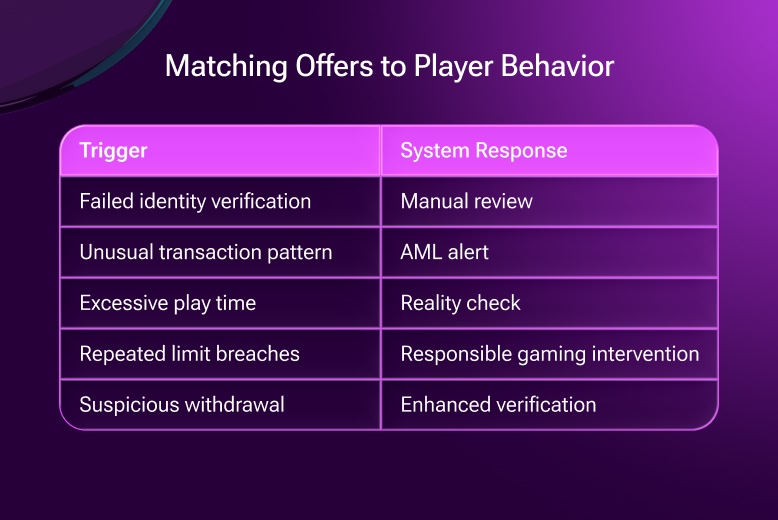
Although KYC, AML, and responsible gambling are often discussed separately, modern poker platforms cannot treat them as independent systems. Each relies on the same player data, many respond to the same events, and together they determine how the platform reacts throughout the player lifecycle. Building three disconnected compliance modules creates duplicated logic, inconsistent decisions, and unnecessary operational complexity. Instead, leading operators increasingly adopt a unified compliance architecture where identity, financial risk, and responsible gambling signals are processed as part of a single product ecosystem.
The unified player profile
At the centre of this architecture sits the player profile. Rather than storing only registration details, modern player profiles continuously accumulate information from multiple services, including:
- player identity verification status;
- AML risk score;
- responsible gambling indicators;
- jurisdiction and licensing information;
- payment history;
- behavioural signals.
Every important product decision can reference this profile. Whether a player attempts to join a high-stakes tournament, increase deposit limits, claim a promotion, or request a withdrawal, the platform evaluates the current state of the profile before determining the next action. Instead of dozens of isolated compliance checks scattered across the platform, decision-making becomes centralised around a single source of truth.
Real-time compliance
A unified player profile only becomes truly effective when it is continuously updated. Modern poker platforms increasingly rely on event-driven architectures, where every important player action generates events that can be analysed immediately.
Typical events include:
- account registration;
- login from a new device;
- deposits and withdrawals;
- table joins and exits;
- tournament registration;
- changes in betting behaviour.
Compliance services subscribe to these events in real time. A large deposit may trigger enhanced KYC verification. A sequence of suspicious transactions may increase an AML risk score. An unusually long session combined with aggressive stake progression may activate responsible gambling interventions.
Because these systems operate continuously rather than through scheduled reviews, operators can respond much earlier to emerging risks while maintaining a smoother player experience for the vast majority of customers. Ultimately, the goal is not simply to automate compliance, but to make compliance part of how the platform behaves every second a player is online.
Designing for multiple jurisdictions
Poker platform compliance becomes even more complex for operators serving multiple regulated markets. Global AML gambling regulations continue to evolve across regulated markets. While many jurisdictions share common principles around identity verification, anti-money laundering, and player protection, the specific rules often differ significantly. Age requirements, verification thresholds, deposit limits, self-exclusion schemes, affordability checks, and promotional restrictions may all vary from one market to another. For platform providers, supporting multiple jurisdictions is therefore a legal and an architectural challenge.
Configurable compliance instead of separate platforms
Maintaining different platform versions for every regulated market quickly becomes unsustainable. Instead, modern poker platforms increasingly rely on configurable rule engines that allow operators to adapt compliance behaviour without changing the underlying product.
Configuration may include:
- different KYC requirements by jurisdiction;
- market-specific regulatory requirements and responsible gambling tools;
- varying deposit and loss limits;
- integrations with national self-exclusion registers;
- restrictions on particular payment methods or promotional mechanics.
This approach allows operators to launch into new regulated markets while maintaining a single technology stack. Choosing poker software with KYC and AML can simplify expansion into regulated markets by reducing the need for custom compliance development. Rather than rebuilding the product for every licence, the platform adjusts its behaviour according to jurisdiction-specific rules, making expansion faster and ongoing compliance easier to manage.
Compliance as a product investment
Embedding KYC, AML, and responsible gambling into product architecture inevitably introduces trade-offs. More verification during onboarding can reduce conversion. Deposit limits and affordability checks may affect short-term revenue. Additional monitoring increases engineering complexity and operational costs. Viewed in isolation, these measures can appear to create unnecessary friction.
In practice, however, operators increasingly recognise that the cost of weak compliance is far greater. Regulatory penalties, licence suspensions, fraud losses, reputational damage, and declining player trust all have a direct impact on long-term business performance. Well-designed compliance systems help reduce these risks while creating a more sustainable operating model.
For product teams, success is measured not only through acquisition metrics but also through indicators such as:
- KYC completion rates;
- onboarding conversion after verification;
- fraud and AML case volumes;
- responsible gambling tool adoption;
- regulatory findings and audit outcomes;
- player retention following compliance interventions.
Effective compliance balances strong risk controls with a seamless player experience. Product teams continuously refine onboarding, verification, and monitoring processes to support both regulatory compliance and player satisfaction.
A practical checklist for poker product teams
Building a KYC- and AML-enabled poker platform requires more than implementing individual regulatory features. The real challenge is ensuring that compliance is integrated into the product from the ground up.
A useful way to evaluate your platform is to ask:
- Do all core services have access to a unified player profile that combines KYC status, AML risk, responsible gambling indicators, and jurisdiction data?
- Does verification scale with player risk through a progressive KYC model?
- Are AML controls designed specifically for poker behaviours such as chip dumping, collusion, and suspicious transfer patterns?
- Do your responsible gambling tools for poker operators support real-time behavioural risk detection rather than relying solely on manual player actions?
- Is compliance configurable across jurisdictions without maintaining separate versions of the platform?
- Can product, compliance, and support teams work from the same player data when making operational decisions?
If several of these questions are answered with “no”, compliance is likely still operating as a collection of disconnected features rather than as part of the platform’s core architecture.
Conclusion
The role of compliance in online poker has fundamentally evolved. KYC, AML, and responsible gambling are no longer isolated compliance functions—they are integral parts of how modern poker platforms operate. Together, they influence player onboarding, financial transactions, gameplay, and long-term platform sustainability.
As regulatory expectations continue to evolve, product, engineering, and compliance teams need to work together to build systems that support both operational efficiency and player protection. Flexible architectures, real-time monitoring, and configurable compliance workflows help operators adapt to new markets while maintaining a consistent player experience. This is one of the key advantages of modern poker software with KYC and AML designed for regulated markets. For poker platform providers, designing with compliance in mind creates a stronger foundation for long-term growth, regulatory readiness, and player trust.
Looking to build or expand a regulated poker platform? EvenBet Gaming helps operators launch and scale poker products with configurable KYC, AML, and responsible gambling tools for poker operators designed for regulated markets. Get in touch with our team to learn how our platform supports compliance without compromising product flexibility.
FAQ
What is responsible gambling in online poker?
Responsible gambling is a set of tools and practices that help players gamble safely and stay in control of their spending and playing time. It includes features such as deposit limits, reality checks, self-exclusion, and early intervention when risky behaviour is detected.
Why is responsible gambling now part of poker platform architecture?
Responsible gambling is now part of platform architecture because regulators require player protection to be embedded throughout the product. Features like limits, reality checks, and self-exclusion must be integrated into player journeys and consistently enforced across the platform.
Why do poker platforms need AML monitoring?
Poker platforms need AML monitoring to detect suspicious financial activity and comply with AML gambling regulations. Continuous monitoring of transactions and gameplay helps identify potential fraud, money laundering, and other financial risks.
What suspicious patterns can AML systems detect in online poker?
AML systems can detect patterns such as rapid deposit-withdrawal cycles, chip dumping, collusion, multi-accounting, and unusual transaction activity. These signals help compliance teams identify suspicious behaviour and investigate potential money laundering or fraud.