

 30 June 2026
  20 min
  191 views
 The Philippines remains one of Asia’s most vibrant online gambling markets: the online segment has already climbed to roughly USD 2 billion, and the growth curve keeps pointing toward 2030. Strong digital infrastructure, deep mobile and internet penetration, and a culture that’s genuinely open to gaming keep the country a magnet for regulated operators, even now that the offshore POGO model has been swept off the board.
The legal landscape for online gambling in the Philippines, though, has shifted under everyone’s feet. Republic Act No. 12312, the Anti-POGO Act of 2025, slams the door permanently on offshore gaming operations and tears down the old tax framework built for Philippine Offshore Gaming Operators. For anyone eyeing a poker room in the Philippines, the takeaway is blunt: the only ground left to build on is the domestic, PAGCOR-regulated e-games and internet gaming market. The Philippines online gambling market continues to attract regulated operators despite major legislative changes.
From POGOs to a domestic e‑games market
In October 2025, President Ferdinand Marcos Jr. put his signature on the Anti-POGO Act, locking into law a sweeping ban on offshore gambling and everything orbiting it — POGO hubs, service providers, the whole ecosystem. The law wipes out every existing POGO licence in one stroke and ties the hands of regulators and special economic zones alike, so no new offshore gaming licences will ever be issued again. Running, supporting, or even promoting such a business now carries criminal liability.
What survived the purge, though, is the domestic market PAGCOR keeps watch over — land-based casinos, e-games cafés, and licensed online platforms catering to Filipino players. Industry data paints a clear picture: regulated domestic GGR now makes up the lion’s share of the country’s gaming revenue, with mobile and online channels leading the charge and steadily funneling players toward licensed operators.
Launching an online poker room in the Philippines in 2026
If you plan to launch an online poker in the Philippines, understanding the post-POGO regulatory framework is essential. In practice, that boils down to two real paths: secure an internet gaming operator licence (or whatever equivalent approval PAGCOR grants) or fold poker into an e-games platform that’s already licensed and running.
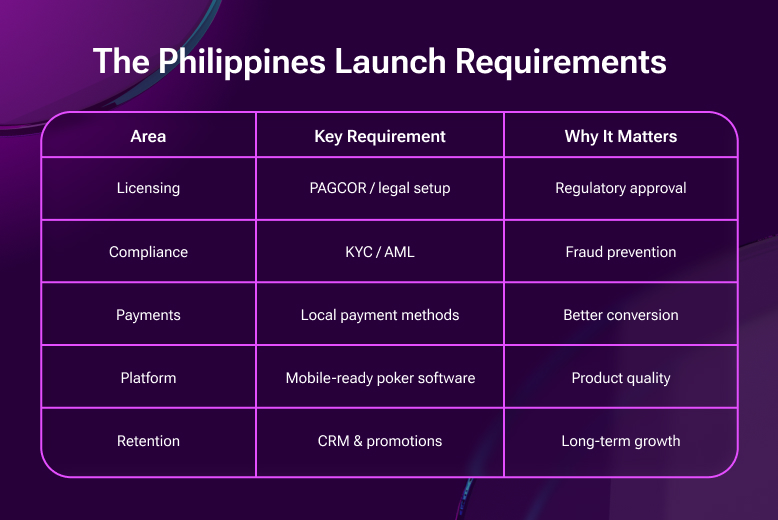
For foreign or regional operators, the Philippines hasn’t shut its doors entirely, the country can still serve as a licensing and operational base. But the business has to play by the new rules: no skirting the offshore ban, no models quietly aimed at markets the law now puts off-limits. The realistic play is a domestic or regionally-aligned poker product built to PAGCOR’s standards — responsible gaming, AML/CTF compliance, advertising limits, and player protection baked in from the start, not bolted on as an afterthought. This is now the core reality of online poker on the Philippines market.
Regulatory framework you need to understand
The starting point is Republic Act No. 12312 (Anti‑POGO Act of 2025), which bans offshore gaming operations and related service/content providers in the Philippines. This Act repeals RA 11590 (the previous POGO tax law) and reclassifies POGO‑related violations as unlawful activities under the Anti‑Money Laundering Act and other criminal statutes.
Parallel to this, PAGCOR maintains its regulatory mandate over domestic gaming, including electronic games and internet‑based gambling offered to Filipino residents. Regulatory manuals and memoranda set out technical, security, responsible gambling, and advertising standards that licensed online operators must follow.
PAGCOR and licence categories
PAGCOR sits at the center of the whole structure, issuing and policing licences across land-based casinos, e-games hubs, and internet gaming sites, while also accrediting the B2B layer: gaming system providers and other technical suppliers feeding the market.
The recent reforms sharpened the lines that used to blur: internet gaming licensees (the B2C operators facing players) now stand clearly apart from gaming system administrators and platform providers (the B2B backbone), with both probity checks and technical requirements tightened across the board.
Poker itself doesn’t get its own separate licence track, as regulators fold it into online casino and poker in the Philippines licensing categories. That means the software and RNG running underneath have to clear approved testing and integration standards, just like any other game. Bottom line: there’s no room for a standalone, unregulated poker app floating outside the system. Any poker product has to live inside a licensed, audited gaming infrastructure or it doesn’t exist legally at all.
Licensing routes for poker operators
Domestic internet gaming operator
One route is to become a PAGCOR‑licensed internet gaming operator, offering poker alongside other legal verticals (e‑casino, bingo, etc.) to players based in the Philippines. This implies full responsibility for compliance, KYC/AML, RG tools, reporting, and technical standards across the platform.
Gaming system provider or B2B platform
There’s another door besides going B2C: positioning as a gaming system provider or B2B platform that arms already-licensed Philippine operators with technology, under PAGCOR accreditation and within the boundaries RA 12312 draws. But that door comes with a catch — the law reaches straight into the service-provider layer too, naming offshore content and service providers explicitly. So any B2B model has to be built ground-up to feed domestic, licensed operations. Half-measures won’t survive the framework, the architecture itself has to point inward, toward the regulated market, from day one.
Hybrid and partnership models
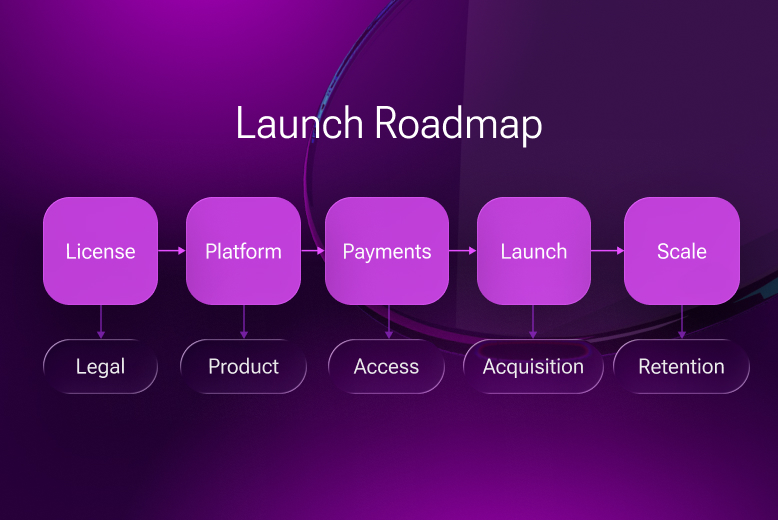
In practice, the path most newcomers launching an online poker business in the Philippines actually walk is partnering with an existing licence holder. The entrant supplies the poker content and the technical tools under a B2B agreement, while the local operator carries the primary licence and shoulders compliance on the front line. That arrangement takes a real weight off — regulatory navigation gets noticeably lighter when someone who already knows the terrain is holding the licence.
But lighter doesn’t mean free. Technical audits still have to happen, and responsible-gaming standards still have to align across both sides. And then there’s the part most easily glossed over in the rush to launch: AML obligations and reporting duties need to be spelled out in the contract with real precision, so nobody’s left guessing who answers for what when a regulator comes asking.
Step‑by‑step: corporate and licensing setup
1. Define your business model and target market
You first need to decide if your poker room will primarily serve Filipino domestic players, regional players under a Philippine licence, or act as a technology supplier to licensed operators. Post‑Anti‑POGO, any strategy built on offshore‑serving operations from Philippine soil is no longer viable and exposes you to criminal and regulatory risk.
2. Incorporate and capitalise a Philippine entity
The starting point, before any licence or partnership conversation, is the corporate shell itself: operators incorporate locally through the SEC, hitting whatever minimum paid-up capital threshold applies and staying inside the foreign ownership limits the law sets. RA 12312 adds its own pressure here too — corporations whose stated purpose touches prohibited offshore gaming activities now have to rewrite their Articles of Incorporation or risk the SEC simply pulling their registration. So the corporate objects clause has to be drafted with real care, every phrase weighed against what the law now forbids.
Beyond the paperwork, the foundation needs to be physical and human too: an actual office, local directors or authorised representatives on the ground, and a banking relationship with an institution that won’t flinch at a regulated gaming client. It’s the base everything else gets built on, the layer that makes later licensing and the ongoing grind of AML/KYC obligations even possible.
3. Prepare PAGCOR application documentation
A typical internet gaming licence application involves a formal letter of intent, filled‑out PAGCOR forms, personal and corporate probity documents, and a detailed business plan. PAGCOR also expects technical descriptions of your gaming system, including architecture, security controls, disaster recovery, and interfaces with payment and KYC providers.
You should also prepare responsible gaming policies, AML/CFT programmes aligned with Philippine law, and internal controls documentation for audits. External legal and compliance advisors are valuable here, as requirements and interpretations can change with new memoranda or political pressure.
4. Undergo technical testing and inspection
Before any approval lands, the gaming software itself goes under the microscope — independent labs like GLI or BMM dig into the RNG, the fairness logic, the reporting architecture, looking for cracks. A poker system has to prove its game logic holds up, that player data is locked down properly, and that reporting can actually deliver what regulators and tax authorities expect to see, not just what looks good on paper.
PAGCOR can show up, on-site or remotely, to walk through the infrastructure itself: servers, monitoring systems, the back-office machinery that’s supposed to keep everything compliant in real time. Only after clearing that gauntlet, and often after posting a performance bond or guarantee and settling the licence fees, does an operator finally get the green light, the Notice to Commence Operations that actually lets the doors open.
Technology and infrastructure needed for a poker room
Core poker platform capabilities
At the bare minimum, the platform has to walk and chew gum at once: cash games running alongside scheduled tournaments and sit-and-gos, real multi-table capability, rake structures that can flex rather than sit fixed in stone. And the bar keeps climbing — in markets where operators are actually competing for the same players, fast-fold or “quick seat” formats, tables built mobile-first rather than mobile-adapted, and a lobby that doesn’t make players hunt for a game have all quietly become table stakes rather than nice-to-haves.
The back office is where the real weight sits, even if players never see it. It needs to track player activity, game outcomes, financial flows, bonuses, and limits down to a granular level. This is the machinery AML monitoring runs on, the layer responsible-gaming controls plug into, the source data tax and fee calculations pull from. Get this layer wrong and everything built on top of it — the licence, the audits, the trust — starts to wobble.
Hosting, performance, and resilience
Hosting needs to sit inside approved Philippine data centres, or at least infrastructure regulators can actually reach and audit, fully aligned with local data laws. Layer on redundancy, regular backups, DDoS protection, and real-time monitoring — the stuff that keeps poker tables from buckling when traffic peaks.
And since mobile drives the bulk of revenue in online gaming in the Philippines, latency and UX for smartphone users across Metro Manila, Cebu, Davao and beyond are core. That means lean client code, adaptive streaming, and capacity planning built to absorb tournament-day spikes rather than choke on them.
Security, KYC, and anti‑fraud
Hooking into KYC providers and e-wallets like GCash and Maya covers more than convenience. Age verification, identity checks, and secure payments all converge there. Players and regulators alike now expect verification flows that are clean and visible, paired with controls that actively keep underage or high-risk gambling out, not just discourage it on paper.
Poker brings its own layer of risk that generic gaming controls don’t catch. Collusion between players, bots and real-time assistance running quietly in the background, suspicious play patterns that only show up when someone’s actually looking for them. These tools earn their keep twice over: they build the regulatory trust a licence depends on, and they keep the ecosystem honest enough that serious, skill-driven players actually want to stick around.
Product, UX, and player behaviour in the Philippines
The player base itself tells a story worth designing around: studies of Filipino online gamblers point to a wide layer of casual, low-stakes players who treat gambling as manageable entertainment rather than a grind. Many arrived here by migrating away from informal, unsafe environments — street games, social-media betting circles — toward regulated platforms that simply feel safer and more legitimate.
Mobile and e-wallets define usage: one recent study found GCash alone used by over 90% of surveyed online gamblers. That single fact reshapes expectations across the board — instant deposits and withdrawals, minimal hassle, and wallet-level spending controls players can actually see and trust.
For operators offering poker in the Philippines, the implication is direct: UX has to be simple and mobile-first, tuned for shorter, casual sessions rather than built solely around long, high-stakes grinds. Layer in proper localisation, promotions timed to Philippine holidays, and tournament schedules that actually track domestic work and pay cycles. The product starts aligning with how people really play, not how operators assume they play.
Market opportunity for poker in the Philippines
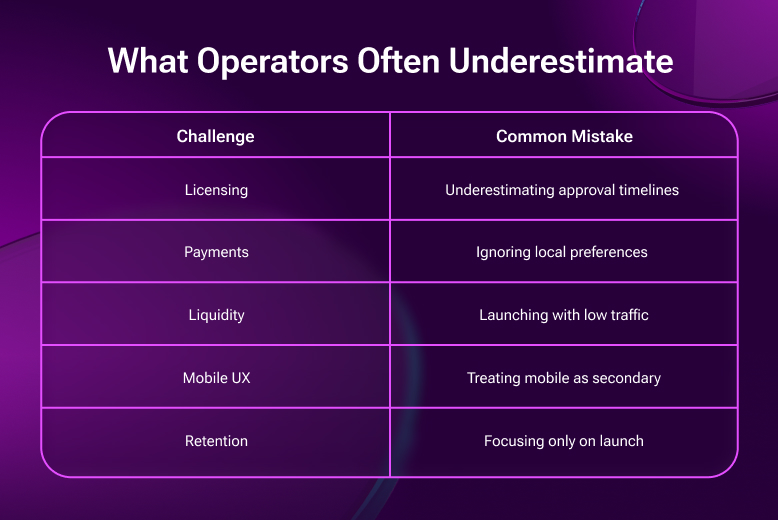
Zoom out, and the trajectory speaks for itself: the broader online gambling market is projected to climb from roughly USD 2.0 billion in 2025 to around USD 3.6 billion by 2034, growing at a CAGR near 6.8%. Analysts are clear about where growth in online gambling in the Philippines actually comes from — the regulated domestic e-games and online gaming segment, not any lingering hope of an offshore revival.
Channelization backs that up: an estimated three-quarters or more of total GGR already flows through regulated operators, a sign that players themselves are voting with their wallets for licensed platforms over informal alternatives. Growth plus strong channelization together make the Philippines a market worth taking seriously for anyone running a compliant poker product.
Poker in the Philippines remains a smaller vertical than sports betting or casino games, but it rides the same currents — smartphone adoption, e-wallet ubiquity, trust earned by regulated brands. Operators who frame poker as one piece of a broader, safe entertainment offering stand the better chance. They pull in the casual players just starting to experiment with skill-based games, not just the ones already chasing a high-stakes draw.
Working with poker software providers
Building an online poker business in the Philippines from scratch means the full poker stack — engine, lobby, mobile clients, risk tools, reporting, the works — is exactly as costly and slow as it sounds, more so once strict regulatory requirements enter the picture. Which is why most operators partner with specialised poker software providers or multi-vertical platforms that already clear the core technical and compliance bar.
A poker-first B2B vendor takes the engine, the UX, and the back office off your plate, leaving the operator free to focus on licensing, local marketing, payments, and player support. Pick a provider like EvenBet Gaming, for instance, and you’re plugging a mature, battle-tested poker product straight into a licensed Philippine e-games or internet gaming environment. That means scaling faster with a fraction of the engineering overhead a from-scratch build would demand.
What separates a good vendor choice from a costly mistake comes down to a few things: audited RNG and fairness, reporting detailed enough to satisfy regulators, integrations with local and regional payment providers, and real flexibility to customize formats and localisation. Get these right, and the poker room passes inspection while genuinely feeling built for the Philippine market.
FAQ
Is online poker in the Philippines legal?
Online poker in the Philippines is legal only when it is offered through properly licensed and regulated platforms. PAGCOR’s Electronic Gaming Licensing Department recognises “Online Poker Games” as one of the approved game types and issues gaming licences to qualified operators that meet its technical, compliance, and responsible gambling standards.
Unlicensed or offshore‑style poker sites operating from or into the Philippines fall under the country’s illegal online gambling and Anti‑POGO framework and risk enforcement action.
Who regulates online poker in the Philippines?
Online poker is regulated by the Philippine Amusement and Gaming Corporation (PAGCOR), a government‑owned corporation under the Office of the President. Within PAGCOR, the Electronic Gaming Licensing Department (EGLD) oversees e‑games operations, including online poker, and processes applications for gaming licences and service provider accreditation. EGLD evaluates the poker platform’s technical integrity, security, fairness, and integration with on‑site venues, and ensures operators comply with AML, KYC, and responsible gaming rules.
Is the Philippines a good market for online poker operators?
Yes, when approached as a regulated, domestic‑facing market rather than an offshore hub, the Philippines is one of Asia‑Pacific’s more attractive gaming jurisdictions. Market research points to strong growth in online gaming in the Philippines, deep smartphone penetration, and high “channelization” toward licensed operators, meaning most revenue is captured by regulated platforms. Poker remains a smaller vertical than casino and sports betting but benefits from the same drivers: digital payments, mobile play, and trust in PAGCOR‑licensed brands.
Why should operators look closer at the Philippines?
Operators should look closer at the Philippines because it combines a fast‑growing regulated market with a clear licensing framework and gaming‑savvy workforce. PAGCOR’s structure and EGLD’s recognition of online poker create defined legal pathways for compliant operators, unlike many neighbouring countries that still prohibit or severely restrict internet gambling. After the permanent ban on POGOs, regulatory attention has shifted firmly to domestic e‑games and online platforms, which opens room for well‑run poker offerings that align with PAGCOR standards and contribute to legal GGR.
What license is needed to launch online poker in the Philippines?
To launch online poker legally in the Philippines, an operator needs a PAGCOR gaming licence that covers Online Poker Games, issued through the Electronic Gaming Licensing Department (EGLD). EGLD issues Gaming Licences for specific game categories, including Electronic Casino Games, Sports Betting, and Online Poker Games, after assessing the applicant’s site, platform, documentation, and suitability.
In practice, you may either:
- Obtain a full PAGCOR gaming licence for an e‑games site that offers online poker as part of its portfolio; or
- Integrate your poker product as a service provider platform accredited by EGLD and attached to a licensed on‑site venue or operator.
Both routes require robust compliance, audited software, and ongoing reporting, so most new entrants work with experienced legal counsel and poker software vendors when preparing their applications.