
 5 June 2026
  Upd: 4 August 2026
  17 min
  1811 views
 Five years ago, picking poker game software providers was a relatively contained problem. You needed a stable platform, a decent game library, and a licensing arrangement without constant friction. Conversations about the top poker software providers in 2026 would have sounded far simpler than they do today.
In 2026, operators face rising acquisition costs, fragmented regulatory frameworks, increasingly complex payment infrastructure, and players who expect seamless experiences across devices and products. Poker has become harder to scale. Liquidity is more fragmented, tournament ecosystems are more crowded, and mobile performance has become a baseline expectation. The compounding effect is what catches operators off guard. A poker game software provider that performs well at launch can become costly once real operational pressure begins. Peak load issues, localization gaps, and infrastructure limitations all create friction that directly impacts retention.
That’s why feature lists no longer tell the full story. What operators want to know is whether the best poker platform software providers can sustain performance when scale, complexity, and player expectations all increase at once.
Top Poker Software Providers in 2026: Several Notable Names
EvenBet Gaming
Founded: 2001 • HQ: Malta • Focus: Poker software • Products: Standalone poker platform, poker skins, casino aggregation & turnkey casino solutions • Markets: 41 countries • Scale: 200+ poker projects, 48M+ players • Regulation: MGA B2B licence, Danish & Swedish supplier licences • Awards: EGR B2B Poker Supplier of the Year 2026
EvenBet Gaming is a poker-focused B2B software provider with more than 20 years of experience in iGaming. Rather than offering a one-size-fits-all solution, the company provides different deployment models for different operator segments. Startups can launch quickly with affiliate programmes and poker skins using shared player liquidity, growing operators can expand with standalone poker platforms and casino aggregation, while established brands can deploy fully customised poker platforms integrated into their existing casino or sportsbook infrastructure.
With more than 40 poker and card games, 200+ launched poker projects, and over 48 million players worldwide, EvenBet has established a strong presence across regulated markets. In 2026, the company won Poker Supplier of the Year at the EGR B2B Awards 2026 and Poker Provider category at the European iGaming Awards 2026, while also securing a five-year B2B supplier licence from the Danish Gambling Authority, further strengthening its regulated European footprint.
Playtech
Founded: 1999 • HQ: Douglas, Isle of Man • Focus: Casino, poker, sportsbook & bingo platforms • Portfolio: 1,000+ proprietary casino games, 3,800+ titles via Games Marketplace • Markets: 40+ regulated jurisdictions • Regulation: UKGC, MGA, and other local licences • Network: iPoker
Playtech is one of the world’s largest gambling technology suppliers, providing platforms across multiple gaming verticals and a portfolio of more than 1,000 games spanning slots, live casino, table games, and poker. The company operates the iPoker network, one of the industry’s largest B2B poker networks, which is now available in North America through PokerStars Exclusively on FanDuel. Playtech is typically selected by enterprise operators seeking unified compliance, reporting, and multi-vertical management rather than standalone poker deployments.
BetConstruct
Founded: 2003 • HQ: London, UK • Focus: Sportsbook, casino, live dealer & poker • Products: Full gaming ecosystem • Markets: Europe, CIS, Latin America, Africa & Asia • Regulation: MGA, UKGC, Romania, France, Denmark, and other jurisdictions
BetConstruct is a privately held iGaming technology provider offering a broad ecosystem that includes sportsbook, casino, live dealer, poker, affiliate tools, and blockchain products such as Fastex and FTN. Its platform is frequently adopted as a single-vendor technology stack for operators seeking centralised infrastructure. In 2025, the company expanded its MGA authorisation to include a poker vertical (Type 3) under both its B2B and B2C licences. BetConstruct is generally best suited for operators prioritising platform breadth and operational efficiency over deep poker specialisation.
Connective Games
Founded: 2000 • HQ: Malta • Focus: Online poker software • Strength: Localised poker experiences • Markets: Europe, LATAM, and other regulated jurisdictions
Connective Games specialises in online poker software and multiplayer card games, powering several leading online poker rooms, including major regional networks across Europe and Latin America. The company differentiates itself through extensive localisation, supporting market-specific formats, speed structures, re-entry rules, and regional poker variants for jurisdictions such as Spain, Portugal, Georgia, and India. Rather than offering a generic casino platform, Connective Games positions itself as a poker specialist with certifications and compliance for multiple regulated European markets.
Cubeia
Founded: 2007 • HQ: Stockholm, Sweden • Focus: Multiplayer gaming engines & poker platforms • Technology: Java 21 engine, HTML5 clients • Scale: Boutique technology provider (~20 employees)
Cubeia develops scalable multiplayer gaming technology with a strong focus on poker. Its platform is built on a multi-threaded Java 21 game engine and modern HTML5 clients designed to support high player volumes. Recent developments include the launch of Poker 2.0, introducing jackpot sit-and-go tournaments, hybrid poker networks, and an expanded roadmap featuring clubs and additional game variants. Cubeia primarily appeals to operators and crypto-focused casinos looking for a lean, highly customisable technology partner rather than a monolithic full-service platform.
Flutter Entertainment
Founded: 2016 (following the rebranding of Paddy Power Betfair) • HQ: Dublin, Ireland • Focus: Consumer gambling brands • Scale: 27,000+ employees • Key brands: PokerStars, FanDuel, Betfair, Paddy Power, Sky Betting & Gaming
Flutter Entertainment differs from the other companies on this list because it is a gambling operator rather than a standalone B2B poker software supplier. Through brands including PokerStars, FanDuel, Betfair, Paddy Power, and Sky Betting & Gaming, the group operates under dozens of local licences across regulated markets worldwide. Flutter controls some of the industry’s largest poker liquidity pools across Europe and North America, with 2026 marking the continued integration of PokerStars technology into FanDuel’s US poker offering. While Flutter does not license its poker platform to third parties, its proprietary technology plays a significant role in shaping global poker liquidity, network structure, and competition.
What to look for in a poker software provider
Integration and architecture
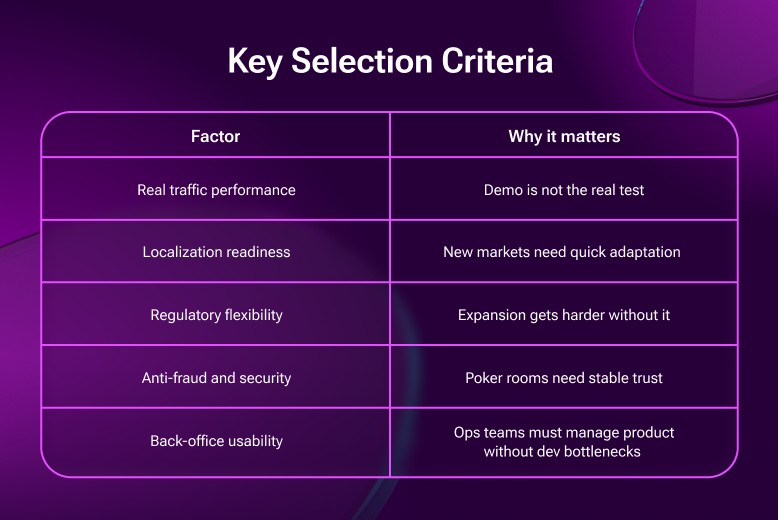
A modern iGaming poker software provider no longer gets to operate in isolation. Now, poker needs to talk to a PAM, payment infrastructure, KYC systems, CRM tooling, affiliate tracking, anti-fraud layers, and analytics often in real time. When those connections are clean, the operation runs. When they’re not, everything slows down in ways that are surprisingly hard to diagnose. Launches stretch, payment routing gets brittle, and routine product changes start requiring custom engineering work that nobody budgeted for.
This is why API-first architecture has stopped being a selling point and started being a baseline expectation. Operators increasingly expect poker software providers to plug into existing infrastructure without forcing expensive rebuilds around the platform itself. The deeper issue is rigidity. A platform that works well in one configuration can become genuinely painful the moment an operator moves into a new jurisdiction, adds a localized payment method, or tries to adapt to a regulatory requirement that wasn’t on the radar at launch. Flexibility isn’t a nice-to-have. It’s what determines whether expansion is an opportunity or an engineering crisis.
Liquidity and player pool strategy
Empty tables don’t hide. A platform can have elegant design, sophisticated tournament mechanics, and a mobile client that looks great in a demo. None of it matters much if liquidity is thin. Slow game starts and half-empty tables push players out the door quietly and quickly, well before any retention campaign has a chance to intervene.
Liquidity, in this sense, is the foundation everything else sits on. Operators need to understand not just whether a provider offers shared liquidity, but how they manage it — how traffic is balanced across the network, how tournaments are scheduled to keep momentum through off-peak hours, how private clubs and network structures interact. The best poker software providers think about table activity the way a good venue thinks about atmosphere: it has to feel alive consistently, not just on Friday nights. When it works, it compounds. Players stay longer when games start fast and tournaments fill naturally. When it doesn’t, the product feels hollow in a way that’s very difficult to fix with marketing.
Scalability and performance
Tournament traffic is where weak infrastructure gets found out. A platform that handles a regional launch smoothly can start showing its limits the moment concurrent users spike or a network event runs across multiple skins at once. The stress shows up in gameplay stability, load times, and the kind of micro-friction that players feel before they can articulate it.
Mobile makes this harder. Players now carry console-quality expectations into multi-table sessions on a phone, and “it works on mobile” has long since stopped being enough. The question operators increasingly ask about the best poker platform software providers is whether those platforms still perform well under heavy load and peak tournament traffic. Scalability, properly understood, is about how much operational strain accumulates as the product grows and how much of that strain was quietly baked in by infrastructure decisions that seemed fine at launch.
Features and retention tools
Nobody is impressed by a feature list anymore. What operators actually want to know is whether those features produce behavior — whether they give players a reason to come back between tournament cycles, build habits around the platform, and stay engaged when there’s no headline event on the calendar.
Loyalty systems, private clubs, flexible tournament formats, and mobile usability all matter. But the piece that consistently surprises operators is the social layer. Video chat, customizable tables, community mechanics, private games — these aren’t novelties. They’re the difference between a poker room that players return to and one they treat as interchangeable with the next option in the app store. Retention, at its core, is about rhythm. The platforms that understand this build products that stay active after the big tournament ends, because the players are still there, and they have somewhere to be.
Common mistakes when choosing a provider
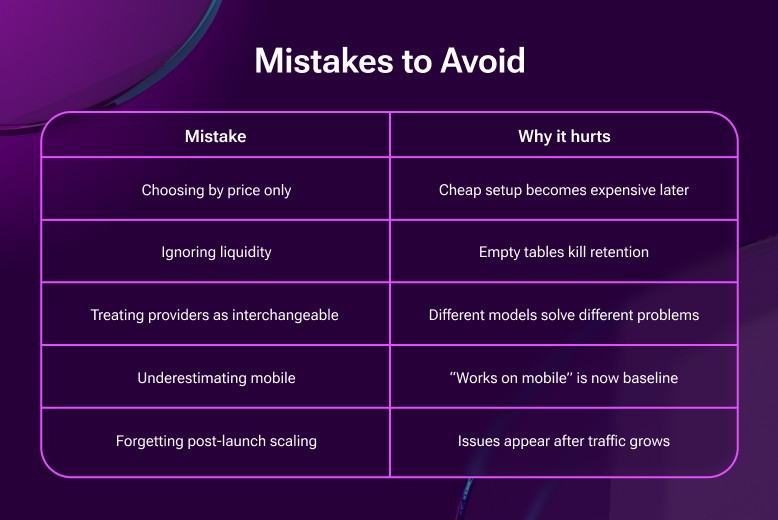
The most expensive mistake is also the most common one: choosing on price. A lower upfront cost is an attractive number until the platform starts creating friction — in payment routing, localization, integrations, scaling. Poker infrastructure rarely fails dramatically at launch. It degrades gradually, in ways that are easy to rationalize until they’re impossible to ignore. By the time the real cost becomes visible, switching is its own expensive problem.
Underestimating liquidity is the other mistake that keeps showing up. iGaming poker software providers sometimes treat it as a secondary concern — something to solve after the platform is live and the product looks good. It isn’t. Interface quality buys goodwill for a few sessions. Empty tables end the experiment. Player pool formation needs to be part of the evaluation from the start, not a problem inherited after launch.
The subtler mistake is assuming that poker software providers in this space are roughly interchangeable. They aren’t. Poker-first vendors and broader iGaming ecosystems with poker capabilities are solving genuinely different problems and supporting genuinely different growth models. Treating them as variations on the same answer is how operators end up with infrastructure that works fine in theory and creates friction in practice.
Conclusion
The market now offers far more variety than it used to, especially among modern poker software providers competing for operators with very different priorities. Some providers build around liquidity and poker ecosystems. Others approach poker as one layer inside larger enterprise platforms shaped by payments, compliance, sportsbook, and multi-product operations.
That variety is useful. It also means operators have to ask harder questions before choosing anything at all: what kind of player behavior are they trying to build, how much flexibility they actually need, and what kind of business the platform is supposed to support three years from now, not just during launch month. Which is why selection of top poker software providers in 2026 no longer feels purely technical. At this point, it is much closer to an operational strategy decision.
FAQ
What is a poker software provider?
A poker software development company supplies the technology needed to run an online poker room — including the game client, tournament systems, wallet integration, back office tooling, and player management infrastructure. The range of what’s included varies significantly between providers, which is part of what makes evaluation non-trivial.
How do I choose the best poker software provider in 2026?
Rankings of the best poker software providers change depending on business model, target markets, and operational priorities. That said, the criteria that matter most right now are integration flexibility, liquidity strategy, scalability under real traffic, mobile performance, compliance readiness, and retention tooling. Providers that score well on a feature list but poorly on any one of those tend to make their presence felt at the worst possible moment.
What features should poker software include?
At minimum: core game variants, tournament management, multi-table support, mobile UX that doesn’t embarrass itself, secure wallet integration, and back-office controls that don’t require a developer to operate. The top poker software providers in 2026 typically layer on private clubs, shared liquidity, loyalty mechanics, anti-fraud systems, analytics, and promotional tools flexible enough to work under real operational pressure. The gap between a minimum viable poker room and a competitive one is wider than it looks on paper.
What is the difference between white label and turnkey poker software?
White label is the faster path — the provider handles most of the infrastructure, you launch under your own brand, and you trade some control for speed. Turnkey gives you more configurability over setup, branding, and operations, but it asks more from you in time and resources before you go live. Neither is inherently better. The right answer depends on how quickly you need to launch and how much operational control matters to your model.
How much does online poker software cost?
It varies enough that any specific number would be misleading. White-label poker software solutions are usually cheaper and faster to launch. Custom or enterprise-grade solutions cost more because they involve deeper integration, tailored features, and ongoing development. The more useful question is what the platform costs when you start scaling, entering new markets, or discovering what the initial setup didn’t include.
Why is scalability important for online poker operators?
Because poker is unforgiving about it. The game runs on real-time traffic, active tables, and tournament operations that can spike hard and fast. A platform that handles your launch numbers comfortably can start showing strain the moment concurrent users climb or a network event runs across multiple skins. When performance drops, players notice immediately and unlike most gambling products, a poker room that feels slow or empty is one that players leave and don’t come back to.