

 26 June 2026
  Upd: 29 June 2026
  15 min
  181 views
 AI has been impossible to ignore in iGaming for the past three years — every vendor pitch, every industry report, every panel discussion has had something to say about it. The vocabulary keeps shifting — machine learning, large language models, agentic systems — while the underlying question stays the same: where does artificial intelligence in poker actually help a poker operation run better, and where is it still mostly noise?
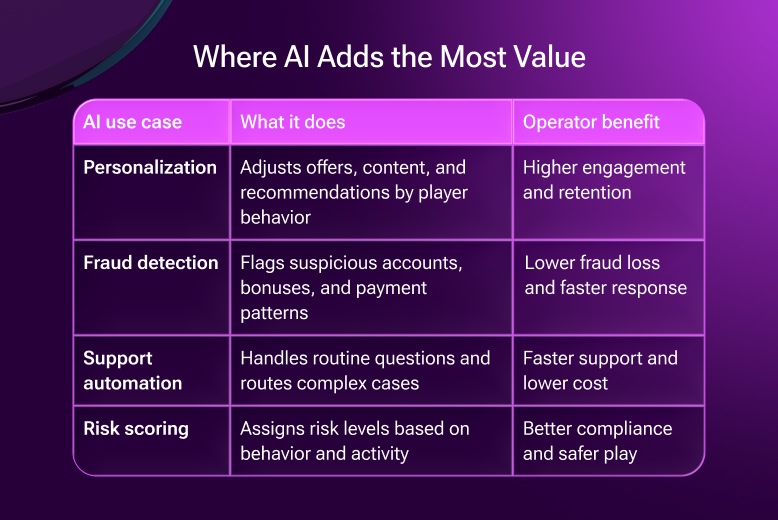
The answer, in practice, is narrower than the hype suggests and more valuable than the sceptics allow. AI can deliver measurable ROI in a few specific operational areas, especially where data volume is high and decisions are repetitive: personalisation, fraud and bot detection, support automation, and risk scoring. This guide is about those areas: what the technology actually does in each one, what kind of AI we’re talking about, and how to implement it without spending eighteen months on a pilot that goes nowhere.
Why AI matters in poker operations now
Over the last few years, AI has become one of the main technology drivers for growth and risk management in iGaming, especially as player volumes grow and fraud tactics become more complex. Traditional rule-based and manual approaches simply cannot keep up with real‑time play, fast payment flows, and evolving regulation.
For poker rooms, the stakes are higher than in many other verticals:
- Player trust is fragile and can be destroyed by a few bad bot or collusion scandals.
- Margins depend heavily on retention and lifetime value rather than one‑off wins.
- Operators must balance game integrity, responsible gaming, and monetisation on the same platform.
AI fits naturally into this environment because it excels at spotting patterns in large volumes of data, reacting in real time, and supporting human teams with better signals for decisions.
What kind of AI are we actually talking about?
“AI” in poker operations is a stack of models and tools that sit inside existing workflows. In practice, artificial intelligence for poker is more about improving operational efficiency through better data signals.
- Machine learning (ML) & anomaly detection
Models that learn typical player and transaction behaviour, then flag deviations, used in fraud, AML, and risk scoring. - Behavioural analytics engines
Systems that track session length, game selection, bet patterns, timing, and responses to promotions to build a behavioural profile for each player. - NLP-based assistants and chatbots
AI models that understand natural language, classify support tickets, and handle routine customer queries. - Scoring models (risk, value, churn)
ML scoring that produces risk scores, churn probabilities, bonus abuse likelihood, or value scores for VIP targeting. - Generative AI for risk & fraud management
Generative AI can support fraud teams by summarizing cases, helping analysts explore scenarios, and assisting with risk reporting and investigation workflows.
Most serious operators combine these models with classic rules (hard limits, compliance checks) instead of trying to replace their decision logic with a “black box”.
Personalization: from generic lobbies to behaviour-driven poker journeys
In 2026, leading iGaming operators consider AI-driven personalization a main lever for competitiveness, not a UX add‑on. This is especially visible with AI in online poker, where player journeys can be optimized in real time across lobbies, promotions, and retention flows. Machine learning helps tailor experiences across the entire player journey – from registration and game selection to bonus allocation and on-site messaging.
For poker rooms, personalization translates into:
- More relevant formats and stakes surfaced to each player.
- Smarter promotion targeting based on behaviour rather than demographics.
- Early identification of VIP and high‑value cohorts.
AI models cluster players using data such as deposit frequency, bet size, preferred content, session length, and response to previous offers. This allows operators to distinguish “bonus hunters” from genuine recreational or loyal players and allocate marketing spend and promos accordingly.
Practical use cases in poker
- Dynamic lobby and table recommendations
AI tracks which variants and stakes each player engages with, then adapts lobby recommendations, table visibility, and tournament suggestions based on live or recent behavioural signals. Casual players see simpler, lower‑risk options, while engaged or experienced profiles get access to deeper formats and missions. - Smart bonus and mission allocation. ML models learn which bonuses actually drive incremental activity for a given segment and which only attract short-term bonus abuse. Operators can down-weight aggressive bonuses for high-risk or low-value segments, and increase mission-based or skill-focused promos for loyal players.
- Churn and reactivation signals
Behavioural analytics surfaces early churn indicators – decreased session frequency, shortened play time, or avoidance of previously favourite formats. Poker CRM teams can trigger tailored reactivation campaigns instead of generic mass emails.
AI personalization in poker focuses on optimising navigation, offers, and lifecycle management using behavioural signals to deliver more relevant player experiences, while avoiding use cases such as personalised odds that may raise regulatory concerns.
Fraud and bot detection
Fraud in iGaming – multi‑accounting, bonus abuse, chargebacks, identity theft – now costs the industry billions annually. In poker specifically, AI-powered bots, collusion, and synthetic identities pose both financial and reputational threats, particularly as bot technology improves.
Most platforms still rely on manual reviews, static rule sets, and basic IP or device checks, which are easy for sophisticated fraudsters to bypass. AI changes the game by detecting patterns and anomalies across behaviour, devices, payments, and identities in real time. For operators, AI in online poker is particularly valuable in fraud prevention because it can detect suspicious patterns far faster than manual review.
How modern AI-based antifraud works
Current best practice for iGaming fraud detection combines several AI layers:
- Multi‑account and bonus abuse detection
ML models evaluate device fingerprints, login patterns, IP/VPN usage, and overlapping banking details to identify linked accounts and promotional abuse networks. - Payment fraud and chargeback risk scoring
AI monitors deposits and withdrawals for velocity anomalies, unusual card usage, and suspicious transaction sequences, flagging high‑risk payments before funds are fully settled. - Bot and automated betting detection
Behavioural models compare betting speed, decision consistency, mouse movement patterns, and endgame behaviour to typical human profiles, spotting AI bots and automated scripts. - Identity and synthetic ID detection
AI strengthens KYC checks by analysing identity documents, email and device patterns, and login behaviour, helping detect synthetic identities and identity theft at onboarding.
AI in customer support
As player bases scale, manual support becomes a bottleneck: common queries about payments, bonuses, tournament rules, or account access consume most of the workload. At the same time, response speed and resolution quality strongly influence satisfaction, retention, and complaint rates.
AI-powered support tools – especially NLP models – are now used to automate routine tasks while escalating complex cases to humans. This is particularly relevant for poker, where rules, promos, and tournament logistics generate recurring types of tickets.
Key AI use cases in poker support
- AI chatbots and in‑app assistants
NLP agents handle FAQ‑style questions about deposits, withdrawals, promotions, and basic game rules, across chat widgets, web, and mobile apps. They can also surface context‑specific information like tournament schedules or table availability. - Ticket intake and routing
AI models classify incoming tickets by topic (payments, responsible gaming, tech issues, collusion complaints) and urgency, assigning them to the right queues and agents automatically. - Agent‑assist tools
Support assistants read knowledge bases, past tickets, and account data to suggest responses or next steps to human agents, reducing handling time. - Signals for product and compliance
Aggregated support data, analysed by AI, helps highlight friction points in registration, payment flows, game UX, or bonus communication. Poker operators can then use these insights to fix underlying issues rather than simply expanding support headcount.
The realistic expectation: AI cuts first‑response times and manual workload for standard cases, but it does not eliminate the need for human support – especially for high‑value customers, disputes, and responsible gaming interventions.
Risk scoring, AML, and responsible gaming
Risk management only works if it operates in real time and at scale. AI-powered tools evaluate each login, deposit, withdrawal, and gameplay event as it happens, assigning dynamic risk scores to players and transactions based on behaviour, history, device signals, and contextual factors.
For poker operators, this enables:
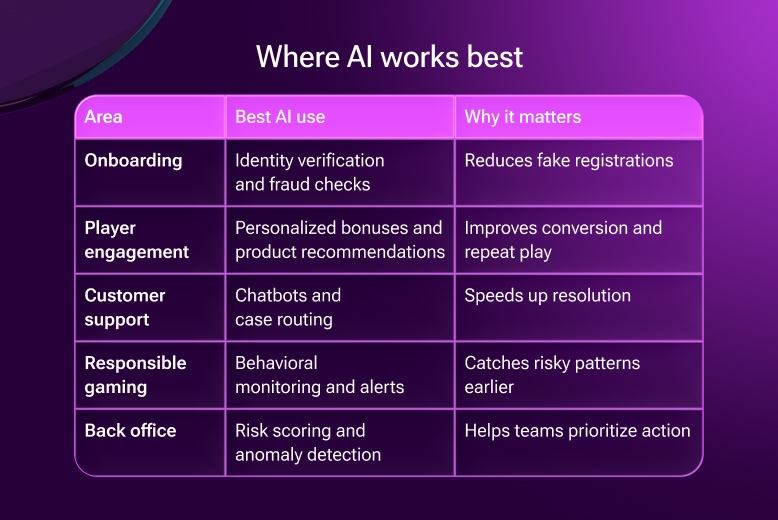
- Onboarding risk scoring: deciding how much friction to apply to a new registration based on risk signals (e.g., document verification intensity, deposit limits).
- Ongoing transaction monitoring: flagging suspicious cash flows, rapid withdrawals, or unusual bet patterns for AML and fraud review.
- Behavioural risk and responsible gaming detection: identifying problem gambling indicators (high loss frequency, late‑night sessions, chasing losses) and triggering interventions.
Compliance and explainability
In many jurisdictions, operators are expected to maintain auditability, explainability, and documentation for risk-based automated decisions. AI modules must provide clear reasoning trails: why a player was given a certain risk score, why a transaction was flagged, or why a bonus was limited.
Some compliance teams are already moving in this direction, building frameworks to oversee AI systems with clear ownership, documented processes, and accountability. This means poker operators must:
- Choose AI tools that can generate audit logs and structured explanations.
- Integrate responsible gaming triggers into personalization layers.
- Align their risk scoring approach with local AML and data protection rules.
Where AI doesn’t help (or hurts)
To keep this realistic: AI is not a silver bullet for every problem in poker operations. There are several common failure modes:
- Poor or limited data
AI needs consistent, high‑quality data. Small rooms with low volume or incomplete tracking may not have enough signal for ML models to be useful. - No clear ownership or KPIs
AI projects that aren’t tied to a specific operational pain (e.g., fraud losses, support backlog, churn) and clear KPIs usually end up as “innovation theatre”. - Over‑reliance on black boxes
Blindly trusting model outputs without human review or explainability can create unfair decisions, regulatory exposure, and player frustration. - Misuse for aggressive monetisation
Hyper‑targeted personalization without responsible gaming safeguards can lead to overstimulation and regulatory risk.
In many low‑volume or edge cases – rare collusion patterns, complex VIP disputes, or unusual payment situations – manual judgement and rules may still outperform AI.
How poker operators should adopt AI
Rather than “implementing AI everywhere”, poker operators should follow a staged, ROI‑focused approach:
- Pick one high‑impact pain point. Typical starting points include rising fraud losses or bot complaints, overloaded support queues, and stagnant retention despite heavy bonus spending.
- Define clear metrics and baselines. These might include fraud loss reduction, chargeback rate, first-response and resolution times in support, retention uplift or LTV increase in key cohorts, or a reduction in manual reviews and false positives.
- Pilot AI in a controlled segment. Deploy the new tool or model on a subset of players, traffic, or transactions first — specific geos or stakes, for example — and compare performance against the baseline before expanding.
- Integrate with existing workflows. Successful adoption depends on strong links between AI outputs and team actions: fraud teams using risk scores to prioritise manual reviews, CRM using segments to adjust campaigns, support using AI summaries to handle escalations.
- Scale gradually and monitor explainability. As pilots show measurable benefits, expand coverage step by step, ensuring that decisions remain explainable and logged for compliance and internal trust.
Final takeaway for poker operators
AI helps poker operators most where three conditions are met: there is a continuous stream of data, clear patterns to detect, and a meaningful cost to errors. The strongest use cases for AI in online poker remain those tied to measurable operational outcomes. In today’s environment, the most mature and impactful use cases are:
- AI‑driven fraud and bot detection that protects both revenue and game integrity.
- Behavioral personalization that improves retention and LTV without blanket bonus spend.
- Support automation that makes service faster and cheaper while keeping humans on complex cases.
- Risk scoring and AML monitoring that keeps operators compliant in real time and supports responsible gaming.
Operators that treat AI as part of their operational stack and connect it to specific business pains, measurable KPIs, and strong governance will get the real upside: lower losses, higher retention, and a more resilient poker ecosystem.
EvenBet Gaming provides poker operators with a flexible platform and modern solutions for every stage of business growth — from launch and daily operations to scaling and long-term optimization. Talk to our team to explore the right setup for your poker business.
FAQ
How does AI improve online poker operations?
AI improves operations by analysing gameplay, payments, and behaviour to surface actionable signals faster and at scale. AI in online poker helps reduce fraud, prioritise manual reviews, improve personalization, and speed support workflows so teams can focus on high-value tasks rather than repetitive checks.
How do poker operators actually use AI?
Operators use AI for player segmentation and personalization, fraud/AML monitoring, bot and collusion detection, risk scoring, and support automation (NLP ticketing and agent assistants). In practice, artificial intelligence in poker helps operators improve decision-making across core operational workflows.
How does AI detect poker bots?
AI builds behavioural profiles (timing, bet patterns, decision consistency, session length) and device/payment fingerprints; models flag machine-like consistency, identical reaction times, overlapping fingerprints, or velocity anomalies and escalate suspicious cases for human review.
How does AI detect collusion in online poker?
AI analyses relationships and chip flows across accounts, comparing betting and fold/call sequences for statistical inconsistencies and coordinated patterns, then combines that with device and IP signals to identify suspicious clusters for investigation.
What AI tools and model types are used in poker operations?
Common classes, not single products, include ML anomaly detectors, behavioural analytics engines, scoring models (risk/churn/value), NLP chatbots and ticket classifiers, graph analysis for network detection, and hybrid rules-plus-ML systems. Operators often combine vendor solutions with in-house models tuned to their own data.