
 5 June 2026
  23 min
  99 views
 Over the past several years, poker has evolved from something people simply played into something millions also watch. Tournament guarantees climbed as player pools expanded, creator communities formed around major streaming channels, and poker content established a permanent place on platforms like Twitch and YouTube. When creators such as Spraggy or Lex Veldhuis stream high-stakes action, traffic spikes and community engagement often follow. Many operators now view poker streaming for player acquisition as a complement to affiliates, paid media, and CRM rather than a standalone tactic.
The mechanism is straightforward enough. Streaming puts a real person at the table, in real time, losing real money and occasionally winning improbable amounts of it. That’s entertainment and, for anyone watching, an extended product demo delivered by someone they already trust. The emotional stakes are visible. The product is the experience.
For operators, the implications were hard to ignore. Streaming combines acquisition, community building, education, and brand exposure in a single format, delivered through personalities rather than banners. The cost-per-acquisition math, at its best, looks nothing like conventional paid channels.
The industry has absorbed this lesson. Poker sites now treat streaming less like a marketing experiment and more like infrastructure. The question has shifted from whether to use streaming for poker user acquisition to something more operationally interesting: how to do it in a way that actually holds up on a spreadsheet.
The Poker Streaming Ecosystem
Twitch: The Primary Home of Live Poker Content
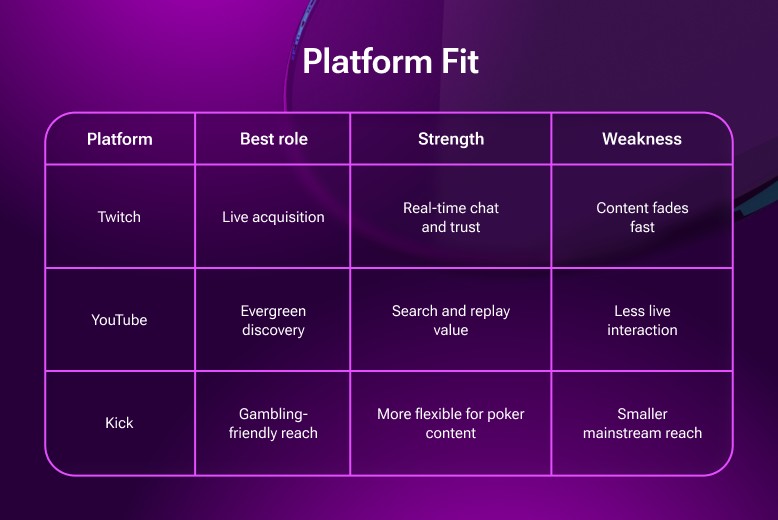
Twitch is where poker streaming lives, and the numbers reflect it. Lex Veldhuis has built one of poker’s largest streaming audiences through a mix of high-stakes cash games and tournament content that remains accessible to beginners while keeping regular players engaged. Education and entertainment running in the same session, which is harder to pull off than it sounds.
Other top international streamers on Twitch include:
- Jamie Staples (Team PokerStars): turned poker training into an entertainment show, streaming 5 days a week with strong educational content
- Spraggy (Team PokerStars Online): streams on his own channel and on PokerStars’ channel, focusing on online tournaments and fun formats
- Fintan Hand (EasyWithAces) (Team PokerStars): high-volume tournament player with a personality-driven format
- Ryan “Beriuzy” Chamus (GGPoker Network): plays high-stakes tournaments and creates dramatic content
- Patrick “egption” Tardif (GGPoker Network): known for big tournament runs and emotional reaction content
What’s useful about this range is what it reveals about the audience. Tournament coverage, high-stakes cash games, personality-driven chaos, each format attracts a different kind of player, at a different stage of their relationship with poker. Operators willing to think beyond a single streaming partnership have a surprisingly wide surface area to work with.
Twitch remains one of the most effective channels for Twitch poker marketing because:
- Real-time chat interaction makes viewers feel part of the action
- Low barrier to entry: anyone with a webcam and poker software can stream
- Community building: chat regulars become loyal supporters and paying customers
YouTube: Evergreen Content + Live Streams
YouTube serves a different function in the poker content ecosystem. The format favors patience — hand breakdowns, strategy deep-dives, tournament vlogs, behind-the-scenes footage that would lose something in a live stream. Creators use it less for real-time engagement and more for building a library: content that keeps working months after it was uploaded and pulls in viewers who found their way there through search rather than a live notification.
YouTube poker marketing offers operators something live streaming can’t: durability. A well-produced hand breakdown or tournament highlight keeps pulling in viewers months after it was uploaded — through search, through recommendations, through players who found a creator’s back catalogue long after the live stream ended. The content keeps working without anyone running it.
Kick: Emerging Platform for Gambling and Poker
Kick has been picking up ground, largely because it asks fewer questions about gambling content than Twitch does. A wave of iGaming creators made the move, and the platform has since earned a place in multi-channel strategies, less a replacement for Twitch than a parallel surface, useful for content that wouldn’t survive moderation elsewhere.
What Makes a Poker Platform Streamer-Friendly?
Sponsorship deals get creators through the door. The product determines whether they stay. Streamer Mode, customizable table layouts, delayed card reveals, referral tracking, creator tournaments, integrated promotional tools — these aren’t cosmetic additions. They shape how comfortably a creator can build content around a platform, how well operators can measure what that content actually produces, and how much room streamers have to engage their audience without running into the edges of what the software allows.
For B2B providers, this is quietly becoming a differentiator. Operators who rely heavily on poker influencer marketing are increasingly asking whether a platform supports creator-driven acquisition from day one.
Main Models of Working with Streamers
Streamer Sponsorships (Team Deals)
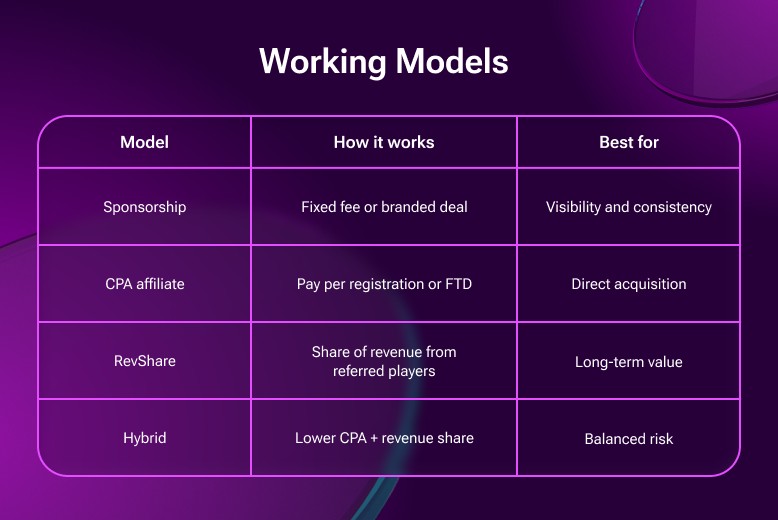
A poker streamer sponsorship can take many forms, including fixed salaries, revenue-sharing agreements, and performance-based bonuses. Sponsorship terms vary significantly depending on audience size, engagement levels, market focus, and exclusivity requirements.
Benefits:
- Consistent presence across streams builds familiarity that compounds over time
- Long-term relationships turn streamers into genuine reference points for their audience, not rotating ad slots
- A creator who actually uses the platform carries more weight with viewers than one who clearly doesn’t
Risks:
- A streamer’s reputation is borrowed equity — useful when things are going well, a liability when they aren’t
- Controversy travels fast in streaming communities, and operators rarely get much warning before it arrives
- Fraud and non-targeted traffic are quieter problems, but they surface eventually, usually in conversion data that looked fine until someone looked closely
In-House Corporate Streams
Some operators cut out the middleman entirely, building in-house streaming operations with creators on payroll or contract.
Benefits:
- Complete control over messaging, branding, and timing
- No exposure to the reputational risks that come with external partnerships
- Easier to coordinate around product updates, promotions, and live events
Challenges:
- Authenticity is harder to manufacture than it looks, and streaming audiences are reasonably good at detecting when something feels produced rather than genuine
- Production costs and staffing requirements add up faster than most operators expect
- Organic reach takes years to build, and in-house channels rarely start with the audience that established creators already have
Affiliate Partnerships and Performance Deals
Affiliate models are performance-based:
- CPA (Cost Per Acquisition): fixed payment per first-time deposit
- RevShare: percentage of rake or revenue from referred players
- Hybrid: lower CPA + RevShare
Successful streamers often earn more on affiliate revenue (30–50% from deposits) than on gameplay itself. Mid-tier streamers with dedicated communities can outearn seasoned pros through subscriptions, donations, and sponsorships.
Working Formats
Live Cash Games and MTT Sessions
This is the baseline format. Streamers play real-money cash games or tournaments while explaining decisions in real time. Jamie Staples turned this into an entertainment show, making training accessible and engaging. Viewers learn strategy while seeing the platform’s UI, tournaments, and features in action.
Challenge Formats
Challenge formats create narrative arcs that keep viewers engaged over multiple streams:
- “Start with $100 and try to reach $10,000”
- “Win a seat to the WSOP Main Event”
- “Spin-up from micro-stakes to high-stakes”
These formats generate suspense and encourage viewers to follow the journey, often registering to participate themselves.
Educational Content
Educational content does something entertainment-first streaming doesn’t: it attracts players who are already invested in getting better. Hand breakdowns walk through annotated replays of pivotal decisions. Coaching-lite drops quick strategy reads into live play without breaking the stream’s momentum. Post-session analysis turns the VOD into something worth watching twice.
The audience this format builds tends to skew toward players who take the game seriously, which, from an operator’s perspective, generally means players are more likely to deposit, more likely to stay, and less likely to disappear after a bad run.
Interactive Formats
Some streamers hand partial control to their audience — bluff or fold, which hand to play, which tournament to enter. The mechanic is simple, and the effect on engagement is not subtle. Viewers who influence what happens on screen watch longer and convert at higher rates than viewers who don’t.
The pattern holds across formats. Audience votes, long-running challenges, community tournaments — what they have in common is that they give viewers a reason to feel personally invested in the outcome rather than passively entertained by it. From an acquisition standpoint, that investment tends to show up where it matters: registration intent goes up, and the players who arrive through these formats tend to stick around longer than those who came through conventional channels.
Tournaments with Audience Participation
Some operators build tournaments directly around streaming communities — the creator invites their audience, viewers get free or discounted entry, and side events with prizes give casual watchers a reason to register and deposit. The funnel is unusually direct: viewer, registration, first deposit, with the creator doing most of the work of making each step feel worth taking.
Collaborations Between Streamers
When two streamers share a session, their audiences overlap in ways that a single-creator campaign can’t replicate. Viewers discover the platform through a creator they already trust, reach expands without additional spend, and the cross-pollination tends to feel organic rather than promotional, which is most of what makes it work.
Always-On vs Event-Based Streaming
Streaming strategies generally fall into two modes: always-on, built around regular weekly streams and consistent platform presence, and event-based, timed around major tournaments like the WSOP or EPT, special challenges, or product launches. A balanced strategy uses both: always-on for retention and community building, event-based for spikes in acquisition. For many operators, this combination forms the foundation of a long-term poker streaming strategy.
The Funnel: How Streaming Drives Poker User Acquisition
Streaming primarily affects the top and middle of the funnel:
- Awareness: viewers discover the platform through the streamer
- Engagement: chat interaction, watching UI and gameplay
- Registration: using promo codes or affiliate links
- First Deposit (FTD): encouraged by bonuses and challenges
- Retention: regular play, tournament participation, community
Streaming also amplifies other channels:
- Retargeting ads to viewers who clicked but didn’t convert
- CRM campaigns to users who registered via streamer links
- Email newsletters highlighting streamer tournaments
Streaming doesn’t fit cleanly into a performance marketing funnel, and that’s part of what makes it valuable and part of what makes it difficult to measure.
A viewer might discover a poker room through a creator, watch casually for weeks, participate in a community event, and only then decide to register. The path is long and nonlinear. Attribution gets complicated. But the player who arrives at the end of that journey tends to be a different kind of player than one who clicked a banner — more informed, more committed, and less likely to churn after a single losing session.
Tracking and Attribution
Tracking typically runs through unique promo codes, affiliate links with tracking parameters, and UTM tags for campaign segmentation. GGPoker’s Streamer Mode supports Twitch and YouTube linking directly, which simplifies verification on the operator side.
The attribution picture is rarely clean. Viewers often watch multiple streams before converting, click several links before registering, and deposit days or weeks after the session that actually influenced them. Operators handle this through a combination of approaches:
- Last-click attribution for simplicity
- Multi-touch models for deeper analysis
- Post-view attribution windows of 7–30 days
Done properly, tracking makes it possible to segment users by source, analyze LTV by creator, and allocate budget toward the partnerships that are actually performing rather than the ones that look good on a reach report.
How to Calculate ROI for Poker Streaming
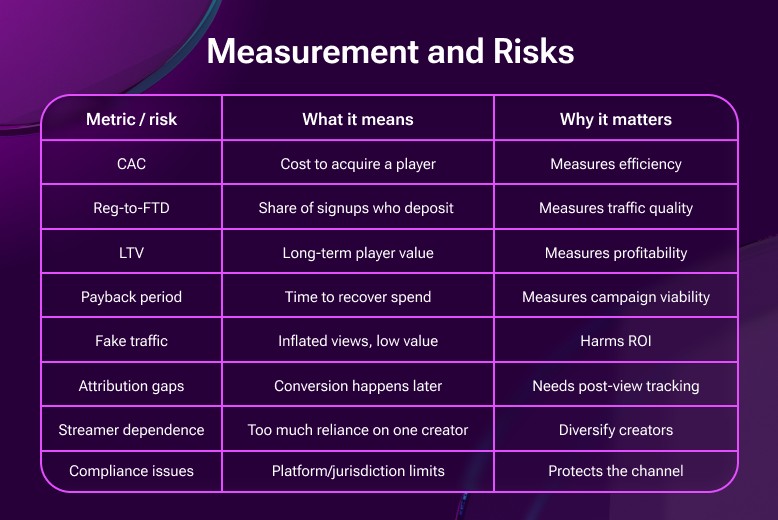
No single metric tells the full story when evaluating streaming ROI. Operators who evaluate streamer campaigns on acquisition cost alone tend to miss what’s actually happening — conversion quality, retention curves, and long-term player value all feed into whether a campaign was worth running. The picture only makes sense when those numbers are read together.
Basic ROI Formula
ROI can be calculated as:
ROI = (Revenue from streamer-acquired players − Campaign Cost) ÷ Campaign Cost × 100%
Where:
- Campaign Cost includes sponsorship fees, affiliate commissions, production expenses, and promotional costs.
- Revenue is the net gaming revenue generated by players acquired through the campaign over a defined period.
Example Calculation
This simplified example is intended to illustrate the calculation methodology rather than represent typical campaign performance:
- Streamer sponsorship cost: $25,000
- Registrations generated: 2,000
- Reg-to-FTD rate: 20%
- Total FTDs: 400
- Average player LTV: $200
Total revenue: 400 FTDs × $200 LTV = $80,000
ROI: ($80,000 − $25,000) ÷ $25,000 × 100 = 220%
In this example, the campaign generates more than three times the initial investment. Understanding streaming ROI requires looking beyond acquisition costs and considering long-term player value.
Performance varies enough between campaigns that aggregate benchmarks are mostly decorative. Geography, audience quality, game mix, retention patterns — each variable moves the numbers in ways that make cross-campaign comparisons unreliable as a planning tool.
Some campaigns take months to reach profitability. Others turn positive almost immediately, carried by creator communities that were already primed to convert. The difference usually comes down to factors that don’t show up in the initial deal: how well the audience matches the product, how robust the tracking is, and whether the partnership has enough runway to compound.
Which is why operators who run these campaigns seriously tend to evaluate them across CAC, reg-to-FTD rate, LTV, and payback period simultaneously, not because any single number is wrong, but because none of them is sufficient on its own. In practice, operators often compare streamer campaigns against other channels to evaluate overall poker marketing ROI.
Qualitative Metrics
The case for streaming doesn’t rest entirely on acquisition metrics. Brand awareness and trust build gradually across consistent creator presence in ways that don’t show up cleanly in a CAC report. Community growth — Discord servers, Telegram groups, social followings — creates infrastructure that outlasts any individual campaign. And players acquired through streaming tend to retain at higher rates than those from conventional channels, partly because they arrived through a community rather than a banner.
Strategy for Scaling: Portfolio Over Celebrity
Audience size is the wrong place to start. A creator with a smaller but genuinely engaged community will often outperform a larger channel whose viewers don’t match the operator’s target market. What matters is fit — engagement levels, content style, platform presence, reputation, and whether the audience watching is actually the audience worth acquiring. Streamer selection, done seriously, is a business decision rather than a branding exercise.
When evaluating potential partners, operators typically focus on:
- Audience alignment with target markets
- Engagement metrics such as average viewers and chat activity
- Content style and format
- Reputation and responsible gambling practices
- Platform presence across Twitch, YouTube, or Kick
Rather than committing significant budget upfront, most operators start with a pilot — three to five creators across different audience segments, running for four to eight weeks. That window is usually enough to generate comparable data on acquisition costs, conversion rates, retention, and traffic quality before any decision to scale.
Performance should be measured against a consistent set of metrics:
- CAC and reg-to-FTD rate
- Player LTV
- Average watch time and engagement
- Post-view conversions
- Retention and traffic quality
Once reliable patterns emerge, scaling follows naturally. Budgets increase, new creators join the roster, additional platforms come into scope — all within the same measurement framework that made the pilot legible. Diversified portfolios tend to outperform celebrity-focused strategies for the same reason they did at the pilot stage: less dependence on any single personality, more surface area for testing what actually converts. Over time, this portfolio approach often evolves into a broader poker streaming strategy that combines creator partnerships, platform diversification, and continuous performance optimization.
Risks and Pitfalls
Fraud and Bot Traffic
Some streamers may inflate viewership or use fake accounts. Mitigation:
- Verify traffic quality via regulated channels
- Monitor for unusual patterns (low deposit rates, high churn)
- Use multi-touch attribution and post-view windows
Dependence on the Streamer
A streamer who leaves, gets banned, or runs into a public reputation issue can take a campaign down with them, which is an argument for treating any single creator relationship as one part of a broader strategy rather than its foundation. Diversifying across multiple streamers reduces concentration risk. Building owned channels alongside influencer deals creates a baseline that doesn’t depend on any external personality. And reputation clauses in contracts give operators at least some structural protection when things go wrong in ways nobody anticipated.
Regulatory Constraints
Online gambling and poker advertising face strict regulations in many markets (US, UK, EU). Operators must:
- Comply with local advertising laws
- Ensure streamers follow responsible gambling guidelines
- Avoid targeting restricted jurisdictions
The risks are real, but they’re not unmanageable. Diversification handles concentration risk. Transparent reporting catches fraud and non-targeted traffic before it becomes a budget problem. Proper compliance processes keep the channel on the right side of jurisdictional requirements that vary more than most operators initially expect.
The broader shift is attitudinal. Streaming has graduated from experiment to discipline — something operators budget for, measure seriously, and build repeatable processes around. The question is no longer whether it belongs in the acquisition mix.
The Future of Poker Streaming
Streaming’s role in iGaming acquisition is still developing, and the infrastructure around it is moving faster than most operators have had time to absorb. The formats, platforms, and tools available in 2026 already look meaningfully different from what existed three years ago and the next wave of changes is already visible in what platforms are building and where attention is shifting.
The trends shaping the next phase:
- Platform diversification: Twitch remains dominant, but Kick and YouTube are taking on more meaningful share. Multi-platform strategies are becoming standard rather than experimental.
- Integration with in-game features: Platforms are beginning to build streaming functionality directly into the product: native chat, reactions, polls, co-streaming, audience participation mechanics. GGPoker’s Streamer Mode is an early example of what this looks like in practice.
- AI and personalization: AI is starting to enter the streaming layer, with potential to recommend streams based on player preferences, personalize offers during broadcasts, and automate promo code delivery through chatbots at a scale that manual management can’t match.
- Hybrid streaming and in-game events: The boundary between watching and playing is getting thinner. Operators are beginning to build tournaments that sync with streamer events, exclusive streams for VIP players, and interactive side events where outcomes are tied to live gameplay.
Conclusion
Poker streaming has earned its place in the iGaming acquisition mix — not as a novelty channel, but as a mature one with its own logic, its own metrics, and its own compounding effects when run well. Twitch, YouTube, and Kick give operators reach that conventional advertising struggles to replicate: entertainment, education, and community delivered through personalities that audiences already follow. The growing use of poker streaming for player acquisition reflects a broader shift toward creator-led marketing models. Creators demonstrate why poker influencer marketing remains an important part of the modern acquisition mix.
None of that makes streaming a guaranteed growth lever. Audience fit, creator selection, tracking infrastructure, promotional strategy, long-term retention — each variable has enough influence on outcomes to make a well-structured campaign and a poorly-structured one look like completely different channels. Operators who treat streaming seriously tend to run it alongside affiliates, paid advertising, SEO, and CRM rather than instead of them — one instrument in a mix, evaluated by the same standards as everything else in the budget.
FAQ
What is poker streaming?
Poker streaming is broadcasting live poker gameplay online while interacting with viewers through chat and explaining decisions. Streamers play real-money or play-money poker and create entertaining or educational content for their audience.
Can poker streaming help operators understand how to attract poker players?
Yes. Poker streaming is a proven user acquisition channel. It drives new registrations and first-time deposits by exposing viewers to the platform in an authentic, engaging context. Streamers act as trusted influencers who recommend the product to their audience.
Why are Twitch and YouTube useful for poker marketing?
Twitch is ideal for live interaction. Viewers can chat in real time, ask questions, and feel part of the action. The platform has a dedicated gaming audience actively seeking entertainment content.
YouTube is better for evergreen content. Edited highlights, tutorials, and hand breakdowns remain discoverable over time and attract users through search.
Both platforms offer built-in audiences, easy discoverability, and native tools for streamers to share links and promo codes.
What poker streaming formats work best for acquisition?
Most effective formats:
- Live gameplay with commentary — shows the platform in action while teaching strategy
- Challenge formats — narrative-driven content (e.g., bankroll challenges) that keeps viewers engaged over multiple streams
- Interactive streams — letting chat influence decisions increases engagement and conversion
- Tournaments with audience participation — direct path from viewer to registered player
- Educational content — hand breakdowns and coaching attract serious players with higher LTV
Less effective:
- Passive streams without interaction
- Content without clear calls-to-action (promo codes, affiliate links)
- Streams that don’t explain the platform or its benefits