
 30 April 2026
  Upd: 1 May 2026
  12 min
  915 views
 Poker has always been a game of skill. As a digital product, it now exists in an environment shaped by constant stimulation. Today’s players are used to instant feedback loops, infinite scroll, and real-time rewards. In this context, poker’s natural pacing — built around waiting, folding, and observing — introduces friction at the product level.
This is where poker platforms and casino integration start to play a critical role in retention. It happens in the quiet intervals between hands, when attention drifts, sessions lose continuity, and players exit earlier than planned.
Market Context
The online gambling market is projected to reach $143.17 billion in 2026, growing from $130.2 billion in 2025 at a CAGR of 10%, while the online poker segment remains much smaller at around $6.08 billion in 2026 (versus the casino-dominated broader market). Mobile-first behavior drives this expansion, with smartphone penetration fueling 96% of digital access and regions seeing surges in mobile iGaming activity due to 5G and on-the-go gaming.
Multi-vertical players (those engaging across poker, casino, and sportsbook) now represent a significant share of high-value users, as operators increasingly bundle products to boost retention and ARPU.
This ties into the “super app” trend in iGaming, where platforms converge multiple verticals into seamless ecosystems (like WeChat-style apps combining gaming, payments, and social), predicted to accelerate in 2026. This shift helps explain why poker sites add casino games as part of their core product strategy.
The Real Leak: Where Poker Platforms Lose Players
In a standard poker session, a player participates in a limited number of hands. Even in relatively active formats, meaningful decisions happen intermittently, while most of the time is spent folding, observing, and waiting. This rhythm is natural for the game itself. At the same time, it creates measurable pressure on product performance.
Inactivity is where attention starts to drift. Each fold introduces a short pause in engagement. Over the course of a session, these pauses accumulate and translate into tangible effects:
- Shorter session duration
- Lower engagement depth per visit
- Higher probability of mid-session drop-off
- Reduced lifetime value due to fragmented activity
Operators increasingly describe this pattern as the “boredom gap”, the inactive time between meaningful poker actions.
Why This Problem Is Becoming More Visible
The gap itself has always existed. What has changed is the surrounding environment. Players now operate in an ecosystem of products designed for continuous stimulation and instant feedback. Short-form video, mobile games, and social platforms set a different pace of interaction. In this context, even brief inactivity inside a poker session becomes more noticeable and more costly in terms of attention.
From Additional Content to Session Design
Early solutions focused on expanding content through casino games. Fast gameplay cycles and continuous action made them a natural addition from a monetization perspective. In many implementations, casino content lived in a separate environment with its own navigation, logic, and flow. This introduced fragmentation inside the overall experience. As a result, engagement split across multiple contexts instead of strengthening the core session.
The focus has gradually shifted toward session design, maintaining continuity of engagement within a single flow. At this stage, poker platforms and casino integrations ensure that sessions continue smoothly without disruption.
Side Games: Extending the Poker Session
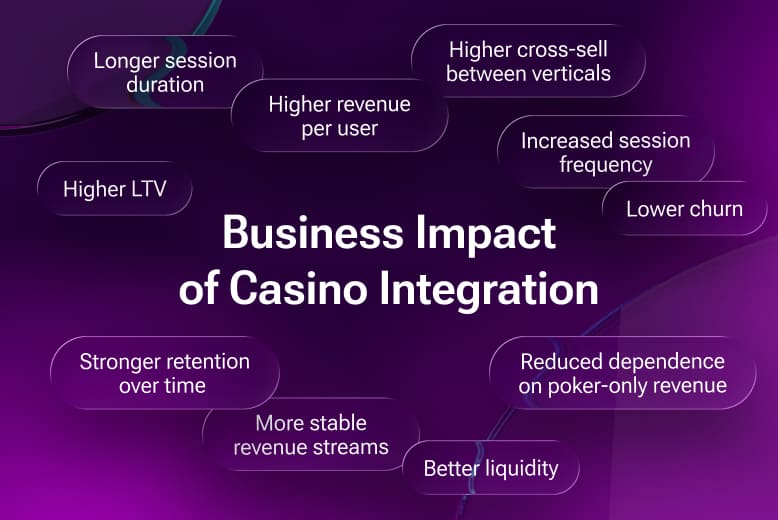
Multi-vertical players show up to 50% higher future value and 40–60% better retention than single-product users, with churn 12% lower. The rise of casino games on poker sites reflects a shift toward session-based engagement design. They are designed to exist alongside poker tables and activate during natural pauses in gameplay. Their role is to keep the player engaged without interrupting the main activity.
EvenBet Gaming’s Casino Side Games illustrate this approach:
- Games launch alongside active poker tables
- Sessions are short and align with hand timing
- A unified wallet removes additional steps
- The interface keeps poker central, with side activity remaining lightweight
This approach treats idle time as part of the product experience and actively incorporates it into the session flow. As a result, sessions become longer and overall player activity increases.
Limits of Aggregator-Driven Expansion
Casino aggregators provide scale and fast access to large game libraries. They remain a strong solution for expanding supply. At the same time, large catalogs introduce complexity in navigation and discovery. Switching between environments adds friction, and engagement becomes less predictable at the session level. Aggregators expand what is available. Side games shape how that content is used within a session.
Player Psychology: Managing Cognitive Load
Poker requires sustained focus, emotional control, and strategic thinking. Casino-style games operate through shorter cycles and faster feedback. They require less effort and provide immediate emotional response. Within a single session, this creates a more balanced rhythm. Periods of concentration alternate with lighter interactions, allowing players to maintain engagement for longer without fatigue buildup.
Retention Across the Player Lifecycle
In this context, casino games on poker sites support engagement across multiple session scenarios.
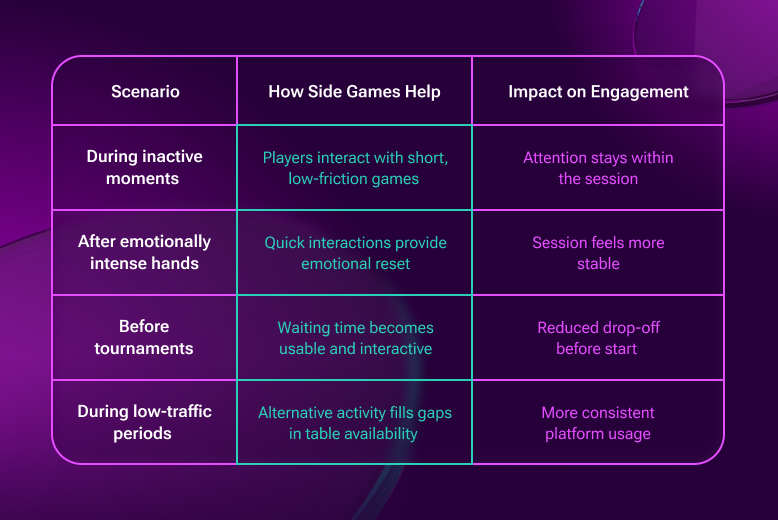
Result: more stable engagement patterns and improved retention, especially among recreational segments. Players are less likely to drop off during downtime, shifting instead to shorter, lower-commitment formats. This increases session continuity and supports more frequent returns over time.
Session Extension and Revenue Dynamics
Casino revenue supports poker economics — lower rake, bigger guarantees, better promos — while diversifying streams against poker volatility. Integrated casino mechanics contribute to longer and more consistent sessions. Increased session time correlates with higher hand volume and improved table activity. Revenue streams become more diversified, and overall platform performance becomes less sensitive to short-term fluctuations in poker activity.
The Move Toward Hybrid Engagement Models
Digital platforms increasingly compete through their ability to sustain attention over time.
- Poker remains a deep and engaging core product. At the same time, session continuity becomes a defining factor of overall performance.
- Side games reflect a broader shift toward hybrid engagement models where each part of the session is intentionally designed.
Gameplay includes both active decision-making and the intervals between actions — all treated as meaningful components of the experience. Idle time becomes a design surface rather than a gap.
What This Means for Retention
These dynamics directly affect player retention in online gambling, especially in mobile-first environments. Retention in poker platforms is shaped less by peak moments and more by what happens between them. Each inactive interval introduces a small risk of disengagement. On its own, this risk is minimal. Across a session, it compounds. Side games reduce that accumulation effect. By keeping players active during natural pauses, they smooth out engagement curves within the session. As a result:
- Session duration becomes more stable
- Drop-off points shift further into the session
- Players return more consistently after previous visits
Over time, this leads to stronger retention patterns, especially among recreational players whose engagement is more sensitive to pacing and emotional flow. In this context, retention is shaped by how uninterrupted the session feels.
To sum up
In modern iGaming products, retention is shaped at the session level. Every pause, every transition, and every micro-interaction contributes to whether a player stays or leaves. When these moments are structured, sessions become more stable, longer, and easier to sustain.
By embedding casino mechanics directly into gameplay, operators reduce inactivity and maintain engagement throughout the session. The result is stronger player retention in online gambling, supported by more consistent sessions and diversified performance.
EvenBet Gaming builds this approach into its platform architecture, enabling operators to extend poker sessions with integrated side games while keeping gameplay central and uninterrupted. Explore how it works.
FAQ
Why do poker platforms add casino games?
Poker platforms integrate casino games to address the inherent downtime in poker sessions, where players spend significant time folding or waiting between hands. This explains why poker sites add casino games as part of a broader product strategy. By embedding fast-paced casino options as side activities, platforms convert idle moments into active engagement, extend session duration, and maintain continuity without forcing players to leave the poker environment.
How do casino games improve player retention?
Casino games enhance retention by creating a balanced session rhythm that alternates poker’s high-focus decision-making with quick, rewarding casino interactions, which act as emotional resets during natural pauses. This reduces the “boredom gap” effect, where attention drifts during inactivity, leading to fewer mid-session drop-offs and more stable return rates, especially among recreational players sensitive to pacing. Over time, it fosters habitual usage patterns and higher lifetime value through uninterrupted engagement flows.
What is a hybrid gambling platform?
A hybrid gambling platform unifies multiple verticals, such as poker, casino slots, and sports betting, into a single, seamless app with shared wallets, intuitive navigation, and context-aware features like side games. Unlike siloed experiences, it prioritizes session continuity, allowing players to switch activities effortlessly during downtime while keeping the core product (e.g., poker tables) central. This “super app” model caters to diverse preferences, increasing cross-sell opportunities and long-term loyalty in a competitive attention economy.
Are casino games more profitable than poker?
Casino games outperform poker in profitability due to their higher house edges, faster gameplay cycles, and independence from player liquidity requirements, generating steady revenue through volume rather than skill-based rake. Poker relies on balanced tables and promotions to attract volume, often resulting in volatile margins, whereas casino mechanics allow platforms to subsidize poker guarantees, promos, and lower rakes, creating a more resilient economic model overall. This makes casino integration a strategic necessity for sustainable growth.