

 12 June 2026
  19 min
  165 views
 Every poker operator is competing for the same players, in the same channels, with the same incentive-led tactics. In that environment, women in poker represent one of the most underdeveloped growth opportunities the market has left untouched. Poker carries a reputation it has spent decades earning — male-dominated, intimidating by design, a culture that has historically done more to repel newcomers than welcome them. Participation numbers still reflect that history. They don’t reflect what’s possible once operators actually do the work of changing the experience itself.
For years, conversations about women in poker have lived in the territory of representation and diversity. That territory matters, but it tends to leave the business case sitting on the table. The commercial logic underneath it is straightforward: female poker players represent an underserved segment with a low baseline and substantial room to grow. Even modest improvements in onboarding, product experience, and retention generate outsized lifetime value gains when the starting number is this small.
That logic lands differently in a market where throwing more money at bonuses stopped being a growth strategy some time ago. The operators building durable advantage are doing it through product experience — through ecosystems that give players genuine reasons to stay. For women specifically, that means something more considered than a campaign with a different color palette. It means examining what actually keeps them away, and building something that addresses it directly.
Market Snapshot: A Segment With Room to Grow
The gender gap in poker is still real, especially in live rooms, but the more important signal is that women are entering the game in growing numbers. Estimates suggest women make up roughly 3–5% of players in live poker rooms, while online audiences are more balanced but still heavily male-skewed. What’s more interesting than the gap itself is the direction of travel. Surveys from 888 and partners have reported a 22% increase in female poker players in the last year, with participation up 23% across a five-year window.
The live tournament ecosystem tells a similar story. PokerStars reported a 49% increase in attendance at women-only events over the past two years, alongside a 116% year-over-year jump in women’s participation at the 2024 Irish Open. These are not the numbers of a segment that has arrived — they’re the numbers of a segment that is arriving.
For operators, that distinction carries real commercial weight. Mature demographics require increasingly expensive acquisition efforts to produce incremental growth. An expanding audience with low market penetration works differently. The growing share of women among poker players creates an opportunity to capture long-term value before the segment becomes more competitive. Modest improvements in onboarding, product experience, and retention generate disproportionate returns when the starting base is this small, because there remains significant headroom for growth, and the competitive pressure to get there first is still relatively light.
Why This Matters Now
Over the past decade, player acquisition has become more expensive, more regulated, and less predictable. Competition has intensified, advertising costs have climbed, and regulatory restrictions have narrowed available channels across a growing number of jurisdictions. Finding a new player keeps getting more expensive, which means holding onto the ones you have keeps getting more valuable. A player who stays active for years generates returns that a bonus-claiming, never-returning registration simply cannot match.
That context reframes what an underserved audience actually represents. Female poker communities offer a way to expand the total addressable market — to generate engagement that genuinely didn’t exist before, rather than redistributing the same players that every operator is already fishing for in the same pool. That’s a fundamentally different proposition.
A competitor can copy a bonus offer in an afternoon. Building a welcoming ecosystem takes longer and runs deeper — effective moderation, educational resources, community trust, product experiences that consistently reward rather than frustrate. These accumulate slowly, through years of consistent investment, and don’t transfer easily between platforms. An operator who has already done that work holds an advantage a late-arriving rival can’t close with a marketing budget alone. Player experience, compounded over time, becomes an asset that promotional spending simply cannot manufacture.
Myths vs. Reality
The assumption that women simply aren’t interested in poker doesn’t hold up against survey data or actual player behavior. Most women who try the game report enjoying it. In one study, 58% said they started playing because poker seemed “a fun and social game,” and 37% liked it because it felt easy to learn. Most enter through friends, family, or casual social settings rather than traditional gambling channels — the appetite is there, and the pipeline is where things break down. Curiosity rarely runs out. What changes is the surrounding environment, and that’s usually what determines whether someone keeps playing.
Women in poker tournaments tend to get read as evidence of a separate, parallel interest — a smaller, gentler version of poker for players who don’t want the real thing. In practice, these events work as on-ramps. They give newer players room to build confidence, develop skills, and form connections before stepping into broader competitive environments. For most, the destination was always the main game.
The skill stereotype runs deeper than the industry tends to acknowledge, and there’s research behind it. Academic studies have found that players adjust their behavior at the table when they believe they’re competing against women — more bluffing, different strategic choices, decisions shaped by assumptions about ability rather than anything actually happening in the hand. Gender stereotypes move table dynamics independently of skill.
The real question is whether the ecosystem makes the experience enjoyable enough to keep them at the table. For operators, that distinction changes what the problem actually requires. A lack of interest calls for marketing. Everything described above calls for product work — and product problems have product solutions.
Why Generic Acquisition Strategies Fail
Most acquisition strategies in iGaming still over-rely on financial incentives. Welcome bonuses, free tickets, cashback offers, loyalty rewards — all variations on the same logic: reduce the perceived cost of trying the product, and more people will try it. The approach works when price is the primary barrier. For many potential female poker players, the bigger obstacle sits somewhere else entirely — confidence, environment, not knowing where to start, a reasonable concern about what the atmosphere at the table is going to feel like. A larger bonus does not touch any of that. Operators can spend heavily on acquisition while solving the wrong problem entirely.
The contrast is easier to see with a concrete example. One platform offers a 200% deposit bonus, minimal guidance for beginners, and weak moderation. Another offers a smaller promotion alongside educational content, transparent rules, responsive support, and an active community. The second platform will likely generate stronger long-term retention despite spending less on acquisition — because it reduces psychological friction rather than financial friction, and psychological friction is what was actually keeping people away.
That distinction matters more as acquisition costs keep rising. The objective has quietly shifted from maximizing registrations to maximizing players who are still active six or twelve months later. Viewed through that lens, improving the experience isn’t the soft, qualitative alternative to performance marketing. For the right audience, it produces better ROI.
Why Women Can Become Long-Term Players
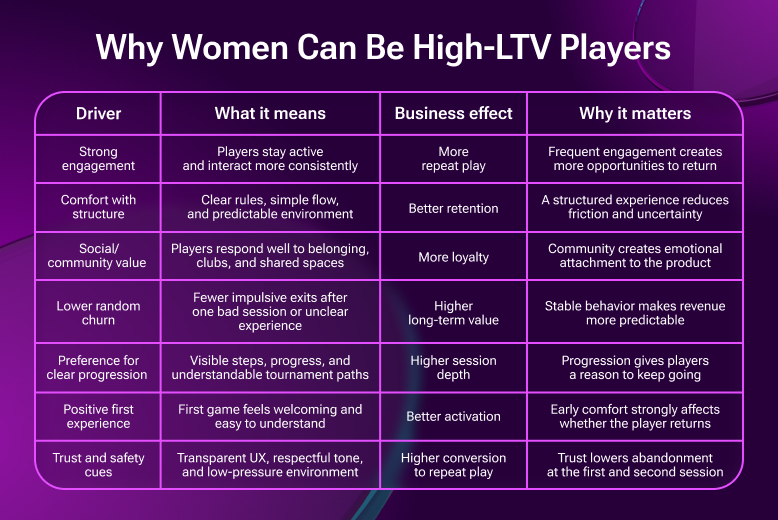
Lifetime value is built in the margins: repeat sessions, community attachment, and gradual progression. These variables determine whether a player was actually worth acquiring, and they compound in ways that initial spend figures tend to obscure. The characteristics that drive that kind of long-term engagement map closely onto what many women say they’re looking for in a poker environment: trust, social connection, fairness, a space where confidence has room to develop rather than getting extinguished on contact. That alignment reflects something real about what produces commercially durable players — the ones who show up weekly, engage with community features, follow educational content, gradually move up in stakes, and stick around long enough for the relationship to compound.
Poker’s revenue mythology tends to center on the high-stakes professional — the whale who sits down with a large bankroll and plays aggressively. In reality, sustainable platform economics runs on recreational players who return consistently over years. A player deep into their third year of weekly tournaments, community engagement, and gradual progression will often generate more cumulative value than someone who arrived loudly, ran through their bankroll, and left before the third session.
Women among poker players represent an opportunity to expand that pool. This is not automatic; it depends on the platform experience. When the product supports repeat play, trust, and community, women can become a strong LTV segment. They keep tables active, ecosystems healthy, and platforms viable well past the point where the acquisition campaigns have moved on to someone else.
The Real Barriers to Participation
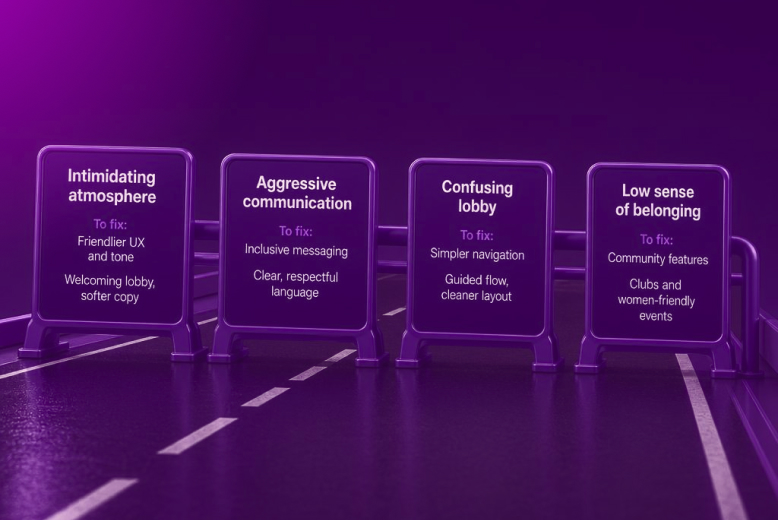
One of the most persistent misconceptions about women in poker is that the game’s complexity puts them off. Research and player accounts point to a different explanation. The game itself is usually not the main obstacle. The surrounding experience often is. Female poker players consistently describe feeling questioned, underestimated, or treated as outsiders at the table. Hostile interactions, unwanted attention, environments that feel unwelcoming to beginners regardless of skill level — these are not edge cases. They are common enough to show up reliably across data and qualitative interviews, and they create pressure at exactly the stage of the player journey where it’s most expensive.
A negative first session reduces the likelihood of a second. Fewer second sessions mean weaker habit formation. Without habits, loyalty programs, CRM campaigns, and retention mechanics operate on a shrinking base — tools optimized for players who never fully arrived. The connection between a bad table atmosphere and a lost customer is mechanical, not theoretical. Every drop in the chain is measurable: first session quality, Day 1 return rate, Day 7 retention, long-term LTV. Social discomfort shows up in all of them.
Operators invest heavily in optimizing payment flows, registration funnels, and game performance because every unnecessary step costs conversions. The same arithmetic applies to psychological barriers. A player who experiences discomfort before they experience enjoyment will leave and they’ll leave before any of the retention infrastructure gets a chance to work. Fixing that is less a question of inclusion than a question of product quality, with the same ROI logic behind it.
This applies to online poker as well. In live rooms, women often report intimidation, questioning, and unresolved negative experiences. In digital environments, the friction is different but equally real: hostile chat, weak moderation, fear of exposure, lack of trust in reporting tools. Both environments require product-level fixes, not just slogans.
Product and UX Opportunities
Improving female acquisition is largely a question of lowering friction at the point of entry and making the first sessions feel clear, safe, and rewarding. The practical levers are well within reach: cleaner onboarding, educational tutorials, beginner-friendly tables, stronger moderation, transparent reporting mechanisms, clearer communication around community standards. None of these are technically ambitious. What they share is an understanding that the earliest stages of the player journey carry disproportionate weight, and small decisions at that stage compound quickly.
Guiding a new player through their first tournament, explaining common terminology before it becomes a source of confusion, recommending appropriate stakes rather than leaving the lobby as an open question — each of these reduces the uncertainty that causes people to quietly give up before they’ve actually played. The moment of abandonment is rarely dramatic. It’s usually someone who doesn’t feel confident enough to take the next step.
Specific product changes that help include:
- Beginner tables and “low-pressure” environments.
- Clearer lobby labels and stake guidance tailored for new players.
- Stronger moderation, default chat moderation, and visible reporting tools.
- Optional anonymity controls to reduce unwanted exposure.
- Onboarding flows that explain rules, etiquette, and basic strategy before the first session.
Community features deserve more attention than most operators give them. Study groups, coaching content, discussion spaces, and ambassador programs can increase the share of women among poker players by making the game feel more approachable and supportive. They convert poker from an isolated transaction into an ongoing experience with social texture. That texture is what retention actually runs on.
The wider point is that none of these improvements are women-specific in their effect. Beginners, casual players, returning users — anyone navigating an unfamiliar environment benefits from the same things: clarity, confidence, and a sense that the product was built with them in mind. Designing for inclusivity produces a better product, and a better product serves everyone.
Content as Infrastructure
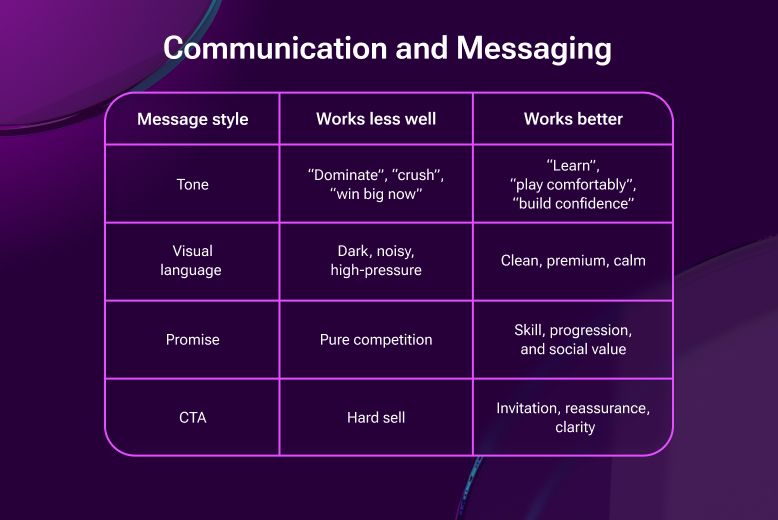
Community is one of the strongest retention mechanisms in poker. For women, it is often even more important than for the average player. Women-focused study groups, ambassador programs, bootcamps, and beginner communities transform poker from a series of isolated sessions into an ongoing experience with social texture. Players who feel connected to a community around the product behave differently from players who feel like they’re simply interacting with software. That distinction shows up in session frequency, format diversity, and long-term LTV.
Ambassador-led education, creator streams, Discord communities, and structured learning groups can make poker feel more approachable and less intimidating. They also normalize female success in the game. Visible role models — from Barbara Enright and Kristen Foxen to Leo Margets, Maria Ho, and Liv Boeree — serve as social proof that women belong at every level of poker, from casual games to elite tournaments.
For operators, community belongs inside the product logic rather than alongside it. It shortens the learning curve, builds trust, deepens engagement, and supports the kind of lifetime value that promotional budgets alone cannot manufacture.
Strategic Recommendations for Operators
The evidence points toward a straightforward conclusion: increasing female participation requires removing the unnecessary barriers inside the existing ecosystem.
Making safety and community standards visible is the logical starting point. Players should understand how moderation works, how misconduct gets handled, and what behavior is expected before they ever sit down at a table — not after their first unpleasant experience.
Onboarding deserves more investment than most operators currently give it. Clear tutorials, beginner-friendly recommendations, and educational resources tend to improve activation more effectively than larger bonuses, particularly for players whose primary barrier is confidence rather than cost.
Communities outlast campaigns. Study groups, ambassador programs, educational events, and creator partnerships build relationships that extend beyond individual sessions — the kind of social infrastructure that keeps players returning when there’s no promotional incentive pulling them back.
The player lifecycle deserves attention beyond first deposits. The objective is more players who are still active a year from now, moving up in stakes, participating in tournaments, and bringing others into the ecosystem with them. Measuring that requires tracking retention alongside acquisition — repeat play, loyalty participation, player satisfaction over time. Improvements that move those numbers create durable business value, regardless of whether they originated as product decisions, UX initiatives, or marketing programs.
Conclusion
The conversation around women in poker is often framed as representation. From an operator’s perspective, it is also a question of growth. Available evidence suggests that women enjoy poker, participate in increasing numbers, and engage strongly when the surrounding environment supports confidence and community. The challenge lies less in generating interest than in removing friction that prevents long-term participation.
As acquisition costs continue to rise across the iGaming industry, operators can no longer depend solely on bigger bonuses or larger advertising budgets to drive sustainable growth. Competitive advantage increasingly comes from better experiences, stronger communities, and higher lifetime value. Women should therefore not be viewed as a niche demographic or a diversity initiative. They represent one of the industry’s most underdeveloped growth opportunities. The operators that succeed over the next decade are unlikely to be those that simply spend the most on acquisition. They will be the ones that build environments where more players, regardless of gender, choose to stay. Because in poker, as in business, long-term value is created by keeping people at the table.
At EvenBet Gaming, we help operators build poker ecosystems designed for sustainable player acquisition and retention through flexible technology, community-focused features, and long-term engagement strategies. Want to create a poker platform that attracts and retains a broader audience? Contact EvenBet Gaming to discover how our solutions can support your growth.
FAQ
What makes online poker attractive to women players?
Poker combines strategy with a social element, making it more approachable than many gambling products. Surveys show many women are drawn to the game because it is fun, easy to learn, and available in flexible online formats that offer greater privacy and control than live environments.
What barriers do women face in online poker?
The biggest barriers are often social rather than strategic. Many women report intimidation, sexist behavior, or hostile interactions, while a lack of confidence in moderation and platform responses can discourage them from returning.
How can online poker platforms become more inclusive for women?
Operators can improve participation by creating a safer and more welcoming experience through effective moderation, clear reporting tools, beginner-friendly onboarding, and community initiatives such as educational content, ambassador programs, and study groups.