
 8 June 2026
  12 min
  132 views
 In the 2026 iGaming landscape, the battle for player loyalty is no longer fought through the sheer volume of content. With most Tier-1 operators offering libraries of 5,000+ titles, “more” has ceased to be a competitive advantage. In fact, without proper curation, an expansive portfolio becomes a liability.
The real differentiator today is Choice Architecture, a core element of casino UI design that defines how games are presented, categorized, and suggested. By understanding the psychology of decision-making, operators can transform a chaotic digital shelf into a high-conversion retention engine.
The Paradox of Choice: When Variety Kills Conversion
In theory, more options should lead to higher satisfaction. In reality, behavioral economics tells a different story. The Paradox of Choice, a concept popularized by psychologist Barry Schwartz, suggests that an abundance of options leads to anxiety and decision paralysis.
For an iGaming operator, this often shows up as bounce rate. If a player spends 30 seconds scrolling through an endless list of slots without a clear hook, they are likely to close the tab. Their brain, overwhelmed by the cognitive load, chooses the simplest path: leaving. This is where effective player retention strategies begin, with reducing friction at the moment of choice.
Applying Hick’s Law
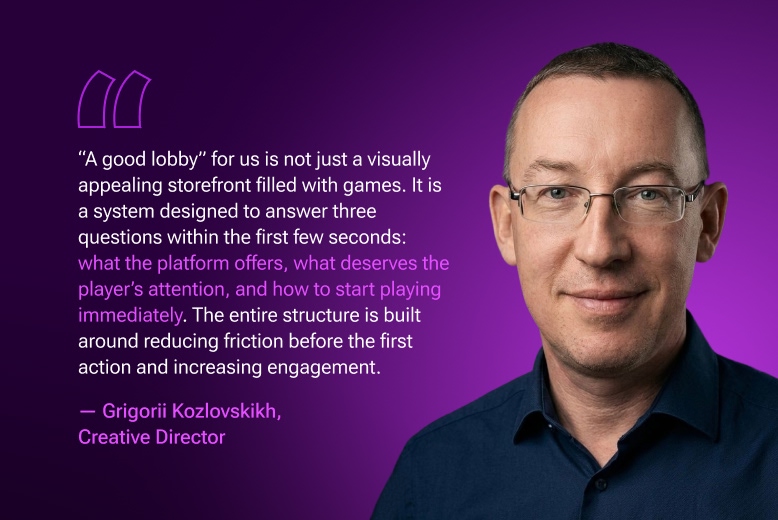
To combat this, we should look at Hick’s Law, which states that the time it takes to make a decision increases with the number and complexity of choices. The goal is to minimize the time from login to first spin or bet. The solution is to reduce the visible choice. Instead of showing 2,000 games at once, surface 5-10 curated entry points, such as “Recommended for You” or “Top Games in Your Region.” This approach is a core principle of gambling website design, where reducing cognitive load directly influences how quickly players move from browsing to action.
Nudging and Visual Hierarchy: The Silent Guide
Choice Architecture is related to nudging, designing the environment to influence behavior without forbidding any options. In practice, this is where casino UI design turns into a behavioral tool: layout, emphasis, and positioning quietly guide decisions without removing freedom.
Default Bias and Positioning
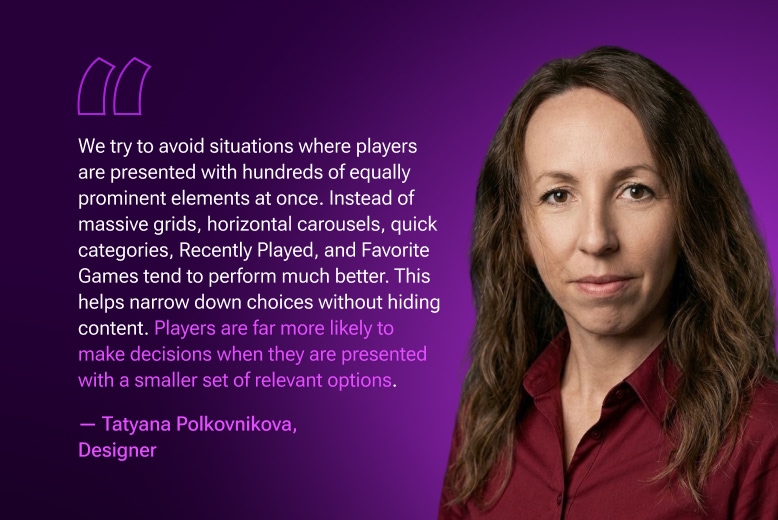
Players are psychologically predisposed to select the first items they see. This is default bias. Top-left positioning, larger game tiles, and featured banners become conversion tools. If an operator wants to promote high-margin games or new releases, the casino lobby design must reflect that priority through visual weight.
Social Proof: The “Live” Casino Feel
Online gambling can often feel solitary. Incorporating social proof into lobby design creates an atmosphere of activity and supports long-term player retention.
- “Trending Now” labels reduce hesitation by showing what others are enjoying.
- Real-time jackpot tickers create urgency and a sense of shared opportunity.
- “Hot” badges use color psychology to draw the eye toward high-activity content.
Filters and Categories: Empowerment Through Control
While too much choice is bad, a lack of control is worse. Players need to feel that they are in the driver’s seat. Modern lobby systems, especially those aligned with online casino user experience best practices, move beyond generic tabs like “Slots” or “Table Games.” Instead, we see more granular categorization based on player intent:
- By mechanics: Megaways, Hold and Win, Bonus Buy, or Cluster Pays.
- By volatility or theme: “High Risk – Big Win” vs. “Casual Play,” or “Ancient Egypt” vs. “Cyberpunk.”
- For poker: separating high-velocity formats like Spins from traditional MTTs helps players match the experience to their available time and mood.
Effective filtering reduces cognitive load by allowing the player to opt out of irrelevant content, making the final decision feel personal and earned.
Measuring Lobby Performance
A well-structured lobby should do more than look clean and intuitive — it should perform. To understand whether the architecture is working, operators need to track how quickly and confidently players move from entry to action.
Key metrics include:
- Time to first click — how long it takes a player to interact with any element after entering the lobby.
- Time to first spin or bet — the most critical indicator of how efficiently the interface converts intent into action.
- CTR from the first fold — whether the initial screen successfully guides attention toward meaningful entry points.
- Return rate to “Favorites” and “Recently Played” — a signal of habit formation and UI trust.
- Engagement uplift from personalization — whether recommendations actually reduce friction or just add noise.
- Turnover and GGR impact from featured content — how effectively the lobby promotes high-value games without disrupting the experience.
These metrics show how players move through the interface and how confidently they reach action. They also highlight where friction appears and where design decisions can be adjusted to improve player retention.
Measuring Design ROI
Interaction metrics show how players behave. Business metrics show whether the lobby creates real value. At this level, design becomes a system for scaling player retention.
Operators should focus on:
- GGR growth tied to featured and promoted content.
- LTV increase driven by faster access to preferred games.
- Churn reduction as a result of smoother decision-making.
- Cross-sell uplift between verticals enabled by better lobby navigation.
Common Mistakes: Where Lobby Design Breaks Down
Even well-intentioned lobby designs often fail at execution. These issues often weaken even strong systems and negatively affect player retention over time.
- Overloading the first screen with too many competing modules dilutes attention. When everything is highlighted, nothing stands out, and the player has no clear starting point.
- Generic categories like “Slots” or “Popular” often fail to reflect real player intent. Without meaningful segmentation, players are forced to browse instead of choose.
- Personalization can also backfire when it feels inconsistent. If recommendations change too aggressively or behave unpredictably, players lose trust in the interface.
- Another frequent issue is burying key actions too deep in the UI. If a player cannot quickly return to a familiar game or format, friction increases and drop-off follows.
- Finally, excessive use of banners, badges, and motion can turn the lobby into visual noise. Instead of guiding attention, the interface starts competing with itself.
Personalization: The End of the “One-Size-Fits-All” Lobby
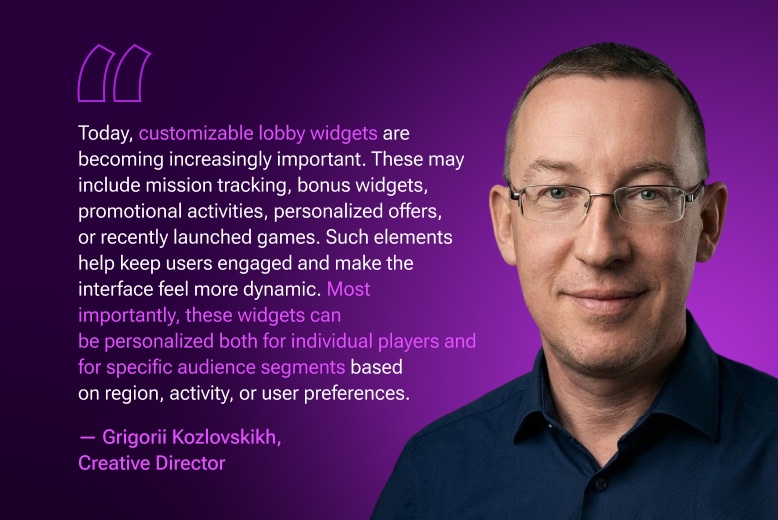
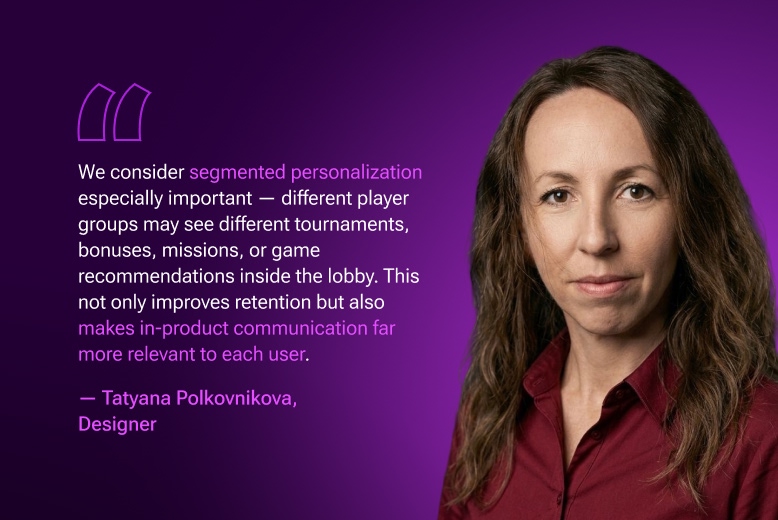
The gold standard of Choice Architecture is dynamic personalization. In 2026, a lobby should look different for a high-stakes poker pro than it does for a casual slots enthusiast.
“Recently Played” and “Favorites” are among the highest-converting modules in any UI. They bypass the decision process entirely by tapping into established habits.
AI-driven recommendation engines can use session history to suggest games with similar RTP, volatility, or themes.
Cross-vertical intelligence adds another layer: if a player has just finished a poker tournament, the lobby can dynamically surface mini-games or side slots that fit a similar risk profile, enabling seamless cross-selling without feeling intrusive.
A modern lobby adapts to behavior, using data from past sessions to surface relevant games and formats. Within advanced player retention strategies, this reduces unnecessary choice and helps players return to familiar patterns without effort.
Strategic Summary for Operators
- Audit your first fold: what do players see in the first 3 seconds?
- Implement social proof: are you showing that the platform is active and alive?
- Refine your filters: move beyond game type into game mechanics.
- Leverage habits: make “Recently Played” one of the most accessible features in the UI.
The EvenBet Perspective: Flexibility as a Retention Tool
At EvenBet Gaming, we see the lobby as the heart of the player experience. Our platform is built on flexible architecture, allowing operators to:
- Customize visual hierarchy and highlight specific tournaments or game formats based on current marketing priorities.
- Integrate poker, casino, and sports betting into a unified lobby without cluttering the experience.
- Use back-office analytics to identify underperforming categories and adjust choice architecture in real time.
FAQ
What is player retention in online casinos?
Player retention in online casinos refers to the platform’s ability to keep users engaged over time. It goes beyond simple repeat visits and includes consistent gameplay, recurring deposits, and ongoing interaction with features such as bonuses, tournaments, and loyalty programs. Best player retention strategies focus on consistency, personalization, and long-term value. High retention indicates that players find long-term value in the platform, whether through game variety, rewards, or overall experience.
Why is player retention important in iGaming?
Player retention directly impacts profitability. Operators rely on best player retention strategies to grow LTV and ease constant acquisition pressure. Bringing in new users through ads and affiliates costs more than keeping existing ones engaged, while returning players tend to spend more consistently and respond better to offers. Over time, this creates a more stable revenue flow and makes performance easier to predict.
How can online casinos improve player retention?
To improve player retention, operators combine personalization, loyalty systems, and targeted promotions with a smooth product experience. This includes offering targeted bonuses based on player behavior, implementing tiered loyalty programs, and running time-based promotions like tournaments or missions. Fast and transparent payment processing builds trust, while proactive customer support reduces frustration. Additionally, using data analytics to segment players and deliver relevant content helps maintain long-term engagement without over-relying on generic incentives.
How does UX design impact player retention?
UX plays a key role in how users interact with a platform. Effective casino UI design reduces friction and supports long-term engagement. A well-structured interface allows users to quickly find games, navigate between sections, and complete key actions like deposits or withdrawals without friction. Mobile optimization, fast loading times, and clear visual hierarchy all contribute to a smoother experience. Poor UX, such as confusing navigation, slow performance, or broken flows, creates frustration and increases churn, even if the casino offers strong bonuses or a large game library.