
 14 May 2026
  16 min
  288 views
 Brazil is quickly becoming one of the most active iGaming markets, with poker playing a central role in that growth. A large and engaged player base, combined with ongoing regulatory changes, creates a strong opportunity for operators entering the market now. For companies planning to start an online poker business, Brazil offers a compelling mix of scale and growth potential.
At the same time, launching a poker room here takes more than just going live. It requires a clear understanding of local regulation, player behavior, payment preferences, and the right product setup. Here’s what to focus on to launch an online poker room in Brazil and grow successfully.
Why Brazil Is a High-Growth Poker Market
Brazil is one of the most promising iGaming markets in Latin America. In early 2024, the country had 187.9 million internet users and an internet penetration rate of 86.6%, which shows how broad the digital audience already is.
The market is also strongly mobile-led, which matters for operators working on online poker software development, as most players expect a smooth smartphone experience. Brazil’s digital ecosystem is supported by a young population and a large social media audience of 144 million users, making it easier to build community-driven poker products.
Demand for poker is not just theoretical. The 2025 BSOP São Paulo stop recorded more than 10,000 total entries across 35 official events, which is a strong signal that competitive poker has real local traction.
From a market perspective, Brazil’s online gambling sector generated US$1.51 billion in revenue in 2024 and is projected to grow to US$3.01 billion by 2030, suggesting there is still room for new entrants to gain share.

Legal Landscape and Licensing in Brazil
Brazil’s online betting market entered a new regulatory phase on January 1, 2025, when the federal framework for licensed operations took effect under the Ministry of Finance. Operators now need authorization from the Secretariat of Prizes and Bets (SPA) to legally start a poker business in Brazil and offer regulated services.
For poker operators, this matters because poker has historically been treated more favorably than games of pure chance, but it still sits inside a broader compliance environment that includes licensing, KYC, AML, and responsible gaming requirements. The practical takeaway is that market entry is possible, but only with a serious compliance strategy and a clear understanding of the local rules.
The government has also moved to tighten enforcement against unlicensed sites, including blocking unauthorized domains and restricting payment flows. Regulation shapes commercial viability. Planning for compliance early puts operators in a stronger position to build a stable, long-term business.
Choosing the Right Poker Platform Provider
One of the most critical decisions when launching a poker room is whether to build from scratch or work with a poker app development company or turnkey provider. Custom development offers total control but demands 12–18 months and millions in upfront costs, making it impractical for most operators entering competitive markets like Brazil. Turnkey or white-label platforms, by contrast, enable launches in 2–4 months at a fraction of the cost while delivering enterprise-grade reliability.
When selecting a provider to create poker game online, prioritize these proven capabilities:
- Comprehensive game portfolio: Cash games, MTTs, Sit & Go, and fast-fold formats tailored to local preferences like low-stakes tournaments.
- Flexible monetization: Customizable rake structures (capped, percentage-based) and rakeback tiers to optimize revenue and player loyalty.
- Robust security: Real-time anti-collusion detection, bot prevention via behavioral AI, and DDoS protection to maintain fair play.
- Brazil-specific localization: Native Brazilian Portuguese (PT-BR) support, local currency handling (BRL — Brazilian Real), PIX integration (the country’s dominant instant payment system), and culturally adapted UX with vibrant visuals and social features tailored to local player preferences.
- Mobile-first architecture: Progressive web apps or native clients optimized for Brazil’s 96%+ mobile internet penetration.
Providers with LATAM experience navigate regional challenges such as payment volatility and regulatory shifts more efficiently, enabling faster time-to-market.
Payments and Local Preferences
Payments are one of the biggest success factors for any online poker platform in Brazil and one of the most common reasons for failure when ignored. PIX, the Central Bank’s instant payment system launched in 2020, has nearly 80% usage among iGaming bettors for deposits and withdrawals due to its 24/7 speed, low/no fees, and mobile convenience.
In 2025 alone, PIX processed 79.8 billion transactions worth R$35.36 trillion (~$6.7 trillion USD), averaging 219 million daily, making it the backbone of Brazil’s digital economy and essential for poker rooms targeting instant deposits.
Key integration priorities include:
- PIX for seamless, real-time deposits/withdrawals
- Local backups like Boleto Bancário, Elo cards, and e-wallets (Skrill, PicPay)
- Fast payouts (under 24 hours) to build trust and reduce churn
- Fraud tools like velocity checks and geolocation to combat chargebacks
Operators without native PIX support often see high abandonment rates and struggle with acquisition. For any poker room development in Brazil, payment integration should be treated as a core feature, not an add-on.
Player Acquisition and Marketing Strategy
Brazil is a highly competitive, socially driven market where acquisition costs are rising but opportunities remain massive. In 2025, the online betting sector invested R$1.44 billion (~$261 million USD) in TV and radio advertising alone, while digital ad spend for gaming/betting surged 192% year-over-year, underscoring the need for efficient, multi-channel strategies.
Proven channels include:
- Affiliate marketing: Still the top traffic source for iGaming, driving high-quality deposits amid SEO shifts and regulation.
- Influencers and streamers: Local poker Twitch stars like Léo Jokura and Jon Vlogs reach engaged communities, blending entertainment with conversions.
- Social media: half of digital ad spend goes here (Instagram, TikTok, YouTube), fueling viral campaigns and Telegram groups.
- Events and tournaments: Series like the Brazilian Series of Poker build player interest, while online events help attract new users and drive FTDs (first-time deposits).
Bonuses are expected, typically up to a 100% first deposit match with rakeback, and should be capped to protect margins. Community channels like Discord and Telegram help retain players and build long-term engagement. For operators building an online poker platform Brazil, blending affiliates, influencers, and social is essential to achieve sustainable acquisition.
Game Formats
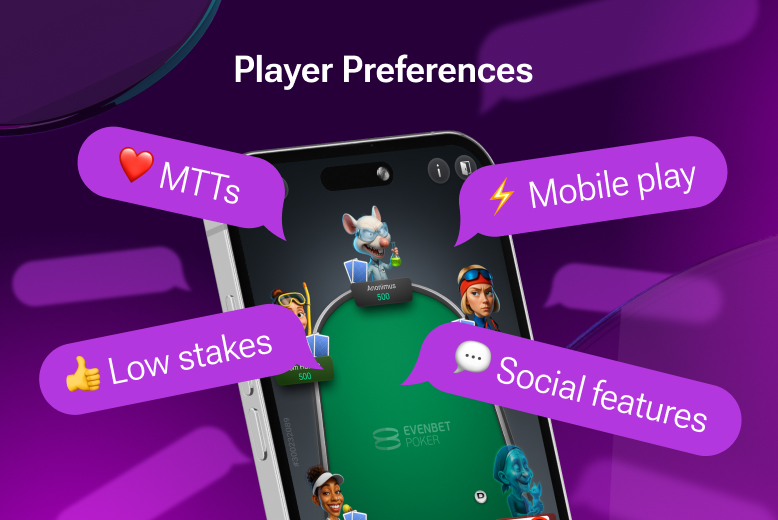
Brazilian poker players show clear preferences shaped by local culture, mobile habits, and a love for competition. No-Limit Texas Hold’em dominates as the top format, alongside growing interest in Omaha variants, which thrive on action and higher variance.
Tournaments are hugely popular, especially MTTs, re-entries, Mystery Bounty (a Brazilian favorite with random prize pools up to $1M), and series like BSOP or online equivalents, drawing enthusiasts seeking adrenaline and big payouts. Low-to-mid stakes prevail, with accessible buy-ins ($5–$50) suiting the recreational majority.
Fast-paced mobile formats like fast-fold poker align perfectly with Brazil’s 96%+ mobile internet penetration.
Social gamification boosts stickiness: leaderboards, achievements, missions, and chat features tap into Brazil’s competitive, community-driven style, turning casual play into loyal habits.
For teams working on online poker software development, this means prioritizing mobile UX, tournament formats, and social features that drive engagement.
Retention Strategies That Work
Acquiring players is only half the challenge. Operators who start an online poker business in Brazil and focus on retention early see better performance over time. A 10% increase in retention can significantly lift LTV in high-CAC LATAM environments.
Proven mechanics:
- VIP and loyalty programs: Tiered cashback and freerolls appeal to players’ sense of progress and status.
- Rakeback: 20–40% weekly or monthly helps retain high-frequency players.
- Tournaments: Weekly MTTs and series formats create anticipation and repeat engagement.
- Personalization: CRM-driven offers like a 50% reload after a losing streak help bring players back.
CRM tools, loyalty systems, and personalized offers are essential parts of any modern strategy of poker room development in Brazil.
Technology and Infrastructure
A stable infrastructure is critical for any poker app development company handling real-time action and peak-hour surges. Downtime or lag directly costs rake, top platforms target 99.99% uptime and sub-100ms latency worldwide.
Key requirements:
- Low-latency servers: Edge nodes in São Paulo + WebSockets for smooth mobile play (Brazil’s 96%+ smartphone users).
- High reliability: Auto-scaling, redundant systems for MTT peaks and 24/7 uptime.
- Security: End-to-end encryption, AI anti-collusion/bot detection, DDoS protection.
- Integrations: PIX payments, CRM tools, analytics platforms, compliance modules.
Turnkey solutions simplify this by bundling everything needed (Redis sessions, AWS/Google Cloud edge) to create poker games online without heavy internal development. In Brazil’s fast-moving market, this lets operators focus on growth, not infrastructure headaches.
Timeline and Cost to Launch
Launch timelines vary dramatically by approach: custom online poker software development takes 12–24 months, while turnkey/white-label platforms deliver go-live in 2–4 months (sometimes 4–6 weeks for minimal customizations). In Brazil, add 2–3 months for SPA licensing post-2025 regulations.
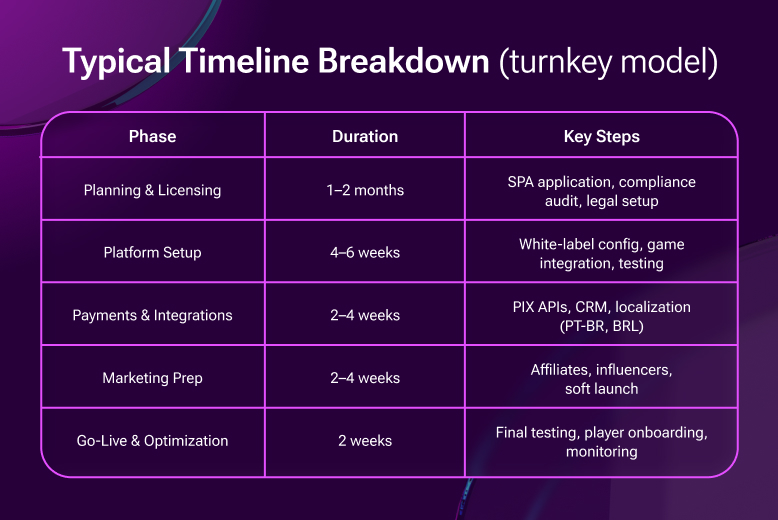
A minimal launch setup can start from approximately $38K–$70K, covering platform access, basic legal setup, payment integration, and initial configuration.
In practice, operating and growing over the first 3 months usually requires a budget in the range of $130K–$180K, depending on marketing intensity and operational scale.
A turnkey approach reduces time and upfront technical effort, allowing operators to focus more budget on acquisition and growth in Brazil compared to full-scale online poker software development.
Common Pitfalls to Avoid
Many operators underestimate the specifics of poker room development in Brazil and run into avoidable issues. Addressing them early helps build a more stable and scalable setup.
The most common mistakes include:
- Ignoring PIX payments: Without instant PIX integration, many users drop off at the deposit stage. Players expect fast, seamless transactions available at any time.
- Weak localization: Poor Brazilian Portuguese (PT-BR) or generic English interfaces reduce trust. Missing cultural context also affects engagement.
- Overly aggressive bonuses: Large welcome offers may attract low-value users and hurt profitability. More balanced incentives tend to perform better long term.
- Compliance gaps: Regulatory requirements are evolving, and lack of preparation can disrupt operations. Early alignment with local rules reduces risk.
Operators that focus on fast local payments, proper localization, balanced incentives, and regulatory readiness are better positioned to build sustainable growth in Brazil.
Why Partnering with EvenBet Accelerates Launch
Brazil combines strong demand, improving infrastructure, and a still-forming competitive landscape in online poker. This creates a solid entry window for operators who move early.
Success in this market depends on a few fundamentals: strong localization, reliable payments, and a product that fits local player behavior. For companies looking to start a poker business in Brazil, speed and execution matter.
EvenBet Gaming offers a ready-to-launch poker platform with:
- fast deployment and shorter time-to-market
- flexible customization for different business models
- built-in tools for player engagement and retention
- stable performance across multiple markets
This setup helps operators focus on growth and marketing while relying on a scalable and reliable technical foundation.
FAQ
Is online poker legal in Brazil?
Online poker operates in a gray area but became more clearly regulated after the 2025 betting law (Law 14.790/2023). The framework legalized sports betting and iGaming under government oversight and generally treats poker as a skill-based game. Operators are expected to follow KYC and AML requirements when building an online poker platform in Brazil.
Do I need a license to start an online poker platform?
Yes. Since 2025, operators need authorization from Brazil’s Secretariat of Prizes and Bets (SPA) to legally start a poker business in Brazil. The license is issued for five years and requires compliance with local rules, including taxes, responsible gaming, and domain registration. Offshore setups may work short-term but carry increasing risks as regulation tightens.
What features are essential for an online poker platform?
A solid setup includes core game formats (cash games, tournaments, Sit&Go, fast-fold), flexible rake and rakeback, and a mobile-first experience. Local payment methods like PIX and full Brazilian Portuguese (PT-BR) support are also essential. For teams working on online poker software development, additional features like CRM, social tools, and scalable infrastructure help drive growth and retention.