
 22 May 2026
  Upd: 1 June 2026
  13 min
  71 views
 In online poker, poker platform structure affects much more than product setup. It influences liquidity, operational workload, growth flexibility, and how efficiently a business can expand into new markets. That is why the choice between a poker skin and a poker network is not just a technical decision, but a strategic one. For some operators, a skin is the fastest way to enter poker with lower risk and lighter operations. For others, growth eventually makes deeper control, broader scaling, and stronger ecosystem ownership the better path.
Why the Choice Matters More in Poker Than in Other Verticals
Unlike casino games, poker depends heavily on liquidity. The player experience is shaped by how many users are active at the tables, participating in tournaments, and generating traffic throughout the day.
A poker platform with weak liquidity often struggles with retention and engagement, even with strong branding or promotional mechanics. Because of this, infrastructure strategy plays a major role in long-term poker growth. Operators entering a competitive online poker ecosystem often prioritize liquidity access and faster launch timelines over full infrastructure ownership.
Most operators choose between two approaches:
- launching a poker skin connected to an existing liquidity ecosystem;
- or building a poker network with greater control over liquidity distribution and ecosystem management.
Each model supports different operational goals, scaling strategies, and levels of infrastructure ownership. The main difference between poker network and skin models comes down to liquidity control, operational complexity, and infrastructure ownership.
When a Poker Skin Makes More Sense
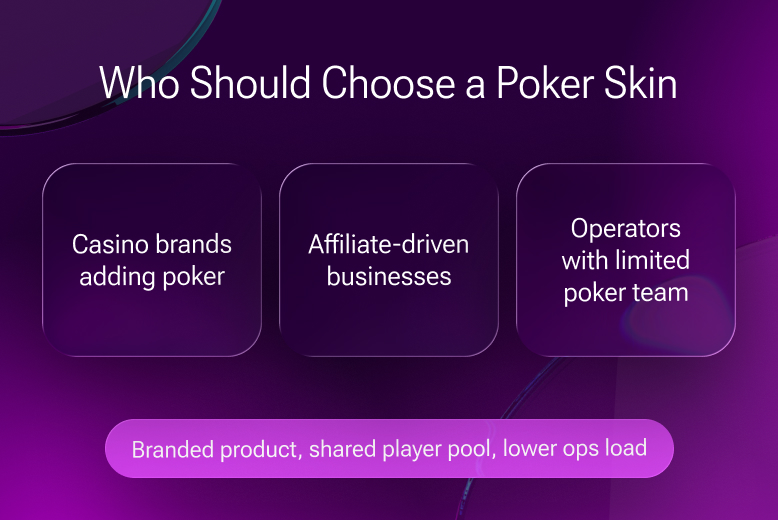
A poker skin is often a practical choice for operators entering poker for the first time or expanding an existing gaming business with an additional vertical. For businesses researching “What is a poker skin?”, the model is essentially a branded poker room connected to an existing liquidity environment. The model allows operators to launch a branded poker room connected to an existing liquidity pool. Access to an active player ecosystem helps reduce one of the biggest challenges in poker operations: generating stable traffic from the earliest stages.
The skin approach also reduces operational complexity. In business terms, poker skins are explained through faster launch timelines and simpler operations. Operators can focus more heavily on:
- acquisition,
- retention,
- branding,
- marketing strategy,
- cross-selling existing casino audiences.
At the same time, much of the backend infrastructure, platform maintenance, and liquidity management is handled within the broader network environment. This approach is especially relevant for:
- casino brands expanding into poker,
- affiliate-driven businesses,
- regional operators testing demand,
- companies without a dedicated poker operations team.
For these businesses, faster launch timelines, lower operational load, and easier market entry are often higher priorities than full ecosystem ownership.
Why Many Operators Start with a Skin
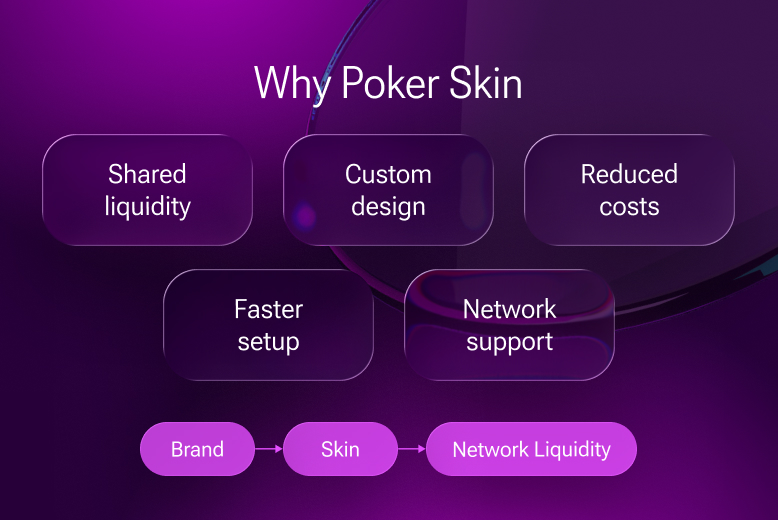
Poker skins are explained best as a practical entry model for operators that want to launch a branded poker room without building the full infrastructure from scratch. The skin connects to an existing liquidity environment, which helps solve one of poker’s biggest early-stage problems: getting enough active players to keep the product alive and engaging.
This is why many operators start with a skin instead of building a network right away. The model reduces pressure on the team and lets the business focus on acquisition, retention, branding, and cross-sell rather than backend complexity. For casino brands, affiliates, and regional operators, that usually makes the first step into poker much more manageable.
When the Skin Model Starts Becoming a Bottleneck
The difference between poker network and skin becomes more visible as the business grows. A skin works well when the priority is speed, simplicity, and shared liquidity. But once the operator wants deeper control over liquidity distribution, partner structures, brand expansion, or custom tournament logic, the skin model can start to feel restrictive.
At that stage, the business may need more than a branded front end. It may need stronger ecosystem control, more flexible commercial terms, better reporting, and the ability to manage multiple brands or regions under one structure. That is usually the point where operators begin evaluating whether it is time to move from a skin into a network model.
When Building a Poker Network Becomes the Better Move
For operators evaluating “What is a poker network?”, the model focuses on liquidity ownership, ecosystem management, and long-term scalability. A poker network becomes more relevant once poker grows into a core part of the business strategy rather than an additional gaming vertical. In this model, the operator manages the broader liquidity ecosystem and gains more flexibility in how traffic, brands, and partnerships are structured. A poker network gives operators greater control over how they position themselves within the broader online poker ecosystem.
Understanding how poker networks work becomes increasingly important once operators begin managing traffic across multiple brands or regions. A poker network can support:
- liquidity aggregation across multiple brands,
- direct traffic distribution management,
- partner and affiliate integration,
- more flexible commercial structures,
- deeper operational customization,
- long-term infrastructure scaling across markets.
At this stage, poker operations often shift toward ecosystem management, liquidity coordination, and multi-brand growth strategy. This approach is commonly chosen by:
- experienced poker operators,
- multi-brand gaming businesses,
- companies with established acquisition channels,
- operators expanding into multiple regions,
- businesses investing in long-term poker infrastructure development.
A network model also requires stronger operational capabilities, including infrastructure management, compliance processes, liquidity operations, and partner coordination.
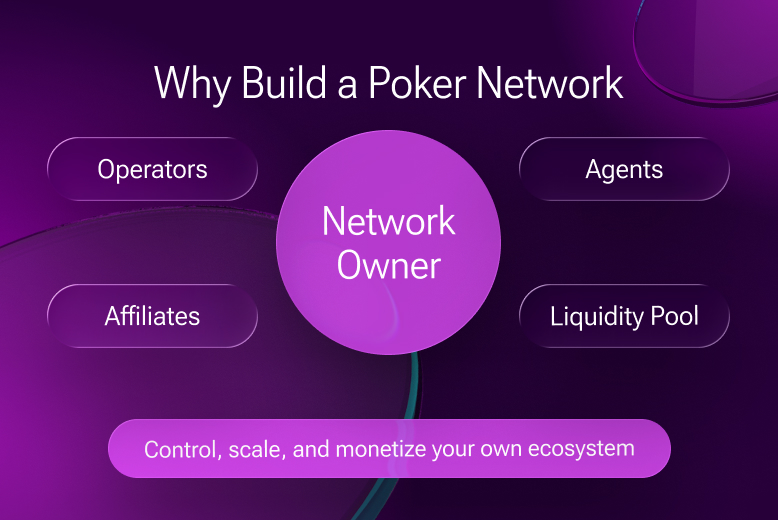
The Hidden Cost of Control
Understanding how poker networks work means looking beyond ownership and flexibility. A network gives the operator more control over the full ecosystem, but that control comes with a heavier operational burden. The business becomes responsible for liquidity management, compliance, anti-fraud systems, partner coordination, technical stability, and the overall health of the poker environment.
That is the trade-off many operators underestimate. A network can unlock stronger long-term scale, but it also demands more internal capability, more process discipline, and more ongoing oversight. For some businesses, that responsibility is exactly what they want. For others, the skin model remains the better fit because it keeps operations lean and predictable.
The Evolution Path: From Skin to Network
In practice, many successful poker businesses do not choose between skin or network forever. They evolve from one model into the other. A common growth path looks like this:
- Launch a poker skin to enter the market quickly.
- Use shared liquidity to acquire and retain players.
- Build internal poker expertise and operational knowledge.
- Validate regional demand and acquisition economics.
- Expand into a network model once scale justifies deeper infrastructure ownership.
This progression reduces risk while still creating a path toward long-term ecosystem control. For many operators, that transition is more sustainable than attempting to build a network too early.
So Which Model Is the Better Choice?
The answer depends less on ambition and more on operational readiness.
A poker skin is often the better choice when:
- speed matters,
- operational simplicity matters,
- poker is still being validated,
- shared liquidity is strategically important,
- the business wants lower infrastructure overhead.
A poker network becomes more attractive when:
- poker is becoming a long-term strategic vertical,
- the operator already has traffic scale,
- multiple brands or partners are involved,
- ecosystem ownership matters more than launch simplicity,
- the company is prepared for greater operational responsibility.
In other words:
- Skins optimize market entry.
- Networks optimize long-term ecosystem control.
Both models can be highly successful when aligned with the right business stage. For operators comparing poker network vs poker skin approaches, the right decision usually depends on growth stage, internal expertise, and long-term infrastructure plans.
Final Thoughts on Poker Network vs Poker Skin
The most effective poker infrastructure strategy is usually the one that matches the operator’s current operational maturity, growth goals, and liquidity strategy. For some companies, a poker skin remains the most efficient long-term solution because it minimizes complexity while providing strong liquidity access. For others, building a poker network becomes the natural next step once poker grows into a larger ecosystem business. The key is understanding not only where the business is today, but also where it is likely to grow next.
Whether the goal is fast market entry or building a scalable poker ecosystem, choosing the right infrastructure model early can significantly impact long-term growth, operational efficiency, and player retention. For operators evaluating both approaches, EvenBet Gaming offers both poker skin and poker network solutions designed for different stages of business growth from fast market entry to scalable multi-brand poker ecosystems.
FAQ
What is a poker network?
A poker network is a shared online poker ecosystem where multiple brands or poker rooms operate on the same backend and liquidity pool. This means players from different rooms can sit at the same tables, enter the same tournaments, and compete in one combined environment. For operators, the main advantage is that the network helps solve the liquidity problem by concentrating traffic instead of splitting it across separate rooms. It also gives the operator more control over the ecosystem, including product configuration, commercial terms, partner structures, and long-term scaling strategy.
What is a poker skin?
A poker skin is a branded poker room that runs on top of an existing poker network. It usually has its own name, design, marketing, and player-facing experience, but relies on the network provider for shared liquidity, software, and much of the technical infrastructure. This model is often chosen by operators who want to enter poker quickly without building a full standalone platform. It is especially useful for casino brands, affiliate businesses, and operators that want to add poker as an additional vertical with lower operational risk and faster time to market.
What is the main difference between a poker network and a poker skin?
The main difference is the level of control and ownership. A poker skin gives the operator a faster and simpler way to launch, but much of the infrastructure is managed by the network provider. A poker network, on the other hand, gives the operator much deeper control over liquidity, branding architecture, partner management, and commercial strategy. In practical terms, a skin is usually better for entry and validation, while a network is better for long-term scale and ecosystem ownership.
Which model is better for early-stage operators?
For most early-stage operators, a poker skin is the better option because it lowers the barrier to entry. It allows the business to launch faster, rely on shared liquidity, and avoid the cost and complexity of building an entire poker infrastructure from scratch. This makes it easier to test demand, understand player behavior, and validate whether poker can become a meaningful part of the business. A network may offer more upside later, but at the start, the skin model is usually the more practical and efficient choice.