
 20 May 2026
  18 min
  283 views
 Every poker product wants the same outcome: turn a first-time visitor into a long-term player. In 2026, the strongest poker platforms increasingly function as progression products, combining core gameplay with missions, status systems, visible milestones, and identity-building rewards that keep players returning over time.
Gamification in poker works best when viewed as a player journey. A user enters the room as a Level 1 newcomer with low commitment, uncertain goals, and little attachment to the brand. The operator’s task is to guide that player through evolving layers of motivation: curiosity, routine, status, and identity.
This progression aligns closely with Self-Determination Theory. Richard Ryan and Edward Deci describe motivation through three core needs: autonomy, competence, and relatedness. In poker, players need freedom of choice, visible progress, and a sense of connection that extends beyond individual hands or balance fluctuations.
That perspective also clarifies how gamification should evolve across the player lifecycle. Newcomers need guidance. Regulars respond to momentum and progression. VIPs look for status, recognition, and continuity. The real goal is to make progression feel emotionally meaningful at every stage of the player journey.
Stage 1: Newcomer to regular, days 1-7
The first seven days focus on reducing friction and building confidence. Many new poker users leave because the product fails to provide a clear starting path. Excessive choices, limited context, and a lack of visible early wins can make the experience feel directionless before habit formation begins.
Flow Theory helps explain this pattern. Mihaly Csikszentmihalyi describes engagement as strongest when challenge and skill stay balanced, goals remain clear, and feedback arrives quickly. In poker onboarding, new players benefit from simple and understandable actions that create immediate signs of progress instead of overloaded races, layered mechanics, or complex status systems.
Learning Loop: Teach First, Retain Second
One of the biggest opportunities in poker gamification lies in treating progression as a learning process. Online poker gamification can function as both a retention loop and a competence-building system. Early sessions can guide players through discovery, familiarization, and confidence-building instead of repetitive actions tied to generic rewards.
Onboarding missions work especially well in this context. A newcomer might complete a tutorial hand, play three freerolls, try a micro-stakes cash session, and unlock a first achievement. Quests, achievements, and personalized poker challenges become tools that create progression and purpose inside poker platforms.
These missions also teach the product itself. They introduce key formats, clarify what an early successful session looks like, and direct players toward the next meaningful action. The mission gradually becomes part of the onboarding experience, helping users build familiarity and confidence through guided interaction.
Daily Streaks and First-Week Momentum
After players complete a few beginner tasks, streak mechanics can help connect separate sessions into a recognizable pattern of activity. Returning on day three carries a sense of accumulated momentum and visible progression toward the next milestone.
Streak systems also create value beyond monetary or cosmetic rewards and remain one of the most reliable strategies to keep poker players engaged longer across repeated sessions. The feeling of continuity itself becomes part of the motivation to return. In poker products, this can take the form of low-pressure streaks, milestone badges, small multipliers, or soft progression boosts that encourage regular engagement while keeping the experience comfortable and sustainable.
Adaptive Goals in Onboarding
The next layer is relevance. New players behave differently, so beginner missions benefit from adapting to individual preferences and play patterns. Smartico highlights personalized challenges built around user behavior, skill level, and preferred formats. A player exploring fast formats might receive short-session missions, while someone leaning toward Omaha or MTTs can see tasks connected to those experiences.
This approach allows onboarding systems to learn alongside the player journey. Early gamification starts identifying preferred formats, session habits, and progression patterns, then adjusts future content accordingly. The experience becomes more responsive, contextual, and aligned with the type of player the user is gradually becoming.
Stage 2: Regular to VIP, days 8-30
By the second or third week, the player has usually moved beyond basic orientation. The focus shifts toward momentum, structure, and visible progression inside the ecosystem. Activity starts carrying social and competitive meaning, strengthening long-term player engagement in poker ecosystems.
Social proof also becomes increasingly important at this stage. Rankings, consistency markers, and visible milestones help players attach meaning to continued activity. Poker already contains a strong competitive foundation, and gamification can extend that sense of competition across longer periods of time instead of tying it only to the outcome of individual tables or tournaments.
Dynamic Leaderboards as Local Status
A strong leaderboard does more than display volume. It creates an attainable social ladder that gives players a realistic sense of progression. Segmented leaderboards tend to work especially well because they create local status: top weekly PLO player in a region, top micro-stakes tournament climber, or top improver within a specific format.
This changes the role of ranking systems inside poker platforms. Visibility and recognition become relevant far beyond the highest-volume players. Someone who ignores a global race may still care deeply about reaching number three on a format-specific board that feels achievable and personally meaningful.
Industry trends also show poker platforms increasingly borrowing progression structures from multiplayer games, including layered ranks, progression tracks, and short-cycle competitive loops. The leaderboard gradually becomes part of the broader progression system, supporting ongoing motivation and reinforcing routine participation across the mid-stage player lifecycle.
Team Challenges and Social Belonging
Shared status often becomes the next layer after individual progression. Team challenges broaden participation by giving players a way to contribute regardless of whether they are top-ranked performers. This connects closely to relatedness, one of the three core needs in Self-Determination Theory, which can receive less attention in poker products centered primarily around solo competition.
Shared goals, club challenges, and squad-based progression systems can strengthen social belonging while preserving poker’s core competitive structure. Players remain individually responsible at the table, while their volume, mission completion, or challenge progress also contributes to a collective identity. Recreational and mid-core cohorts often engage strongly with collaborative achievement systems that create a sense of participation, contribution, and shared progression.
Status as a Retention Tool
At this stage, progression systems start revolving more around status and identity than around simple rewards. Regular players often look for visible signals that their activity and consistency carry meaning inside the platform. Leaderboard placements, rank icons, team titles, and public achievement markers can reinforce that feeling of recognition and presence.
The player experience also begins shifting from routine participation toward social meaning. Sessions become connected to movement inside a broader system of standing, progression, and visibility within the ecosystem.
Stage 3: VIP to Legend, day 30 and beyond
Long-term retention is where modern poker player retention strategies start centering on identity and emotional attachment. At this stage, players already understand the product, follow established routines, and recognize the rewards structure. The focus shifts toward maintaining long-term investment in a specific ecosystem and strengthening the sense of belonging attached to that platform.
Identity becomes increasingly important in sustaining that connection. Mature players often stay engaged when the platform gives them ways to accumulate meaning, recognition, and continuity over time. Cosmetic layers, prestige ladders, collections, and long-horizon loyalty systems all support that deeper sense of progression inside modern poker UX.
Collection Systems and Deep Progression
One of the clearest developments in modern poker design is the shift from isolated achievements toward persistent collection and progression systems. Modern gamified poker platforms increasingly use long-term level structures, visible advancement paths, and game-like milestone tracking that extends across months or even years of activity.
Collection systems also change the emotional texture of retention. Players stop focusing only on single achievements or short-term payouts and begin building a recognizable profile, progression history, and sense of ownership over time. That accumulated identity creates a stronger long-term attachment to the platform and gives progression a more personal dimension.
Prestige Levels and Cosmetics
This is the stage where status gradually becomes identity. Prestige systems create visible signals of endurance, participation, and belonging. Non-decaying ranks, exclusive profile frames, custom avatars, collectible cosmetics, and table-side markers all reinforce the feeling that the platform recognizes a player’s long-term journey.
These design patterns have also become more common as poker platforms adopt progression and expression systems inspired by multiplayer games. Personalization, collectability, and visual identity now play a larger role in sustaining engagement over time. In that context, cosmetics function as markers of accumulated status and long-term participation within the ecosystem.
AI-Personalized Roadmaps
The next frontier involves adaptive long-term progression systems shaped around player behavior and preferences. A player who consistently engages with Omaha challenges, leaderboard competition, and prestige mechanics can gradually move into a deeper progression path connected to that format. Casual tournament players may follow a lighter, event-driven progression structure aligned with shorter sessions and lower commitment patterns.
At this stage, gamification starts functioning as a broader orchestration layer inside the product experience. The system continuously interprets behavior patterns, identifies likely preferences, and adjusts progression routes accordingly. This creates a more responsive and personalized retention structure built around evolving player identity and engagement style.
2026 Trends: What Is Actually Changing
The biggest shift in gamification in poker is no longer the existence of missions, achievements, or loyalty systems. The real change lies in how these systems are integrated into the product experience. Modern poker retention design is becoming more adaptive, mobile-native, social, and identity-driven.
1. Poker UI Is Becoming More Game-Like
Poker interfaces increasingly use progression structures associated with multiplayer games: progress bars, tier systems, cosmetic customization, mission loops, and visible social markers. Progression now occupies a more central place in the interface instead of remaining hidden inside secondary loyalty menus or back-office reward sections. The UI itself participates in retention by continuously visualizing advancement and status.
2. Mobile-First Retention Design Is Shaping Engagement Loops
Mobile usage continues dominating online poker traffic, which changes how retention systems are structured. Shorter sessions, clearer progression signals, lightweight mission prompts, and low-friction interaction patterns become more important when engagement happens through fragmented mobile sessions and smaller screens.
3. Loyalty Systems Are Becoming More Persistent
Long-term loyalty design is shifting toward stable progression and reduced status volatility. More poker platforms now use extended tier protection, longer progression windows, and systems that preserve accumulated status over time. This creates a more durable sense of continuity and reduces the pressure associated with constant rank maintenance cycles.
4. Personalization Is Moving Into the Core Product Layer
In modern online poker gamification, personalization increasingly shapes the mission and progression system itself rather than remaining limited to CRM flows or marketing automation. Challenges, milestones, and progression paths can now adapt directly to player behavior, preferred formats, and engagement patterns, making retention systems feel more contextual and less repetitive.
5. Social Expression Is Becoming Part of Poker UX
Modern poker products increasingly include visual identity systems such as avatar customization, profile cosmetics, collectible markers, and expressive social layers. Self-expression has become a standard expectation across digital entertainment products, and poker platforms are allocating more interface space to identity, personalization, and visible long-term progression.
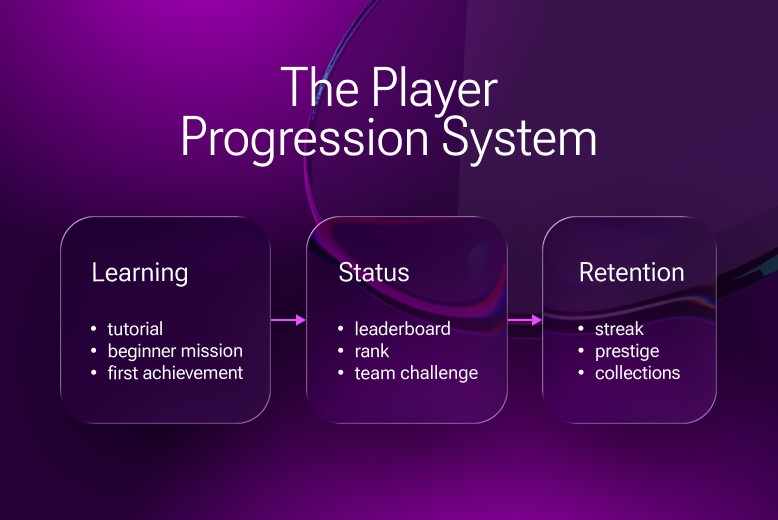
Learning, status, and retention loops
A useful way to summarize how gamification increases retention is through three connected progression loops that work together inside the player lifecycle rather than existing as isolated promotional features.
- The first is the learning loop. Onboarding missions, tutorials, low-pressure goals, and adaptive early tasks help players understand the product, build familiarity, and experience competence during the first sessions.
- The second is the status loop. Segmented leaderboards, team progression, public achievements, and visible ranks give activity social meaning while reinforcing consistency through recognition and visible standing inside the ecosystem.
- The third is the retention loop. Streaks, prestige ladders, collections, loyalty tiers, and long-term identity systems strengthen continuity and emotional attachment over time, helping routine participation evolve into long-term investment.
Many operators focus heavily on the retention layer while underdeveloping the earlier stages of progression. More effective systems usually develop in sequence: onboarding and competence first, visible status and social meaning next, long-term prestige and identity afterward.
Metrics: what moves, and why
The metrics section becomes much more useful when different mechanics are connected to specific behavioral outcomes instead of treating gamification as a universal growth lever.
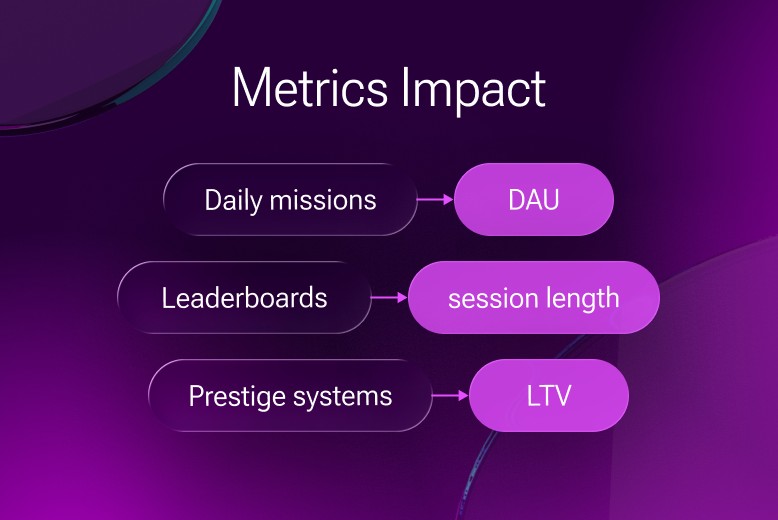
DAU responds most directly to daily missions, streak systems, and short-cycle challenges because these mechanics create immediate reasons to open the product consistently. Industry case studies and engagement-focused gaming data also suggest that missions, leaderboards, and collaborative progression systems can significantly improve recurring daily activity and overall player engagement in poker products.
Session length is influenced more strongly by visible near-completion states. Players who are close to finishing a mission, maintaining a streak, or climbing past a nearby leaderboard position often stay engaged longer to complete that progression step. Short and transparent progress systems can extend sessions naturally by creating momentum and continuation pressure.
LTV develops through the combined effect of the full progression journey, which is why advanced poker player retention strategies increasingly combine onboarding, status systems, and long-term identity mechanics. Products that help players learn the ecosystem, establish routines, gain recognition, and build long-term identity tend to create more durable engagement patterns over time. Loyalty systems, personalized progression, and stable long-horizon status structures can strengthen emotional attachment while increasing long-term commercial value per player.
Gamification in Poker: From Newcomer to Legend
The strongest poker gamification strategies in 2026 treat players as participants in a progression journey shaped by different motivational needs over time. Newcomers look for guidance and clarity. Regular players respond to momentum and visible progression. VIP cohorts value recognition and status. Long-term players engage more deeply with identity, collectability, and continuity.
The most important shift is conceptual. Gamification works more effectively when viewed as a connected retention roadmap rather than a collection of isolated features. Strong systems usually develop in sequence: learning and onboarding first, status and social meaning next, prestige and identity afterward.
For operators, the practical 2026 priorities are relatively clear:
- Integrate adaptive mission systems tied to player behavior and preferred formats.
- Build segmented leaderboards that create achievable and socially meaningful progression.
- Introduce team challenges and shared progression systems that strengthen participation and relatedness.
- Expand prestige layers through cosmetics, collections, and persistent status structures.
- Design progression visibility around mobile-first engagement patterns, where most poker traffic now exists.
The future of poker retention depends more on structuring progression in a coherent way across the entire lifecycle. This also explains why gamification works in online poker platforms: the strongest products create journeys players can learn through, progress within, and gradually attach part of their identity to over time.
If you are looking to build stronger poker player retention strategies through missions, leaderboards, loyalty systems, or long-term progression mechanics, the team at EvenBet Gaming can help design and implement retention features tailored to your poker platform and player audience.
FAQ
What is gamification in poker?
Gamification in poker is the use of game-like progression systems outside the hand itself, such as missions, leaderboards, achievements, streaks, and rewards. The goal is to make the product feel more engaging, give players a sense of progress, and create reasons to return more often.
How do leaderboards affect poker player behavior?
Leaderboards influence behavior by adding competition, status, and urgency. When players can see their rank, they are more likely to play longer, return more often, and push to improve their position, especially if the leaderboard is segmented and feels achievable.
Why are achievements important in poker platforms?
Achievements are important because they make progress visible and memorable. Instead of letting a player’s activity feel invisible, achievements mark milestones, reinforce identity, and give players a reason to keep building their profile over time.
How does gamification improve player retention?
Gamification improves retention by creating repeatable reasons to come back. Daily goals, streaks, and rewards turn poker into a habit loop, while leaderboards and achievements add long-term motivation, which can increase DAU, session length, and LTV.