
 30 July 2026
  16 min
  2 views
 For years, many iGaming platforms were built around the same promise: one product that could support almost any operator. Turnkey and white-label solutions made launching faster and easier, while bundled services reduced the complexity of entering the market. For operators looking to get started quickly, this approach often made perfect sense.
The industry, however, has become far more diverse. Today, operators differ in the markets they serve, the regulations they face, the teams they build, and the strategies they pursue. Some are entering their first regulated jurisdiction, others are expanding across multiple regions, while established brands focus on player retention, operational efficiency, and product differentiation.
As a result, platform selection has become less about comparing feature lists and more about understanding business priorities. The same technology can solve very different challenges depending on the operator’s objectives, available resources, and market environment. As a result, operators increasingly look for iGaming solutions that fit their business model, rather than a universal platform that promises to do everything.
That’s why the conversation is shifting from “Which platform should we choose?” to “What business problem are we trying to solve?” Once that question is answered, the right combination of technology, integrations, and services becomes much easier to identify.
Different goals, different realities
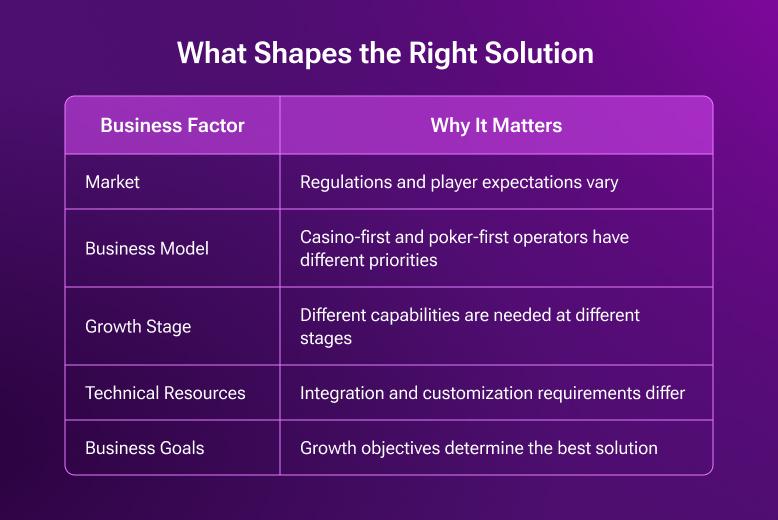
No two iGaming operators have the same business context. They enter different markets, work under different regulatory frameworks, operate with different budgets, and build teams with different levels of in-house expertise. Growth strategies vary just as much, shaping the technology, services, and level of flexibility each business requires.
A company launching its first brand typically focuses on building an efficient operating model, managing costs, and reaching the market with limited internal resources. Regional operators often balance expansion across multiple jurisdictions with localisation, player retention, and operational efficiency. Enterprise operators manage complex product ecosystems, multiple brands, dedicated product teams, and large-scale CRM operations, making integration, customization, and governance central to their technology strategy. These differences also shape the turnkey vs custom iGaming platform decision, as operators at different stages of growth rarely benefit from the same technology approach.
Business priorities evolve throughout the operator lifecycle. Market entry brings one set of requirements, growth introduces another, and mature businesses focus on optimization, profitability, and long-term sustainability. The same applies to commercial objectives, whether that’s entering a regulated market, increasing player lifetime value, improving unit economics, or strengthening brand positioning. This diversity explains why platform selection starts with understanding the operator’s business context. Technology creates value when it supports the objectives, capabilities, and constraints of the business it’s built for.
Localisation and regulation break universality
Operator profiles are only part of the picture. Markets introduce another layer of complexity, influencing everything from compliance and payment infrastructure to player expectations and user experience. In iGaming, localisation goes far beyond translating content. Every jurisdiction has its own regulatory framework, payment ecosystem, cultural preferences, and player behaviour, all of which shape how an online poker room or casino should operate. Several factors make a universal platform increasingly difficult to deliver.
Regulatory requirements
Regulation affects almost every aspect of an online gambling product, including:
- deposit limits and player protection measures;
- bonus restrictions and wagering requirements;
- advertising rules and marketing communications;
- reporting obligations and licensing requirements;
- taxation models.
These rules vary significantly across jurisdictions. For example:
- Germany imposes a €1,000 monthly deposit limit, restrictions on multitabling, mandatory responsible gambling tools, and a turnover tax that directly influences poker economics.
- Many regulated European markets restrict autoplay, limit bonus mechanics, and tightly regulate cross-selling between casino and poker.
- Brazil continues to develop its regulatory framework, requiring operators to adapt tournament formats, promotions, taxation models, and responsible gambling features as legislation evolves.
Payment infrastructure
Payment preferences are equally market-specific, influencing both conversion rates and the overall player experience. Regional differences affect cashier UX, fraud prevention, bankroll management, and payment integrations:
- Brazil and LatAm rely heavily on PIX and local bank transfers.
- Europe combines SEPA, local instant banking, e-wallets, and prepaid vouchers while also introducing country-specific restrictions on gambling payments.
- Africa is built around mobile money services, making wallet integration a core part of the customer journey.
- Asia is dominated by mobile-first experiences, local e-wallets, and super-app ecosystems that shape expectations around deposits and withdrawals.
Player preferences
Player behaviour is just as local as regulation. Operators need to consider differences in:
- preferred games and formats;
- tournament schedules;
- promotional mechanics;
- communication style;
- UX expectations.
For example:
- Europe remains the largest online poker market, with strong demand for multi-table tournaments alongside live casino.
- Brazil has become one of the world’s busiest poker markets, creating demand for localized tournament schedules and promotions.
- Asia favors mobile-first experiences, baccarat, and faster casino gameplay.
- Africa remains sportsbook-led, with casino and poker typically acting as complementary products.
Communication styles also differ. Compliance-focused messaging is expected in many regulated European markets, while Latin American campaigns often emphasize entertainment and football culture. Asian markets generally prioritize mobile-native interfaces, speed, and seamless in-app experiences.
These differences influence far more than localisation. They shape platform configuration, payment integrations, bonus mechanics, frontend design, CRM workflows, and day-to-day operations. Supporting multiple markets therefore requires technology that can adapt to different regulatory, commercial, and cultural environments instead of applying the same product to every jurisdiction.
Start with the business objective
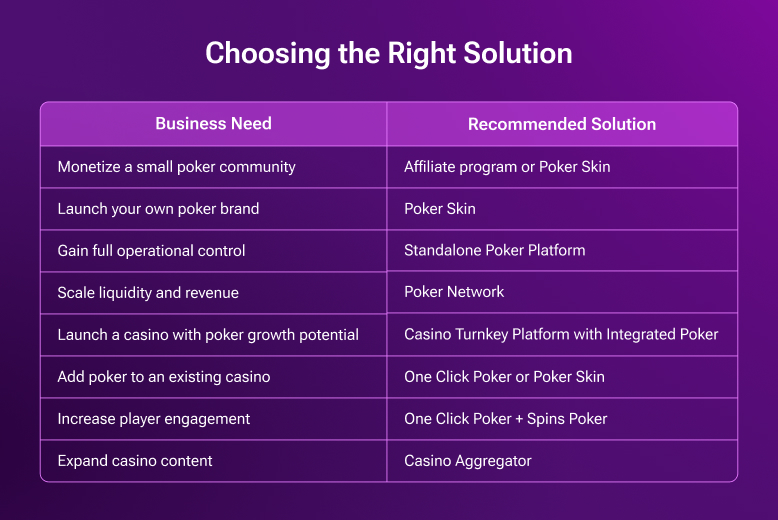
Platform selection often begins with a familiar question: Which platform should we choose? In reality, that question comes too early. A platform is only one part of a broader business strategy. Before evaluating products, operators need to define the goals they want to achieve and the constraints they need to work within. Those decisions shape the technology requirements far more than any feature comparison.
Key questions usually include:
- Which markets are we targeting, and what regulatory requirements do they bring?
- What business objectives are we prioritising over the next two to three years?
- Which capabilities do we already have in-house, and where do we need external support?
- How much localisation, customization, and operational flexibility will our strategy require?
These discussions also shape one of the biggest strategic decisions operators face: iGaming software build vs buy. For some businesses, buying an existing platform provides the fastest route to market. Others may benefit from extending a commercial platform with custom development or investing in proprietary technology as their business matures.
Modular platforms support different business strategies
The rise of the modular iGaming platform reflects this shift. Rather than offering a fixed set of capabilities, modern platforms are designed to adapt to different operator strategies, growth stages, and market requirements.
Several trends are driving this evolution:
- Modular architecture. Operators can activate the capabilities they need — from PAM and poker to bonus engines, payment integrations, and compliance tools — without rebuilding the entire platform. This allows technology to evolve alongside the business instead of being replaced as requirements change.
- API-first ecosystems. Open APIs make it easier to integrate CRM platforms, analytics tools, payment providers, and other third-party services, giving operators more freedom to build a technology stack that fits their operating model.
- Self-service capabilities. Greater access to frontend configuration and platform management enables operators to iterate on UX, launch campaigns, and localize player journeys more independently, reducing reliance on vendor development cycles.
Together, these capabilities give operators more flexibility to adapt their platforms as markets evolve, regulations change, and business priorities shift. Instead of forcing every operator into the same technology stack, modern platforms provide a foundation that can be configured around different business needs.
B2B SaaS has already learned this lesson
The shift from product-first to solution-first thinking isn’t unique to iGaming. Many B2B SaaS companies have already moved away from positioning their products as universal solutions, choosing instead to focus on specific customer segments, industries, and use cases. This shift has been driven by a simple reality: businesses rarely share the same priorities. Different customers value different outcomes, making a single “all-in-one” offering difficult to optimize for everyone.
Several trends illustrate this change:
- Vertical specialization. Rather than serving every customer, SaaS vendors increasingly build solutions for specific industries or business problems.
- More focused products. Instead of adding features for every possible use case, companies prioritize capabilities that deliver the greatest value to their target customers.
- Flexible commercial models. Tiered pricing, modular products, and usage-based plans better reflect differences in customer size, maturity, and business needs.
The same evolution is taking place in iGaming. Platform providers are placing greater emphasis on operator segments, market requirements, and business objectives, recognising that the best solution depends on the context in which it will be used.
What this means for vendors and operators
As platform selection becomes more closely tied to business strategy, the relationship between vendors and operators changes as well. Conversations increasingly begin with understanding the operator’s objectives rather than demonstrating product features. This changes the role of the vendor. Instead of presenting a standard product demo, providers are expected to understand the operator’s markets, business model, internal capabilities, and long-term plans before recommending a solution. Discovery becomes the foundation for selecting the right platform architecture, integrations, and implementation approach. The sales process becomes more consultative, with discussions focused on trade-offs rather than feature lists. Operators evaluate how different approaches support their commercial objectives, while vendors help identify the combination of products and services that best fits the project.
This shift also encourages greater transparency. Not every platform is the right fit for every operator, and recognizing that early helps avoid unnecessary complexity, unrealistic expectations, and costly migrations later on. For operators, this means investing more time in defining business priorities before evaluating technology. For vendors, it means positioning their platforms around the problems they solve and the operator profiles they serve, rather than trying to appeal to every possible customer.
From product to solution
The iGaming industry isn’t moving away from products. It’s changing the way products are evaluated. Operators no longer choose technology based on feature lists alone. They evaluate how well a platform supports their markets, business model, growth strategy, and operational needs. The same platform can deliver very different outcomes depending on how it’s configured, integrated, and supported. For platform providers, this means being clear about the problems they solve and the operators they serve. For operators, it means defining business objectives before comparing products or requesting demos.
At EvenBet Gaming, every project starts with understanding the operator’s business. Markets, growth plans, operational priorities, and product goals all shape the final solution. Contact us to discuss your business objectives and explore the platform strategy that best supports your long-term growth.
FAQ
Why does a one-size-fits-all approach no longer work in iGaming?
Modern iGaming operators serve different markets, work under different regulations, and pursue different business goals. A platform that works well for one operator may not meet the technical, commercial, or compliance requirements of another. Choosing technology based on business objectives rather than a generic feature set helps operators build solutions that better support long-term growth.
How should operators choose an iGaming platform?
Platform selection should start with the operator’s business objectives rather than a feature comparison. Factors such as target markets, licensing requirements, growth strategy, available resources, localisation needs, and integration requirements all influence which platform architecture is the best fit.
What is a modular iGaming platform?
A modular iGaming platform allows operators to activate and combine different products and services—such as poker, casino, sportsbook, payment solutions, CRM, or compliance tools—based on their business needs. This approach provides greater flexibility than a fixed all-in-one platform and makes it easier to scale as the business evolves.
Why is localisation important in iGaming?
Localisation goes beyond translating content into another language. It includes adapting payment methods, promotions, UX, responsible gambling tools, communication, and game offerings to local regulations, player preferences, and market expectations. Effective localisation helps improve compliance, player engagement, and conversion.
How do regulations affect iGaming platform selection?
Regulatory requirements influence many aspects of platform architecture, including payment processing, responsible gambling tools, bonus mechanics, reporting, and player verification. Operators entering multiple jurisdictions often need technology that can be adapted to different regulatory frameworks without rebuilding the entire platform.
What are the benefits of API-first iGaming platforms?
API-first platforms make it easier to integrate third-party services such as CRM systems, payment providers, analytics tools, and business intelligence platforms. This gives operators more flexibility to build technology ecosystems that support their specific business model and operational requirements.
What is the difference between turnkey and modular iGaming platforms?
Turnkey platforms provide a ready-to-launch solution with core services bundled together, making them suitable for operators that want to enter the market quickly. Modular platforms offer greater flexibility, allowing operators to choose individual components and integrate them into their existing technology stack as business requirements evolve.
Why are consultative sales becoming more important in iGaming?
As operator requirements become more diverse, platform selection depends on more than product features. A consultative approach helps vendors understand the operator’s markets, business objectives, and technical requirements before recommending a platform or solution, reducing the risk of selecting technology that doesn’t match long-term goals.