
 24 July 2026
  Upd: 27 July 2026
  20 min
  5 views
 Denmark is one of Europe’s most mature and tightly regulated online gambling markets. Since opening its gambling sector to private operators in 2012, the country has built a licensing framework that combines strong consumer protection, advanced digital infrastructure, and one of the highest channelisation rates in Europe. For online poker operators, this creates an attractive commercial opportunity, but also leaves little room for compliance mistakes. High consumer trust, widespread digital adoption, and effective regulatory oversight have made Denmark an attractive destination for licensed gambling businesses. Success, however, depends on meeting strict licensing, technical, and responsible gambling standards from the outset.
This guide explains the regulatory, technical, and operational requirements for launching an online poker room in Denmark. It covers licensing, platform requirements, KYC and AML obligations, responsible gambling measures, and the practical compliance challenges operators most often underestimate.
Denmark’s Gambling Framework and Why It Matters for Poker
Denmark liberalised its gambling market in 2012, replacing the former state monopoly with a licensing system overseen by the Danish Gambling Authority (Spillemyndigheden). Any operator wishing to offer online poker to players located in Denmark must obtain an online casino licence issued by the regulator. Spillemyndigheden supervises licence holders, enforces technical and reporting standards, and operates key responsible gambling initiatives, including the national self-exclusion register ROFUS and the gambling support service StopSpillet.
The Danish regulatory model is considered one of Europe’s most mature. In 2024, the country’s online channelisation rate reached 91.5%, meaning that the overwhelming majority of online gambling activity took place through licensed operators. The result is a stable commercial environment supported by clear regulation, high consumer trust, and effective enforcement.
Under Denmark gambling laws, poker falls within the online casino vertical rather than a separate licence category. Poker operators therefore follow the same regulatory framework as online casino licensees, including technical certification, player verification, anti-money laundering controls, responsible gambling measures, and regulatory reporting.
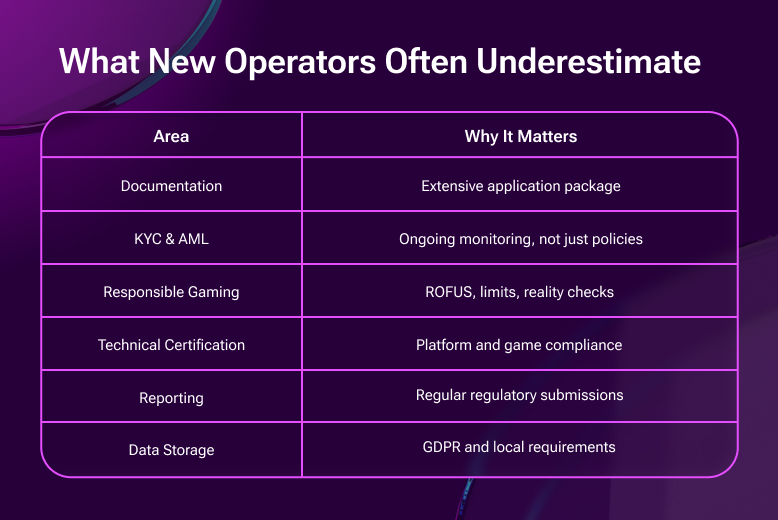
Launching a poker room involves far more than obtaining a licence and deploying a gaming platform. Compliance obligations shape every stage of the operation, from player onboarding and identity verification to payment processing, reporting, and customer support. Incorporating these processes early simplifies licensing, supports long-term compliance, and reduces operational risk.
Licensing: Getting Authorised to Offer Online Poker
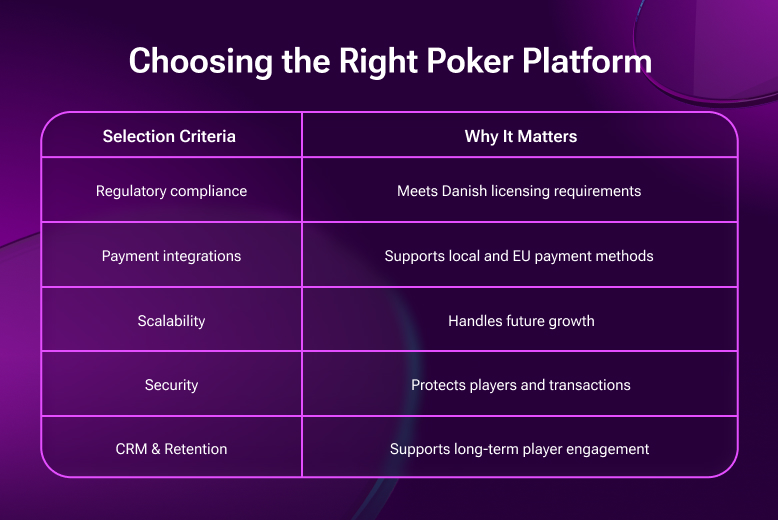
Obtaining the appropriate licence is the first step towards entering the Danish market. Although the licensing process is transparent and well defined, applicants must demonstrate financial stability, operational readiness, and the ability to comply with Denmark’s regulatory standards before launch.
Licence Type and Scope
Operators wishing to offer online poker to players located in Denmark must obtain an online casino licence from Spillemyndigheden. Online poker in Denmark is regulated within the online casino vertical rather than under a separate licence category. The licence authorises operators to offer poker and other online casino games to players physically located in Denmark and does not permit operations in other jurisdictions.
An online casino licence is generally issued for up to five years and may be renewed subject to continued compliance, financial stability, and regulatory approval. Operators may also enter the market through white-label agreements with an existing licence holder. In these arrangements, however, responsibility for compliance, regulatory reporting, and player protection remains with the licence holder.
Applicant Requirements and Fit
Spillemyndigheden assesses both the applicant company and its management. Applicants must demonstrate sufficient financial resources, transparent ownership, and sound corporate governance. Ultimate beneficial owners and senior managers are subject to fit-and-proper assessments covering criminal records, tax compliance, and regulatory history.
Depending on the business structure, operators established outside Denmark may need to appoint a local representative or establish a local presence. As part of the application process, the Danish Gambling Authority also reviews the operator’s business plan, internal controls, responsible gambling measures, and AML procedures.
B2B Licensing for Suppliers
Since 2025, Denmark has introduced licensing requirements for a number of B2B gambling suppliers, including game providers and certain data service companies. As a result, operators should verify that critical technology partners comply with the applicable Danish gambling certification requirements. This affects key components of a poker operation, including the poker platform, random number generator (RNG), live casino integrations, and external data services. Early vendor due diligence helps identify compliance issues before licensing and technical testing begin.
Market Assessment
Although Denmark has a population of fewer than six million people, it is one of Europe’s most attractive regulated gambling markets thanks to its high level of digital adoption and well-established licensing system. In 2024, Denmark’s regulated gambling market generated approximately DKK 11 billion in GGR. Online casino has been the fastest-growing segment in recent years. In 2024, GGR reached approximately DKK 3.5 billion, growing by around 13–15% compared to the previous year. Slots generated almost 78% of online casino revenue, with poker, bingo, and other games accounting for the remainder. Although poker represents a smaller vertical, it remains an effective acquisition and retention tool within broader casino portfolios.
Online gambling continues to drive market growth. Digital channels account for approximately 68–70% of total gambling revenue, while mobile devices generate around 70% of online betting and casino GGR. A mobile-first product strategy is therefore essential for operators entering the Danish market. Another indicator of market maturity is Denmark’s 91.5% online channelisation rate. Most online gambling activity takes place with licensed operators, reducing competition from offshore platforms and creating a more predictable commercial environment. By the end of 2024, 55,899 players were registered in ROFUS, reflecting the regulator’s continued focus on responsible gambling alongside market growth.
Positioning a Poker Room in Denmark
Online poker in Denmark is generally positioned as a skill-based product within the online casino market. Competition depends on fair rake structures, attractive tournament schedules, reliable software, and a high-quality player experience. Many operators also use poker to strengthen their wider casino offering through a shared wallet, a unified loyalty programme, and cross-selling. Localisation is equally important. Customer-facing content should be available in Danish, and the platform should integrate responsible gambling tools such as ROFUS, StopSpillet, and deposit limits.
Platform and Technical Requirements
A poker platform operating in Denmark must meet technical standards designed to ensure system integrity, player protection, secure data handling, and effective regulatory oversight. Compliance starts before launch with certification and continues throughout the platform’s lifecycle as the product evolves.
Core Technical Obligations
To obtain and maintain a licence, the platform must comply with Spillemyndigheden’s technical standards for online casino products. These standards cover secure transaction logging, tamper-resistant security controls, and integration with the regulator’s SAFE reporting system. SAFE is the framework used by the Danish Gambling Authority to collect operational data from licensed operators. It standardises how gambling transactions are recorded, stored, and transmitted, giving the regulator a consistent view of operator activity.
For poker operators, this includes complete records of cash games, tournament participation, hand histories, prize payouts, player balances, and responsible gambling events. Audit trails, error logs, and security controls are equally important, allowing operators to investigate incidents and demonstrate compliance during inspections.
Digital Identity and Self-Exclusion Integration
Identity verification is built into Denmark’s digital gambling ecosystem. Most players register and access their accounts using MitID, making its integration a standard part of the onboarding experience rather than an optional feature. The same applies to ROFUS, Denmark’s national self-exclusion register. Player status must be verified during registration and each login attempt. If a player is registered in ROFUS, the system must automatically prevent account creation or deny access to an existing account.
Data Storage and Security
Licensed operators are expected to retain gambling records for the periods required under Danish regulation while protecting them against unauthorised access, alteration, and loss. The records should be sufficient to support regulatory inspections and audits. For poker operators, this includes hand histories, tournament records, player activity logs, financial transactions, and responsible gambling events. As the platform develops, technical documentation, backup procedures, and disaster recovery plans should be reviewed regularly to ensure they remain aligned with regulatory expectations.
Poker Product Requirements
A poker platform operating under a Danish online casino licence must meet both regulatory and technical standards. Beyond certification, the product should provide clear game rules, transparent player information, and features that support responsible gambling.
Game Types and Account Structure
Licensed operators may offer a range of poker formats, including cash games, sit-and-go tournaments, scheduled multi-table tournaments, and other certified variants covered by the licence. All gambling activity must take place through a single player account. Deposits, withdrawals, balances, bonuses, and responsible gambling settings are managed centrally, allowing players to move between games without creating multiple accounts. Tournament structures, buy-ins, re-buys, prize pool distribution, rake calculations, and payout rules should be clearly explained before a player joins a game or tournament. Transparent rules reduce disputes and improve the player experience.
Localisation and Player Information Duties
Key customer information must be available in Danish, including terms and conditions, game rules, responsible gambling information, complaint procedures, and mandatory regulatory notices. Poker-specific content should explain tournament formats, cash game rules, rake structures, promotional mechanics, and any special game features. Clear communication supports consumer protection while helping players understand how the product works.
The platform should also display licence information together with visible links to ROFUS and StopSpillet. Information about deposit limits, self-exclusion, and responsible gambling tools should be easy to locate, while the minimum gambling age of 18 years should be clearly communicated throughout the platform.
Certification and Testing
Before launch, poker platforms must complete certification through testing laboratories accredited by the Danish Gambling Authority. Testing covers system integrity, game logic, reporting functions, and random number generation used for card shuffling and other game mechanics. Certification does not end at launch. Significant software updates, new game formats, infrastructure changes, or modifications affecting regulated functionality may require additional testing or re-certification before deployment. Working with accredited testing laboratories throughout product development helps identify compliance issues early and reduces the risk of delays during launch or future platform updates.
Payments, KYC, and AML
Payment processing, customer verification, and anti-money laundering controls are closely connected within Denmark’s regulatory framework. Together, they create the foundation for secure gambling operations and should be built into the platform before launch.
KYC and Identity Verification
Danish regulations do not allow anonymous gambling. Every player must complete identity verification before accessing gambling services. Verification is typically carried out through MitID, Denmark’s national digital identity system, alongside standard customer information such as name, date of birth, and residential address. The KYC process should confirm that the player is at least 18 years old, eligible to gamble in Denmark, and not registered in the ROFUS self-exclusion system. It also provides the information needed for customer risk assessments and ongoing AML monitoring.
AML Obligations
Licensed operators are subject to Denmark’s Act on Measures to Prevent Money Laundering and Financing of Terrorism and are expected to apply a risk-based AML programme. That programme typically includes customer due diligence (CDD), enhanced due diligence (EDD) for higher-risk customers, transaction monitoring, and procedures for reporting suspicious activity to the relevant authorities. Poker presents several risk scenarios that deserve particular attention, including unusual deposit and withdrawal patterns, rapid cash-outs, collusive behaviour, and chip dumping. Internal policies should clearly define how suspicious activity is detected, escalated, documented, and reported.
Payment Methods and Restrictions
Licensed operators in Denmark typically support bank transfers, debit and credit cards, and regulated e-wallets. Besides providing familiar payment options for players, these methods also support identity verification and transaction monitoring. Payment providers should supply the data needed for regulatory reporting and financial oversight. Transaction information should integrate seamlessly with internal compliance systems and the SAFE reporting framework, creating a complete and traceable record of financial activity.
Responsible Gambling and Player Protection
Responsible gambling is a core requirement for obtaining and maintaining a Denmark gambling licence. Operators must implement effective player protection measures, including deposit limits, session timers, reality checks, spending summaries, and gameplay reminders, while ensuring that ROFUS and StopSpillet remain easily accessible throughout the player journey. Spillemyndigheden also expects operators to apply a duty of attention by monitoring player behaviour for signs of gambling-related harm and intervening where appropriate. This requires documented procedures, regular staff training on responsible gambling, self-exclusion, and AML requirements, and clear processes for responding to at-risk players.
Reporting, Audits, and Regulatory Oversight
Maintaining a Denmark gambling licence requires regular reporting through the SAFE system and accurate record-keeping. Operators should be able to provide player activity, transaction, and game history records during audits or investigations. Spillemyndigheden may review reporting, technical systems, responsible gambling measures, AML controls, cybersecurity, and supplier compliance. Failure to meet regulatory requirements may result in financial penalties, licence suspension, or licence revocation.
Marketing, Advertising, and Go-Live Preparation
Launching an online poker room in Denmark involves more than obtaining a licence and completing technical integration. Marketing and customer communications must also comply with Denmark gambling laws and consumer protection rules. Advertising may not target minors, mislead consumers, or suggest that gambling is a way to achieve financial success or solve personal problems. Licensed operators should clearly display their licence status and, where required, provide responsible gambling information and access to self-exclusion tools. Operators are also responsible for marketing carried out by affiliates and other partners, making regular oversight and clear contractual requirements essential.
Gaming Package 1: Upcoming Restrictions
Denmark has adopted a major package of advertising reforms known as Gaming Package 1, with full implementation scheduled for 1 January 2027. The new rules introduce restrictions on gambling advertising around live sporting events, tighter limits on welcome bonuses, and additional controls over the use of celebrities and influencers. Advertising on public transport and near schools will also be restricted, while individuals under the age of 25 will no longer be permitted to appear in gambling advertisements. Although these measures have not yet taken full effect, operators planning to enter the Danish market should incorporate them into their marketing strategy early. Doing so reduces the need for future campaign redesigns and supports long-term compliance.
Go-Live Readiness
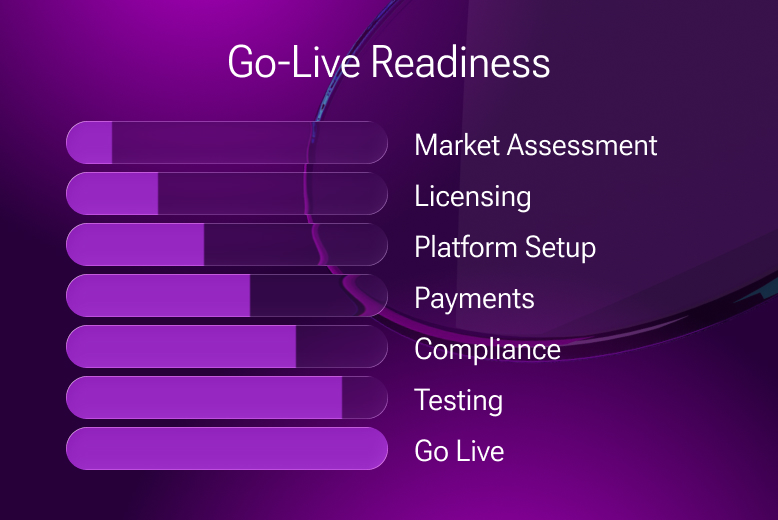
Before launch, all critical systems should undergo comprehensive testing, including player registration, MitID authentication, ROFUS integration, payment processing, SAFE reporting, and responsible gambling functionality. Customer support, compliance, and operational teams should receive training on Danish regulatory requirements and escalation procedures. Internal playbooks should cover incident management, technical failures, AML alerts, self-exclusion cases, and other scenarios that may arise after launch. A final compliance review should confirm that all mandatory information is available in Danish, regulatory notices are displayed correctly, and responsible gambling tools function as intended before the platform goes live.
Launching in Denmark with EvenBet Gaming
Denmark offers one of Europe’s most attractive regulated gambling markets, but successful entry depends on choosing technology that already meets local regulatory expectations. EvenBet Gaming holds a five-year B2B supplier licence issued by the Danish Gambling Authority, covering its poker software, turnkey casino platform, and gaming content portfolio. This allows operators to work with a technology provider whose products have already been approved under Denmark’s supplier licensing framework. Whether you are launching a standalone poker room or expanding an existing casino, our team can help you build a compliant solution for the Danish market.
FAQ
Is online poker legal in Denmark?
Yes. Online poker is legal in Denmark when offered under a valid online casino licence issued by the Danish Gambling Authority (Spillemyndigheden). It is regulated as part of the online casino sector rather than under a separate licensing regime.
What licence is required to operate online poker in Denmark?
Operators must hold an online casino licence issued by Spillemyndigheden to offer online poker to players in Denmark. The licence also covers other online casino games, including roulette, blackjack, baccarat, bingo, and slot machines.
Does Denmark issue a separate online poker licence?
No. Denmark does not issue a separate online poker licence. Online poker is covered by the online casino licence, which applies to both cash games and tournaments.
Can a foreign company apply for a Danish gambling licence?
Yes. Foreign companies can apply for a Danish online casino licence if they meet the financial, ownership, and fit-and-proper requirements. Depending on their business structure, they may also need to appoint a local representative or establish a local presence.
How long is an online casino licence valid in Denmark?
An online casino licence is generally valid for up to five years and may be renewed subject to continued compliance with Danish regulatory requirements.
What does the Danish gambling licence application process involve?
Applicants must provide information about their company, ownership structure, financial position, business plan, internal controls, and technical systems. They must also demonstrate compliance with Danish certification, reporting, AML, and responsible gambling requirements before launch.
Does an online poker software provider need a Danish supplier licence?
Yes. Since 2025, companies supplying poker software or other casino games to Danish-licensed operators must hold a Danish B2B supplier licence where required under the licensing framework.
What are the KYC requirements for online poker operators in Denmark?
Operators must verify each player’s identity, age, and eligibility before allowing access to gambling services. This typically includes MitID verification, checking the ROFUS self-exclusion register, and applying KYC and AML procedures in line with Danish regulations.