
 2 June 2026
  19 min
  150 views
 In iGaming, retention rarely drops all at once. Players usually show smaller signals first: slower deposit patterns, shorter sessions, skipped onboarding steps, reduced activity in a favorite vertical, longer gaps between visits.
iGaming CRM systems help operators recognize those shifts early and respond while player intent is still active. That can mean guiding a new user toward a first meaningful action, re-engaging a player before churn accelerates, identifying cross-sell opportunities, or avoiding wasted bonus spend on low-value reactivation campaigns. Segmentation, trigger-based campaigns, and lifecycle marketing help structure those decisions across the player journey.
Timing matters heavily here. A well-timed intervention connected to actual player behavior often produces stronger retention results than a larger generic bonus delivered after engagement has already started fading.
Why CRM in iGaming Depends on Behavioral Data
In many iGaming teams, CRM in iGaming is still treated mainly as a messaging function and revolves around campaign calendars, promo pushes, and periodic reactivation offers. Player behavior changes constantly throughout the lifecycle. Some users deposit quickly but never place a second wager. Others become active only around major sporting events. Some start showing churn signals long before they fully disappear. Registration status, first deposit timing, preferred games, session frequency, wager patterns, bonus use, failed payments, and inactivity gaps all reveal something about intent, engagement, and retention risk.
Modern iGaming CRM systems use those signals to trigger onboarding nudges, habit-building campaigns, milestone messaging, value-based rewards, cross-product prompts, and selective win-back flows. Retention quality depends on identifying the signals that actually predict behavior change, linking them to the right campaign logic, and measuring whether interventions improve downstream value, repeat behavior, and long-term LTV.
Segmentation That Supports Retention
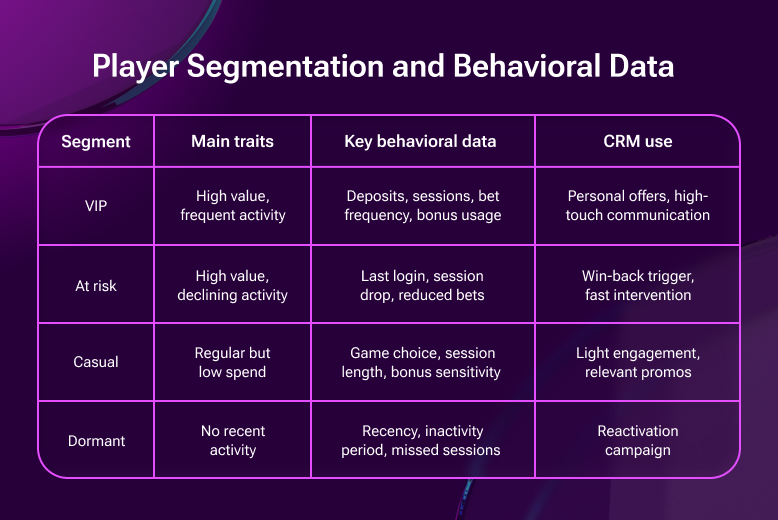
Segmentation is the foundation of many casino CRM systems because retention becomes expensive when every player receives the same treatment. In iGaming, broad grouping by geography or acquisition source is rarely enough on its own. Operators need segments that reflect how players behave, where they are in the lifecycle, and what level of value they are likely to generate over time. A practical segmentation model usually combines three layers.
Lifecycle Segmentation
Lifecycle segmentation maps players according to progression and risk: newly registered, deposited but not activated, active, declining, dormant, and reactivated. This layer matters because the same message means different things at different stages. A first-deposit prompt may help a hesitant new user, but it becomes irrelevant for an already engaged player showing repeat behavior.
Lifecycle structure also helps CRM teams prioritize intervention timing. A delayed onboarding sequence or late reactivation attempt often misses the point where player behavior could still be changed.
Behavioral Segmentation
Behavioral segmentation groups players by how they actually use the product. Relevant inputs include session frequency, preferred vertical, bet size, volatility preference, time-of-day patterns, responsiveness to promotions, and gaps between deposits or playing sessions. This layer moves CRM in iGaming beyond generic labels.
A frequent low-stakes poker player, an event-driven sportsbook user, and a bonus-sensitive casual casino customer may all appear “active” in dashboards while requiring completely different retention logic. Behavioral segmentation also helps reduce irrelevant messaging. When operators repeatedly push campaigns disconnected from actual player habits, CRM fatigue increases quickly. Messages stop feeling personalized and start feeling automated.
Value-Based Segmentation
Value-based segmentation helps CRM teams focus on players with stronger long-term revenue potential. Instead of ranking players only by recent conversion or current spend, operators can prioritize by present value, predicted future value, or signs of long-term monetization potential. This distinction matters because not every dormant segment deserves the same reactivation effort.
Many operators over-message inactive low-value users because large reactivation numbers look impressive in dashboards. In practice, this often increases bonus cost without meaningfully improving long-term retention quality. Strong CRM teams focus resources where retention uplift is most likely to produce incremental value. Segmentation should help teams decide where retention efforts and budgets will have the biggest impact. The most useful segments help teams identify which players are most likely to respond and generate stronger long-term value.
Trigger-Based Campaigns That Match Player Behavior
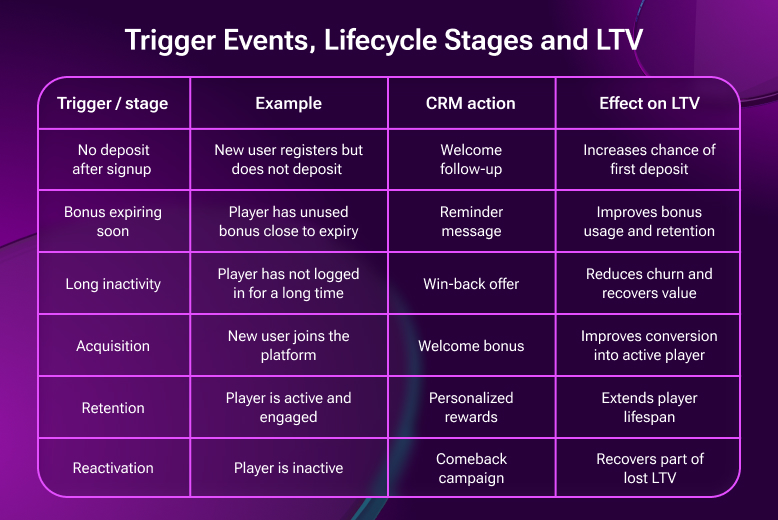
Once segments are in place, trigger-based CRM turns segmentation into action. Triggered campaigns play a major role in iGaming customer retention because they respond to specific player actions or behavior changes as they happen, instead of waiting for the next scheduled promo campaign.
In iGaming, player intent can fade very quickly. A user who was ready to deposit, place a bet, or return to the platform in the evening may lose interest completely a few hours later. Because of that, timing has a major impact on iGaming CRM performance. Messages connected to actual player behavior usually perform better than campaigns sent according to a fixed schedule.
Common triggers usually start with the early lifecycle:
- Registration completed, but no deposit
- First deposit completed, but no first game, bet, or second session
- First bet placed, followed by inactivity
- High engagement in one product category without cross-play in another
More advanced triggers rely on behavioral change rather than one-off milestones:
- Session frequency starts to decline
- Average stake drops sharply
- Deposit intervals become longer
- A previously engaged user stops responding to preferred channels
- A player repeatedly encounters payment friction or abandons transactions
The value of these campaigns lies in timing and relevance. In many cases, timing matters more than offer size. A well-timed reminder connected to actual player intent can outperform a much larger generic bonus delivered too late.
- A player who deposited but never placed a first bet may need reassurance, guidance, or a lower-friction next step.
- A player whose activity is cooling may respond better to a personalized prompt tied to their preferred game or format than to another broad promotion.
- A player showing strong cross-product potential may engage more with a carefully timed introduction to another vertical than with repeated bonus messaging.
The key is that triggers should not be built only around promotions. They should be built around the next desired behavior. Sometimes that is a second deposit. Sometimes it is a return session, a successful first withdrawal, or simply a smoother path back into play.
Lifecycle Marketing Across the Player Journey
In CRM for online casinos, lifecycle marketing helps teams define the right retention goal for each stage of the player journey. Rather than treating retention as one broad objective, lifecycle marketing recognizes that onboarding, activation, habit formation, loyalty, and reactivation all require different signals, interventions, and success metrics.
Onboarding and Activation
Early onboarding often shapes future retention patterns. At this stage, new players need trust, clarity, and a quick understanding of how the product works. CRM teams usually monitor signals like time to first deposit, completion of KYC or registration steps, first game or bet initiation, device behavior, and early responsiveness to messages. Campaigns during onboarding should guide players through the first steps, explain key product features, and help users reach the first session where the experience starts feeling engaging and familiar.
Habit Formation and Early Retention
After the first deposit or session, retention starts depending on routine. Operators begin tracking signals like second deposits, repeat sessions, active days, and how regularly players return to the same product. At this stage, CRM is more about giving players reasons to come back naturally through iGaming personalization: relevant tournaments, personalized recommendations, milestone rewards, familiar game formats, or timely reminders tied to existing habits.
Overreliance on bonus-led retention can train players to wait for the next incentive instead of returning because they genuinely enjoy the experience. The strongest retention systems build familiarity, consistency, and personalized engagement patterns that keep players active even outside promotional periods.
Ongoing Retention and Loyalty
For active players, CRM focuses on keeping engagement stable over time and increasing long-term value. Segmentation at this stage usually reflects product preferences, spending patterns, responsiveness to different channels, and playing behavior. In advanced casino CRM systems, highly engaged or high-value players often expect a more personalized experience: VIP-style support, milestone recognition, exclusive rewards, or tailored offers connected to their habits.
Mid-tier segments usually respond better to consistency — relevant recommendations, familiar game formats, recurring tournaments, missions, or challenges that fit naturally into existing routines. The goal is to keep players engaged without overwhelming them with promotions or training them to return only for bonuses.
Reactivation
Reactivation works best when operators treat dormant players as separate groups instead of one inactive audience. Some users simply need a relevant reason to return: a favorite game, a product update, a major sporting event, or a reminder connected to previous playing habits. Other players show very low re-engagement potential long before they become fully inactive. Pushing aggressive bonus campaigns toward those segments often increases retention costs without creating meaningful long-term value.
Many CRM programs lose efficiency during reactivation. Large blanket campaigns can generate short-term activity spikes while doing very little for long-term retention. In many CRM for online casinos setups, lifecycle marketing helps teams avoid this trap by assigning the right objective to the right moment.
Using Behavioral Data in Practice
In Customer Relationship Management, behavioral data becomes valuable when it helps operators answer three practical questions:
- Who is likely to change behavior?
- Which signals appeared before that change?
- Which intervention is most likely to improve the outcome?
At that point, CRM starts functioning as an active retention system connected to real player behavior. A practical workflow often looks like this:
- Choose a behavior you want to increase, such as second deposits, repeat sessions, cross-product activity, or returning after inactivity.
- Identify the patterns that usually appear before players become more active or start dropping off.
- Group players with similar behavior into segments.
- Create campaigns and triggers for each segment.
- Measure whether those campaigns improve retention, repeat activity, or long-term player value over time.
Several examples illustrate how this works in practice.
- Players who register and browse without depositing may need reassurance around trust, payments, or product clarity rather than a larger welcome incentive.
- Players who complete a first deposit but never start playing may need recommendations, simpler navigation, or prompts tied to products they already explored.
- Players whose activity begins slowing after an initially active period may respond better to retention flows connected to their historical behavior patterns, including preferred session times, game types, or stake levels.
- Players with strong engagement in one vertical but no activity in another may become strong cross-sell candidates capable of increasing total value while reducing single-product churn risk.
Not every behavioral pattern deserves a campaign. Good operators focus on the moments where intervention has a measurable chance of shifting future value. Everything else creates noise, wasted spend, or channel fatigue.
Connecting CRM to LTV
The real test of successful iGaming CRM is whether it improves LTV. Not whether it increases message volume or produces isolated campaign spikes.
LTV grows when CRM helps players move into more valuable long-term patterns:
- More active days
- More repeat deposits
- Better cross-product adoption
- Longer playing lifecycles
- Lower churn during high-friction moments
LTV should influence segmentation and campaign strategy from the very beginning. A player with moderate current spend but strong repeat behavior may be significantly more valuable than a promo-responsive user with a high first conversion and weak retention. Likewise, a reactivation campaign that revives low-quality traffic for several days may appear successful in dashboards while adding little incremental value.
A practical LTV-oriented CRM model often tracks:
- Retention by lifecycle segment
- Deposit and repeat deposit behavior
- Active-day frequency over time
- Reactivation efficiency by segment
- Cross-sell or multi-product adoption
- Bonus cost versus incremental post-campaign value
These metrics help teams understand whether CRM campaigns are actually improving long-term player value, retention quality, and repeat behavior over time. That perspective also changes how operators approach targeting, retention budgets, and campaign priorities. In mature platforms, Customer Relationship Management becomes closely tied to overall retention strategy and long-term commercial performance.
Common CRM Mistakes in iGaming
Many CRM programs underperform because the logic behind them is too broad, too delayed, or too disconnected from actual player behavior.
Several mistakes appear repeatedly across CRM for gaming industry operators.
- Treating segmentation as a fixed set of tags instead of updating it based on player behavior, lifecycle stage, and long-term value.
- Building campaigns around what the business wants to send instead of what the player is most likely to do next.
- Overusing blanket promotions that inflate short-term activity while damaging retention quality and margin.
- Reactivating large inactive pools without filtering for return probability or expected value.
- Measuring success through opens, clicks, or bonus claims while ignoring retention lift and downstream LTV.
- Failing to connect CRM decisions with payment and product signals, even though friction often appears there first.
The operators that avoid these mistakes usually share one trait. They treat Customer Relationship Management as a cross-functional retention system where data, product usage, monetization patterns, and campaign logic all support the same objective: sustained player value over time.
CRM as a Retention System
For iGaming operators, retention problems rarely appear out of nowhere. A player who used to deposit twice a week suddenly disappears for ten days. Session frequency drops. Sports bettors stop returning after a major event ends. Casino players begin engaging only during bonus periods. High-value users quietly lose interest long before they fully churn.
Advanced casino CRM systems help operators catch those changes early and respond while player intent still exists. Segmentation helps teams understand which players behave similarly, which users are likely to churn, and which segments still have strong long-term value potential. Trigger-based campaigns help operators react at the right moment instead of weeks later. Lifecycle marketing connects those actions into a more consistent retention strategy across the entire player journey. The strongest CRM programs pay close attention to timing, engagement patterns, reactivation quality, and bonus dependency over time.
In highly competitive iGaming markets, small retention decisions can directly affect acquisition efficiency, retention costs, player value, and long-term profitability.
At EvenBet Gaming, we help operators build retention-driven poker and iGaming platforms with CRM integration and scalable iGaming customer retention systems, player segmentation, trigger-based engagement flows, and lifecycle-focused retention tools designed for long-term player value.
FAQ
What is CRM in iGaming?
CRM for the iGaming industry is a system and strategy for managing player relationships through data, segmentation, automation, and personalized communication. It helps operators understand player behavior, send relevant messages, and support the full player journey from registration to reactivation.
Why is CRM important for player retention?
CRM is important because retention depends on timely, relevant engagement, not generic outreach. Modern iGaming CRM strategies help operators identify at-risk players, automate the right trigger campaigns, and improve long-term value by keeping players active for longer.
How do casinos personalize player experiences?
Casinos personalize experiences by using behavioral data such as game preferences, session timing, deposit patterns, and engagement history. This data is used to tailor offers, recommendations, rewards, and communication so that each player receives content that matches their activity and interests.