
 4 June 2026
  18 min
  103 views
 Most conversations about slot performance revolve around RTP or return to player, especially when slot RTP is explained through theoretical payout percentages alone. Operators compare percentages, suppliers advertise theoretical returns, and players learn to associate higher RTP with better value. Yet casinos rarely succeed or fail because of RTP alone.
Two games with nearly identical RTP can produce completely different business outcomes. One keeps players engaged for forty minutes and quietly stabilizes daily revenue. Another creates short, intense sessions filled with sharp bankroll swings, frustrated exits, and unpredictable GGR spikes. The difference lives inside slot volatility, pacing, hit frequency, and emotional rhythm.
A slot portfolio behaves less like a static game catalogue and more like a behavioral environment. Some games slow players down, while others accelerate spending or create comfort and continuity. That emotional architecture shapes far more than entertainment value. It influences retention curves, bonus efficiency, bankroll perception, session length, revenue variance, and the likelihood that players return tomorrow instead of disappearing after one disappointing evening.
How Game Math Shapes Session Experience
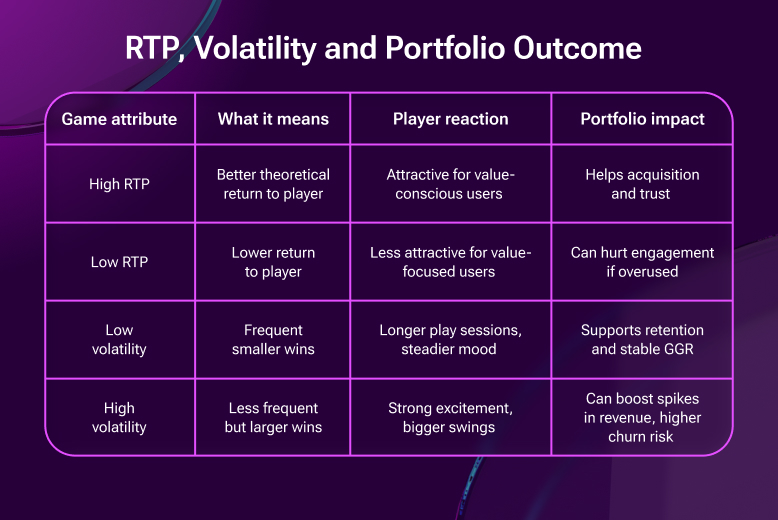
RTP describes how much money a slot theoretically returns over time, while slot volatility meaning usually refers to how frequently and intensely wins are distributed during gameplay. The number matters, but it says almost nothing about how a session actually feels.
Understanding RTP and volatility in slots becomes easier when looking at how players experience tempo during real sessions. A high-RTP slot with aggressive volatility can still feel brutal in short sessions. Long dead-spin stretches create the impression that the bankroll evaporates without momentum, even if the theoretical return is generous over millions of spins. Meanwhile, a lower-volatility game may create a much softer emotional experience. Frequent small wins, near recoveries, bonus triggers, and visible activity stretch the perception of value even when total losses remain similar.
The industry often treats RTP as transparency while players react to something far more psychological: whether the session feels alive. That gap matters commercially. Retention is heavily influenced by perceived momentum. Players rarely leave a casino calculating expected value. They leave with an emotional memory of whether the session felt entertaining, exhausting, unfair, exciting, slow, punishing, or worth repeating.
Losing Slowly Feels Different From Losing Fast
Two players can lose the same amount of money and walk away with completely different impressions of the casino. One experiences a long session filled with near-misses, bonus rounds, partial recoveries, and enough movement to maintain engagement. The bankroll declines gradually while the session continues delivering stimulation. The other burns through the balance in minutes. The experience feels abrupt and cold. Technically, both sessions may produce similar financial outcomes. Emotionally, they belong to different universes.
Volatility changes the texture of losing. That distinction becomes especially important during onboarding. Early sessions shape how new users perceive the platform itself: rewarding, dynamic, frustrating, repetitive, or worth revisiting. A first deposit that disappears inside a sequence of cold, highly volatile sessions can create churn long before loyalty systems or CRM flows have time to matter.
Casino teams often underestimate how much session pacing affects retention. Players do not always leave because they lost. Many leave because the experience felt emotionally flat before it had time to become entertaining.
Different Players Search for Different Emotional States
Not every player enters a casino looking for the same experience.
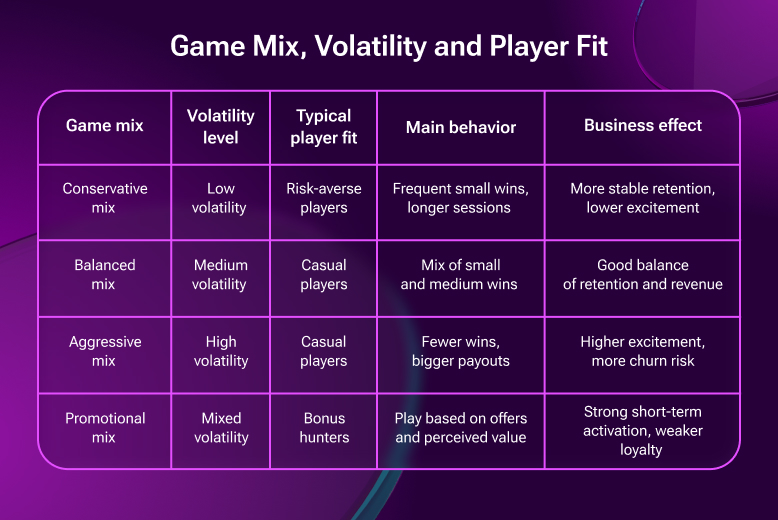
- Casual users often prefer continuity. Small wins and steady gameplay create reassurance, extend sessions, and reduce friction during exploration. These players frequently treat slots as low-intensity entertainment rather than high-risk excitement.
- Experienced players often tolerate much harsher volatility curves. Anticipation becomes part of the attraction. Long losing stretches feel acceptable when balanced against the possibility of a significant hit.
Players return to high-volatility games for excitement and bigger emotional swings. That creates an important portfolio challenge. A lobby designed entirely around explosive mechanics may look exciting from a marketing perspective while quietly underperforming among broader recreational audiences.
The opposite problem exists too. A casino filled exclusively with safe, steady content can start feeling emotionally interchangeable. Sessions become predictable. Nothing creates tension or standout moments. A balanced portfolio includes both steady engagement games and higher-intensity titles that create stronger emotional peaks.
When Every Slot Starts Feeling the Same
Many modern slot lobbies suffer from a quieter problem than volatility imbalance: mechanical sameness. Different visual themes often hide nearly identical gameplay structures. Similar volatility curves, recycled feature logic, familiar pacing patterns, and interchangeable bonus systems often make slot volatility in casino games feel repetitive across large catalogues.
Players may scroll through hundreds of games without feeling meaningful contrast between experiences. Over time, that weakens discovery. The lobby stops feeling like an ecosystem and starts feeling like repetition wrapped in different graphics.
A broader supplier mix helps solve part of that problem, though scale alone is not enough. Large game libraries work best when operators can tailor game selection to onboarding, CRM campaigns, VIP players, and promotions. Successful casino game portfolio strategy depends more on portfolio curation than catalogue size alone. Strong operators use different games for different purposes: some attract attention, some support steady engagement, and some help keep players returning over time.
Volatility and GGR Stability
Discussions around slot volatility and GGR often focus on how high-volatility slots create less predictable revenue patterns. Large wins can drive excitement, stronger emotional reactions, and more aggressive betting behavior among some player groups. These games also tend to perform well in tournaments, jackpot campaigns, and promotional events built around high-intensity gameplay.
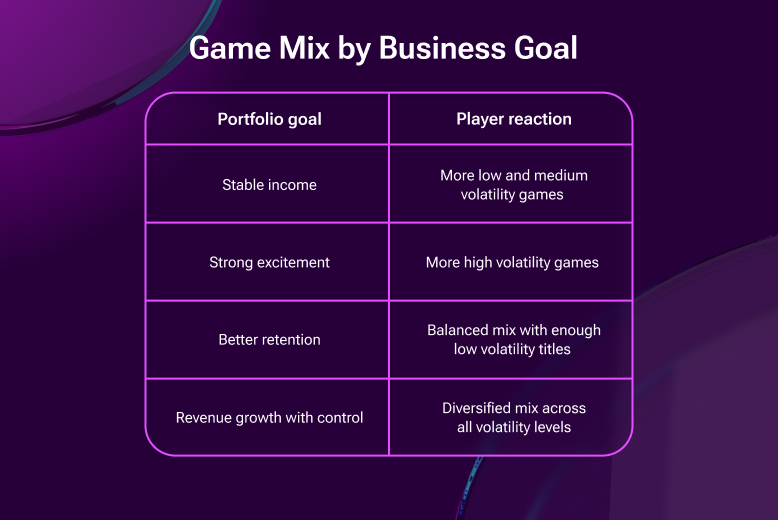
At the same time, portfolios heavily focused on aggressive volatility usually produce sharper swings in GGR. Daily performance becomes harder to forecast, bonus campaigns become less stable, and casual players may burn out faster during repeated high-risk sessions. Lower- and medium-volatility games often support steadier engagement across a wider audience. Longer sessions, more consistent pacing, and slower bankroll decline can help create more stable revenue patterns over time.
The strongest portfolios usually combine different volatility levels rather than relying too heavily on a single style of gameplay. Some games attract attention and create high-intensity moments, while others support longer engagement and more sustainable player activity.
The Lobby Is a Pacing System
Casino lobbies are often treated like storefronts: display enough content and players will find something they like. In reality, lobby structure shapes behavioral flow. Placement decisions influence emotional pacing long before players consciously evaluate volatility. A homepage with visually aggressive, high-volatility titles creates a very different onboarding atmosphere from one built around lower-friction recreational content.
Even bonus mechanics change meaning depending on the surrounding game mix. Twenty free spins on an extremely volatile slot can create spectacular outlier wins for a handful of users while leaving most players with a short, emotionally empty session. The same reward attached to steadier content may produce smaller peaks yet generate stronger average satisfaction across the entire cohort.
Retention metrics usually reflect those differences clearly. Some session structures create short bursts of excitement, while others support longer and more sustainable engagement. Different player groups also respond to different pacing styles across the lifecycle. New users often engage better with steadier momentum and lower friction, while returning or high-value players may respond more strongly to higher-intensity gameplay built around anticipation and volatility. A balanced portfolio gives operators more flexibility to adapt those experiences to different audiences and stages of the player journey.
Bonus Design Changes When Volatility Changes
Promotions do not exist independently from game math. A welcome offer connected to lower-volatility slots usually creates a different player experience from the same offer attached to highly aggressive games. Session length, bonus completion rates, bankroll perception, and overall engagement can all shift depending on how quickly players move through the experience. The same pattern appears in CRM campaigns.
- High-volatility games often perform better in tournaments, jackpot events, VIP campaigns, and reactivation flows where players already expect more intense gameplay and higher emotional peaks.
- Lower-volatility content usually works better during earlier lifecycle stages, especially when casinos are trying to build habit formation and longer engagement rather than short bursts of excitement.
One common mistake is focusing too heavily on standout wins while ignoring the average player experience across the campaign. A promotion associated with quick losses and short sessions may still produce memorable outliers, but it rarely supports long-term retention across a broader audience.
Volatility Is Cultural
Perceptions of slot volatility in casino games vary significantly between markets. The same slot portfolio can feel balanced in one region and exhausting in another because players respond differently to pacing, session flow, perceived intensity, and bankroll rhythm.
In mature European markets, experienced players often pay closer attention to provider reputation, RTP expectations, feature mechanics, and volatility profiles. Repetitive gameplay structures tend to fatigue faster because players recognize familiar patterns quickly.
LATAM markets often reward a different balance. Faster onboarding, mobile-friendly pacing, accessible volatility levels, and stronger engagement loops can perform better during early lifecycle stages, especially in highly competitive acquisition environments.
In MENA-facing markets, session trust and overall user experience frequently matter as much as raw intensity. Smoother onboarding flow, clearer progression, and lower-friction gameplay can support retention more effectively than aggressively high-volatility content introduced too early.
Cultural expectations shape how players experience intensity, reward pacing, and session value across different regions. Regional strategy becomes more effective when operators adapt volatility mix to player behavior instead of applying the same portfolio structure across every market.
Portfolio Control Becomes an Operational Advantage
As game libraries grow, casino game portfolio management becomes closely tied to operations, player segmentation, and lifecycle management. Adjusting onboarding flows, balancing volatility across campaigns, rotating underperforming content, and adapting pacing for different player groups all require more than a basic content feed. A large game library becomes more valuable when operators can shape how different titles appear across onboarding, CRM campaigns, VIP programs, tournaments, and regional lobbies.
Many portfolio problems come from imbalance rather than lack of content. Some casinos overload onboarding with high-volatility games, rely too heavily on repetitive mechanics, or miss the mid-volatility layer that supports longer-term engagement. The ability to rebalance content quickly becomes important as player behavior shifts across markets and lifecycle stages.
EvenBet’s Casino Game Aggregator gives operators access to more than 15,000 games from 230+ providers through a single API, making it easier to expand, localize, and adjust content mixes without managing separate integrations for every supplier. The broader platform environment also includes CRM, promotions, reporting, loyalty systems, payments, player management, and anti-fraud tools. This allows operators to connect game distribution more directly to retention strategy, monetization, and player lifecycle management.
For example, one market may respond better to slower onboarding sessions and steadier pacing, while another engages more actively with tournament-driven volatility and high-intensity promotional mechanics. Integrated segmentation and reporting tools help operators test and adapt those strategies more efficiently across different player groups.
Most Portfolio Reviews Look at the Wrong Signals
Many casinos evaluate portfolio performance mainly through game popularity and acquisition results. Strong traffic, however, does not always translate into healthy long-term engagement. A lobby may attract new players successfully while gradually weakening retention through repetitive mechanics, overly aggressive volatility during onboarding, or weak mid-volatility content that fails to sustain routine play.
In many cases, the issue is structural rather than promotional. Some portfolios contain plenty of acquisition-focused games and high-intensity content, yet very little designed to support steady engagement between those two extremes. Mid-volatility evergreen titles often play an important role here because they help maintain continuity between onboarding sessions and higher-risk gameplay.
The most effective portfolio reviews focus on how different types of games shape player behavior across the lifecycle: which titles support onboarding, which encourage longer sessions, which drive higher-intensity engagement, and which help sustain repeat play over time. Effective casino game portfolio management works best as an ongoing adjustment process. Player behavior, regional preferences, bonus mechanics, and content trends continue evolving, which means volatility balance inside the lobby changes over time as well.
The Most Effective Portfolios Rarely Look Extreme
Many operators overcorrect toward whatever currently feels commercially effective, whether that means aggressive volatility, heavier bonus mechanics, or rapid catalogue expansion without enough attention to player flow inside the lobby. Strong casino game portfolio strategy usually creates a better balance between intensity and sustainability. Different types of players engage differently across the lifecycle, and a healthier game mix gives operators more flexibility to support onboarding, longer sessions, higher-intensity play, and repeat engagement without exhausting players too early.
That balance affects far more than entertainment value. It shapes revenue stability, acquisition efficiency, CRM performance, and long-term retention across different player groups and markets. Slot volatility remains one of the most important parts of portfolio strategy because it influences how players experience pacing, reward perception, and session value over time.
FAQ
How does game mix affect casino revenue?
Game mix affects revenue by shaping how long players stay, how often they spin, and how much variance the operator sees in daily GGR. A balanced mix of low-, mid-, and high-volatility slots helps casinos serve different player types while keeping revenue more stable over time.
What is slot volatility?
Slot volatility describes how a game distributes wins. Low-volatility slots pay smaller wins more often, while high-volatility slots pay less frequently but can deliver larger payouts.
How does slot volatility affect GGR?
In practice, slot volatility and GGR are closely connected because volatility changes how revenue is distributed across player sessions. Low-volatility games usually create smoother revenue patterns, while high-volatility games can produce sharper swings in GGR because outcomes are less frequent and more extreme.
Why does game mix matter for casino operators?
Game mix matters because different players prefer different levels of risk and reward. A well-balanced portfolio helps operators improve retention, support bonus performance, reduce overreliance on a single game type, and create a more predictable revenue profile.
Are high-volatility slots better for GGR?
Not by default. High-volatility slots can be strong for excitement, VIP engagement, and promotional spikes, but relying on them too heavily can increase revenue volatility and weaken retention among casual players.
How often should an online casino review its game mix?
An online casino should review its game mix regularly, ideally on a monthly basis for core performance monitoring and more often when testing new markets, campaigns, or content suppliers. The review should focus on player segments, retention trends, session metrics, and the balance between low-, mid-, and high-volatility content.