
 4 June 2026
  14 min
  104 views
 In 2026, poker competes for attention in a very different environment. Players move between TikTok, instant games, streaming platforms, social apps, and short mobile sessions throughout the day. Entertainment is increasingly shaped around immediacy, low perceived effort, and fast emotional payoff. That shift changes how poker products are experienced.
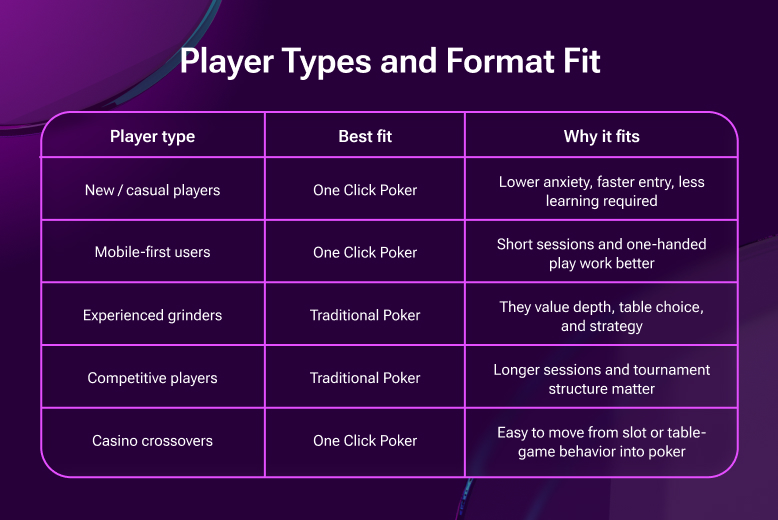
Formats like One Click Poker fit naturally into mobile-first behavior: short sessions, fast entry, minimal setup, and instant action. Traditional poker still serves players who enjoy depth, longer sessions, strategy, and competitive progression. Simpler formats expand the moments when poker feels accessible. Poker is evolving into a category that supports both deep sessions and fast casual interaction.
The Psychology of Play: Why Simpler Entry Matters
Traditional poker often feels “heavy” before the game even starts. Many traditional flows were built around longer play sessions, and players are often asked to:
- Understand formats and stake structures
- Navigate large lobbies
- Compare tables
- Make buy-in decisions
- Wait for seats or the next hand
Experienced poker players barely notice these steps anymore. New and casual players do, and the lobby becomes a maze. Every additional choice increases perceived effort before the player reaches any emotional payoff. Even small delays create opportunities for distraction, hesitation, or session abandonment. A player opens the app while waiting for coffee. If they haven’t reached a hand before the barista calls their name, the session is already lost. This is why traditional poker naturally attracts a narrower audience: players already comfortable with the ecosystem and willing to invest attention upfront.
One Click Poker Removes Uncertainty From the First Minutes
One Click Poker is designed around immediacy — the idea that the distance between opening the app and sitting in a hand should be as small as the product can make it:
- From one tap to instant seat
- Minimal navigation
- Automatic buy-in flow
- Immediate participation
There’s no “figuring it out”, “am I choosing the right table?” or “should I wait or leave?” For newer players, this modern poker software solution reduces skill anxiety. Casual users don’t feel pressure to study the product before interacting with it. The experience feels closer to instant entertainment than a structured competitive environment. This is not “dumbing down” poker. The format simply feels faster to enter and easier to return to.
Expanding Poker Into More Everyday Moments
Traditional poker starts with intent — you clear time, sit down, and commit to playing. Simpler formats work differently. They fit into the gaps: a commute, the space between tasks, half-attention while something else is on in the background. Moments that wouldn’t support a full session but can hold something lighter.
The player does not need to commit to a full session before opening the app. That changes who enters the funnel:
- Mobile-first users
- Casual entertainment audiences
- Players from casino or instant-game ecosystems
- Users who previously bounced from poker because the onboarding felt intimidating
Simpler formats expand the number of situations where poker feels approachable and a wider entry point means the audience stops being defined by who already knows the game.
Attention Economics and the Speed of Entry
Short-form content platforms have quietly recalibrated what users consider a reasonable amount of waiting. TikTok and Reels have compressed tolerance for friction to near zero, instant games have built entire design philosophies around eliminating setup, and casual mobile products have trained a generation of users to expect the core interaction within seconds. When the setup feels longer than the reward, attention goes somewhere else.
Why Speed Matters in Casual Play
In traditional poker environments, the path to the first hand can involve multiple small pauses and small pauses, in aggregate, add up to something that feels like friction even when no single step is unreasonable:
- Lobby browsing
- Table comparison
- Buy-in decisions
- Waiting states
- Seat availability
Individually, these steps seem minor. Together, they slow emotional momentum. Players move through an environment filled with autoplay videos, notifications, instant games, and other apps competing for attention every few seconds. A long setup process gives distraction more opportunities to win.
One Click Poker Optimizes for Immediate Engagement
One Click Poker reduces the distance between opening the app and feeling engaged. A player taps the app during a three-minute break. Within seconds, they’re already making decisions, reacting emotionally, and participating in gameplay. That transition matters because the flow keeps attention in the game. The product flow supports:
- One-handed mobile play
- Short sessions
- Fast emotional feedback
- Low setup effort
- Rapid re-entry after interruptions
The experience feels lightweight enough to repeat multiple times throughout the day, which is, ultimately, what turns a product someone tries once into one they build a habit around.
Habit Formation and Session Frequency
Behavioral loops become stronger when the action is easy to repeat. With traditional poker, sessions are often planned: dedicated time, focused attention, longer play windows. With faster-entry formats, poker becomes easier to revisit casually. Players start building patterns: “Whenever I have 2 minutes, I open and play.” That shift matters because modern retention is increasingly tied to frequency, not only duration.
Faster Access Changes Return Behavior
When the barrier to entry feels small, the entire relationship with the product shifts. Returning after a break feels easier. An interrupted session doesn’t feel like a loss. A ten-minute window feels worth opening the app for. The product starts fitting into daily routines rather than requiring a departure from them and because the reward arrives quickly enough to close the loop, repeat engagement starts to feel less like a decision and more like a habit. The reward arrives quickly enough to reinforce the loop, making repeat engagement feel more natural.
Different Formats Support Different Retention Styles
Traditional poker appeals strongly to:
- Skill progression
- Competitive identity
- Rankings and tournaments
- Deep strategic engagement
Simpler formats support:
- Habit-driven retention
- Casual repeat sessions
- Low-pressure entertainment
- Mobile-first behavior
These formats serve different emotional contexts and different player moods. This shift is important in 2026 because player behavior is increasingly fragmented across devices, platforms, and short attention windows.
Why Simpler Entry Changes Performance Metrics
From an operator perspective, reducing the distance between intent and action affects multiple stages of the player lifecycle. Simplified flows change what happens between registration and first hand, between deposit and gameplay, between opening the app and sitting in an active session — each gap a place where players quietly disappear if the path feels longer than expected. Less hesitation before gameplay generally means:
- Higher activation rates
- More completed first sessions
- Lower abandonment during onboarding
The emotional payoff arrives sooner, which helps maintain momentum during acquisition. A player who reaches their first hand quickly is considerably more likely to come back for a second session than one who spent that energy navigating the setup.
More Frequent Sessions Create More Opportunities
Session length and session frequency tend to move in opposite directions and for operators, frequency is often the more valuable variable. Shorter, easier sessions increase the likelihood that players return multiple times a day. That cadence compounds across the metrics that matter most:
- Session frequency
- Hands played
- Retention consistency
- Long-term player value
The gains rarely come from a single extended session but from repeat interaction accumulated across smaller windows of time. Over a long enough horizon, a player who opens the app four times a day for fifteen minutes tends to look very different in the data than one who plays once a week for an hour.
Broader Accessibility Expands Acquisition Potential
Simpler formats also widen the addressable audience. Marketing is no longer limited to existing poker audiences, experienced grinders, and strategy-focused communities. Turnkey platforms make the product more approachable for:
- Casual mobile users
- Cross-category iGaming audiences
- Emerging markets
- Players with limited session time
That flexibility changes acquisition dynamics without removing traditional poker from the ecosystem and an audience that was previously out of reach becomes, with the right format, a natural place to start.
Portfolio Strategy: Different Formats for Different Moments
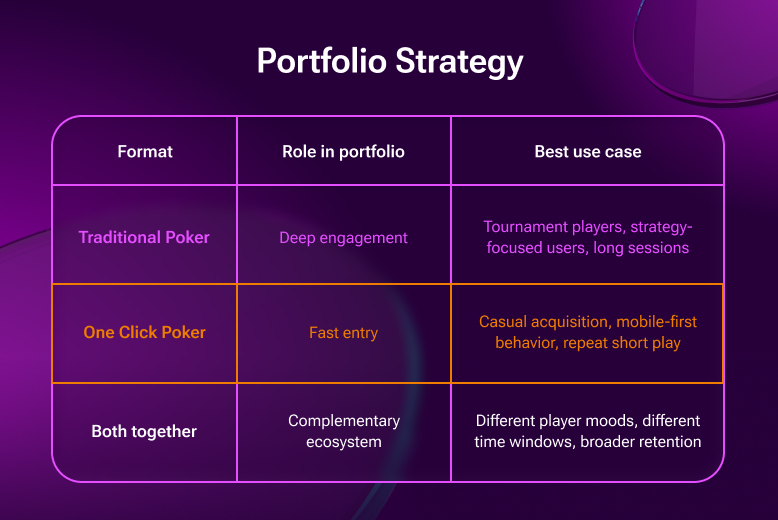
One Click Poker and traditional poker solve different engagement needs. Traditional formats continue to support long-form sessions, competitive depth, community identity, and tournament ecosystems. Simpler formats support:
- Fast entry
- Mobile convenience
- Casual engagement
- Repeat short sessions
The strongest turnkey poker products in 2026 increasingly treat these formats as complementary parts of the same portfolio, allowing players to engage differently depending on context, available time, and play behavior.
Poker Is Expanding Into More Play Contexts
The biggest shift in poker is increasingly tied to accessibility and interaction design. Players move through entertainment in shorter, faster, more fragmented sessions than before. Products that reduce perceived effort and accelerate emotional payoff fit more naturally into that behavior.
Simpler poker formats align well with:
- Mobile-first usage
- Short attention windows
- Habit-driven engagement
- Fast session entry
- Casual repeat play
Traditional poker still retains its place for players seeking depth, competition, and longer-form experiences. These formats increasingly coexist as parts of a broader poker ecosystem, each serving different situations and player expectations.
In 2026, poker is becoming more adaptable to the way people already consume digital entertainment. Looking for a poker software solution that supports faster formats and mobile-first player engagement? Contact the team at EvenBetGaming to explore flexible solutions built for modern player behavior.
FAQ
What is One Click Poker?
One Click Poker is an innovative poker solution from EvenBet Gaming that allows players to instantly join a multiplayer cash game with a single click, without complex lobbies or extra redirects.
How does One Click Poker differ from traditional poker?
The main difference is the no-lobby, cash-game-only format. In traditional poker, players navigate through multi-step lobbies to choose tournaments or tables, while One Click Poker launches instantly directly from the casino lobby.
Who is One Click Poker designed for?
The format is built for both curious newcomers and casino operators. It simplifies poker entry for players accustomed to slots and allows operators to easily integrate poker into their existing casino platform.
Do players need separate registration for One Click Poker?
No, players don’t need separate registration or to enter a separate poker room. The game launches natively from the main casino lobby without redirects.
What are the benefits of One Click Poker for operators?
Operators get easy integration, simple backend management, instant liquidity, and the ability to keep players within the casino ecosystem without the traditional overhead of a separate poker room.
Is this real player-vs-player poker?
Yes, One Click Poker offers real player-vs-player poker rather than gameplay against bots.