

 27 February 2026
  26 min
  236 views
 AI in HR is rapidly becoming part of everyday practice. From automated resume screening and recruitment chatbots to AI-assisted interviews and employee learning platforms, technology is reshaping how companies attract, assess, and develop talent.
But alongside efficiency gains come new questions. How reliable are AI tools in evaluating candidates? Where do they genuinely add value — and where do they create new risks? What happens when candidates themselves begin using AI to pass interviews? And, ultimately, does this technological shift threaten human roles in recruitment and beyond?
In this article, we combine industry insights with our own practical experience to show how to use AI in HR responsibly and effectively. We explore where AI adds value, where it falls short, what safeguards we have introduced, and how the balance between automation and human judgment is evolving in real working environments.
How AI Is Shaping Modern HR
Imagine walking into your HR office today. The recruiter might not be human — at least not at first. As AI and HR become increasingly intertwined, a digital assistant can greet candidates online, answer their questions, and help schedule interviews. What once felt like sci-fi is now everyday reality in many organizations.
From Routine Tasks to Strategic HR Partnerships
In the last few years, Artificial Intelligence (AI) has gone from a curiosity to a core HR tool. One of the clearest signs of this change is the rise of AI-powered chatbots. These digital assistants help candidates navigate job postings, answer common questions, and keep applicant engagement high even before a human recruiter steps in. By 2025, surveys suggest that about 43 % of organizations used AI for HR tasks, including candidate communication, resume screening and administration — up sharply from previous years as HR functions adopt technology more widely.
This trend isn’t slowing down. A significant share of companies say they plan to implement AI solutions for communications and initial candidate interactions over the next one to two years, signalling that even more HR teams are set to experiment with automated tools soon.
However, for several reasons, EvenBet Gaming does not use AI for candidate communication, although we apply it in other areas of our work. We explain our approach in more detail below.
Why AI Adoption in HR Is Taking Off
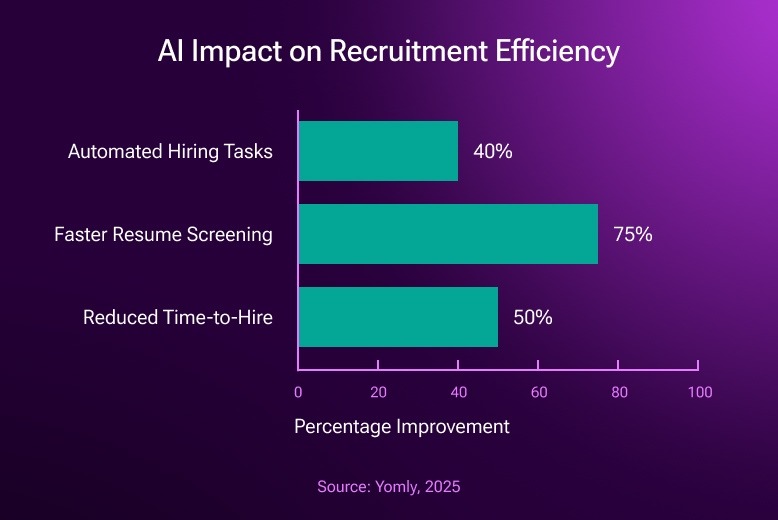
Part of what’s driving this adoption is hard data: AI isn’t just new technology for technology’s sake — it shows results. Organizations identified as talent tech leaders — those actively using AI in hiring — are filling vacancies about 20 % faster and improving the quality of candidate matches by up to 30 %.
These gains come from automating repetitive parts of the hiring funnel — things like drafting job descriptions, parsing resumes, and screening initial applications — freeing HR professionals to focus on what machines can’t replicate well: building relationships, judging culture fit, and developing long-term talent strategies.
AI Everywhere: Hiring, Onboarding, and Beyond
AI’s footprint in HR goes well beyond recruiting. In many companies, systems now support learning and development, performance tracking, and even personalized career guidance. According to industry research, roughly 58 % of organizations use AI for performance management tasks such as real-time feedback or bias reduction in reviews, and many see measurable improvements in efficiency and decision quality.
What’s striking is how fast workers themselves are adopting AI tools — often ahead of formal company rollouts. Microsoft’s global Work Trend Index finds that as of 2025, 75 % of knowledge workers regularly use AI tools in their daily tasks, and almost half of those users started only within the last six months. This suggests that familiarity with AI isn’t just coming from HR systems — it’s happening organically as employees integrate tools into their workflow.
AI Resume Screening: Pros and Cons
In many companies today, the first reviewer of a candidate’s CV isn’t a person — it’s an algorithm. AI-powered tools scan, rank, and filter resumes based on how closely they match a job description. The goal is simple: save time and surface the most relevant applicants faster.
The Pros
Speed and Efficiency
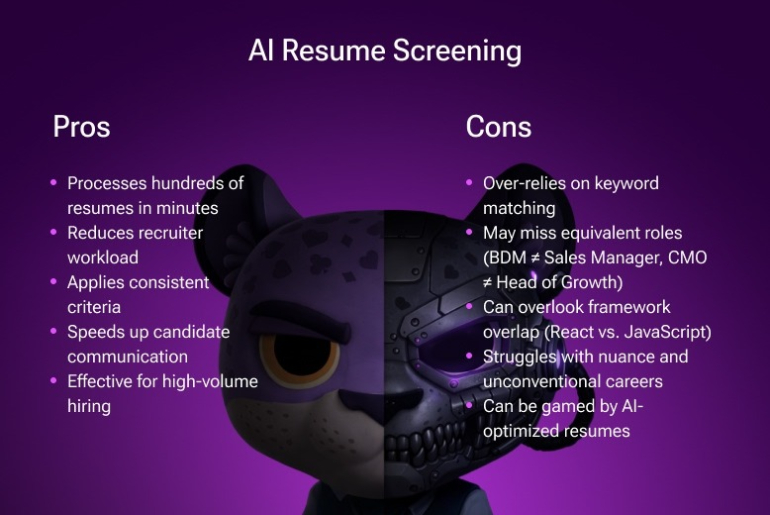
The rise of automated mass applications has become increasingly visible in recent years. Some candidates now use bots to send resumes broadly based on keyword triggers. While hiring platforms apply filters, irrelevant applications still get through. AI may help reduce noise.
AI tools can process hundreds of resumes in minutes. Research shows that automation can significantly reduce screening time. In many cases, automation significantly reduces screening time, giving recruiters back valuable hours each week. For high-volume hiring, this is a major advantage.
Consistency
Unlike humans, AI doesn’t get tired. It applies the same criteria consistently, which can reduce inconsistencies in early-stage filtering.
Faster Communication
Automated systems often integrate with applicant tracking platforms, allowing quicker responses to candidates and a smoother initial experience.
For mass hiring — when companies are opening 10–15 identical roles at once — these benefits can be game-changing.
In some cases, when candidates rely on AI tools to generate their responses, the early stages of communication may end up being conducted almost entirely between two algorithms.
The Cons
Keyword Dependency
In practice, many AI systems still rely heavily on keyword matching. If a candidate describes relevant experience using different wording than the job post, the system may flag it as irrelevant — even when it isn’t.
For example, a Business Development Manager may apply for a Sales Manager role. A Chief Marketing Officer might describe their position as Head of Growth. Without contextual interpretation, an algorithm may not recognize that these titles refer to comparable functions.
The same issue arises in technical roles. A company may be hiring specifically for a React developer, while a candidate describes themselves as a JavaScript developer without explicitly listing React among their frameworks. A human reviewer might understand the likely overlap and investigate further. An automated filter, however, may simply categorize the resume as non-matching.
Context Blind Spots
AI can evaluate facts, but it often struggles to interpret them. Nuance, unconventional career paths, and transferable skills are not always correctly understood.
Algorithm Gaming
There are already cases where candidates tailor resumes specifically to pass AI filters rather than accurately reflect their experience. In one of our recent internal discussions, our HR Director shared an experiment: a candidate once created an intentionally absurd resume, optimized purely to satisfy AI filters — and received an interview invitation. In such scenarios, the system may advance less suitable candidates while filtering out strong ones who simply wrote more naturally.
This creates a paradox: those who write “for the algorithm” move forward, while those who write “for humans” may not.
Because of these limitations, many experts recommend a hybrid approach — AI for volume, humans for judgment.
How EvenBet Gaming Approaches Resume Screening
At EvenBet Gaming, we have consciously chosen not to use AI for resume screening. The reason is simple: our hiring model doesn’t require it.
We rarely open large batches of identical positions. At most, we may hire two or three similar specialists at the same time. Our roles are typically specialized and unique, where contextual understanding matters more than automated filtering.
In this environment, the risks of AI screening outweigh the benefits. If a system filters out a strong but non-standard candidate because of wording differences, we lose valuable talent. Human review allows us to interpret experience more flexibly, ask clarifying questions, and see potential beyond exact keyword matches.
For our scale and hiring philosophy, human screening remains more reliable.
Advice for Candidates
Whether a company uses AI or not, one rule remains constant:
Tailor your resume to each vacancy.
Mass-sending identical CVs rarely works. Highlight the experience that matches the job requirements — and use clear, relevant terminology. Even human recruiters may not have deep technical expertise in your field, so clarity matters.
AI Chatbots in Recruitment
AI-powered chatbots are increasingly used in recruitment processes. At the most basic level, they can accept applications, answer standard questions about a vacancy, and guide candidates through the next steps.
The Pros
Time Efficiency
AI chatbots can significantly reduce the workload of recruiters and hiring managers. For companies hiring dozens of similar specialists at once, automating basic screening questions can save hours of manual communication.
Instead of scheduling multiple short clarification calls, recruiters can review structured chatbot responses and focus only on candidates who pass the initial threshold.
Structured Technical Pre-Screening
For technical roles, AI assistants can be used as a technical pre-screening step — positioned after the initial HR interview but before a deep technical interview with a CTO or team lead. They handle simple qualification checks: experience with specific tools, understanding of core concepts, familiarity with required frameworks.
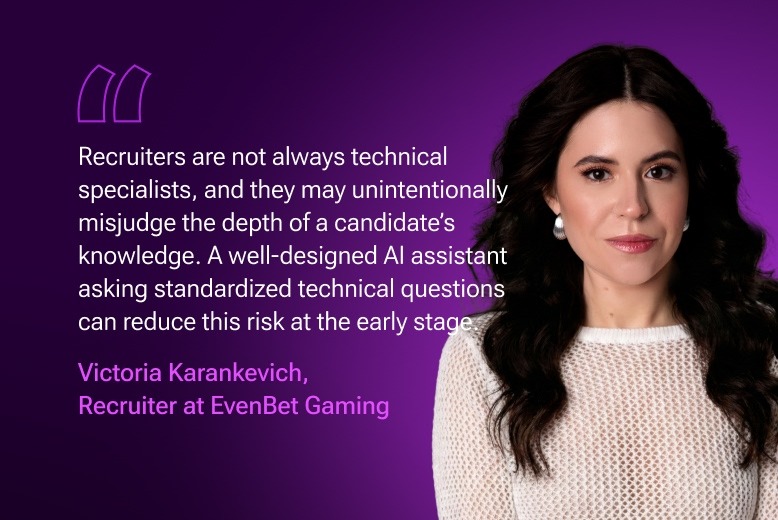
Victoria Karankevich, Recruiter:
AI-powered pre-screening can actually benefit candidates. Recruiters are not always technical specialists, and they may unintentionally misjudge the depth of a candidate’s knowledge. A well-designed AI assistant asking standardized technical questions can reduce this risk at the early stage.
24/7 Availability
Chatbots respond instantly and operate outside business hours, which can improve responsiveness and make the process feel faster.
The Cons
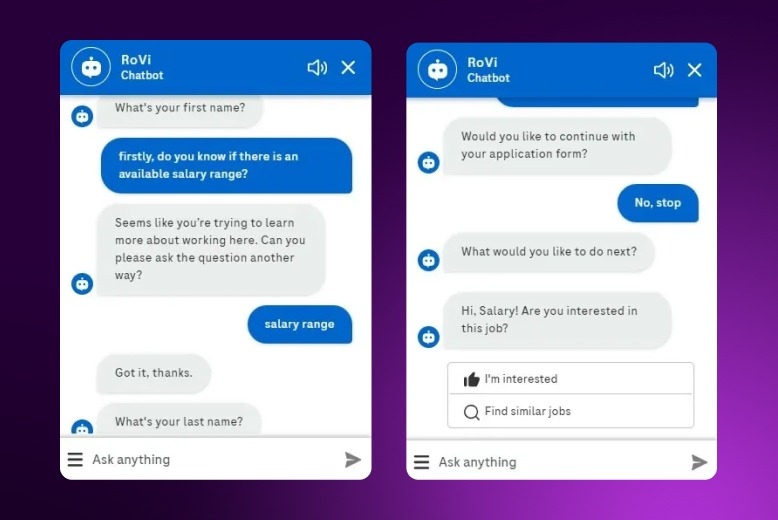
Script Limitations
Chatbots often struggle when conversations deviate from predefined flows. Non-standard questions, unexpected phrasing, or nuanced discussions can easily confuse them. These moments frequently become the subject of online jokes — but in real hiring, they create friction.
Candidate Frustration
Some candidates perceive chatbot interaction as impersonal or dismissive. When a recruiter “doesn’t show up” at the first stage, it may feel like the company doesn’t value the candidate’s time or effort.
For senior or highly specialized professionals, this reaction can be particularly strong.
Risk to the Funnel
As with AI resume screening, there is always a risk that an automated system may incorrectly filter out a strong candidate. If monitoring is weak, valuable applicants can be lost simply because the conversation did not follow the expected pattern.
Automation increases speed — but it also requires careful oversight.
Where Chatbots Make Sense — and Where They Don’t
AI chatbots are most effective in high-volume hiring scenarios, where consistency and speed are critical. They work best when:
- the role requirements are clearly defined,
- evaluation criteria are measurable,
- and the hiring process involves many similar candidates.
For highly specialized or unique roles, however, human communication often remains more appropriate from the start. Nuance, motivation, and contextual career paths are still better assessed in live conversation.
Like many AI tools in HR, chatbots are not inherently good or bad. Their effectiveness depends on scale, role type, and implementation strategy.
The key question is not whether to use AI — but where it truly adds value without weakening the human side of hiring.
AI-Assisted Cheating in Interviews
Like any technology, AI can be used for both constructive and dishonest purposes. In recruitment, we are increasingly seeing cases where candidates rely on AI assistants during interviews or technical assessments.
What started as a tool for drafting resumes or preparing for questions is, in some cases, turning into real-time support during live conversations.
At EvenBet Gaming, we have encountered situations where it strongly appeared that a candidate was using external assistance during an interview. In some cases, the signs were subtle. In others, they were difficult to ignore.
In one recent example, after a technical question from a team lead, a candidate paused for nearly a minute while staring at one point on the screen. Then, without hesitation, they began delivering a perfectly structured answer in highly polished literary language. During the explanation, a second voice could be faintly heard in the background.
This example was unusually explicit. In practice, candidates who rely on AI support during interviews tend to do so more discreetly, making detection considerably harder.
Why This Is More Serious Than It Seems
At first glance, this behavior may appear pointless. If a candidate exaggerates their skills, the mismatch will eventually become visible once they start working. A lack of real competence cannot be hidden for long in a technical role.
However, the situation may be more complex.
There are growing indications that parts of the job market are seeing the emergence of borderline fraudulent practices. Some individuals reportedly use AI tools to pass interviews for high-paying IT roles — sometimes even securing multiple jobs simultaneously. By the time an employer discovers that the employee’s actual competence does not match what was demonstrated during the interview, the person may have already worked for weeks or months.
From a legal standpoint, this creates a difficult situation. Employers are obligated to pay for time worked. Proving intentional deception is complicated, and pursuing compensation or legal action is rarely straightforward.
The Cost of AI-Driven Deception
The consequences affect more than just the employer.
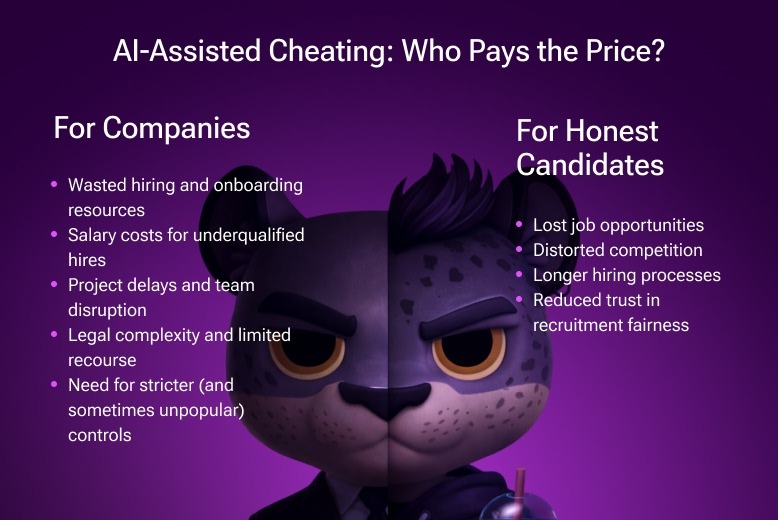
Companies invest time and resources into recruitment, onboarding, and team integration. When a hire turns out to be based on misrepresentation, that investment is lost. Projects may slow down. Team morale may suffer.
At the same time, honest candidates lose opportunities they rightfully deserved. A position taken through deception is a position not offered to someone genuinely qualified.
Perhaps the most frustrating part is that proving cheating is difficult. Even when suspicion is strong, concrete evidence is not always easy to obtain. And even when wrongdoing is confirmed, the lost time and disrupted workflows cannot be recovered.
As a result, companies are increasingly forced to introduce protective measures — some of which may feel strict or unpopular — in order to preserve fairness and maintain hiring standards.
Measures to Prevent AI-Assisted Cheating
As AI-assisted cheating becomes more sophisticated, companies are adapting their hiring processes. The goal is not to create unnecessary barriers — but to preserve fairness, protect resources, and ensure that technical competence is assessed accurately.
At EvenBet Gaming, we have introduced several practical measures in response to these risks.
Verifying the Candidate’s Work Environment
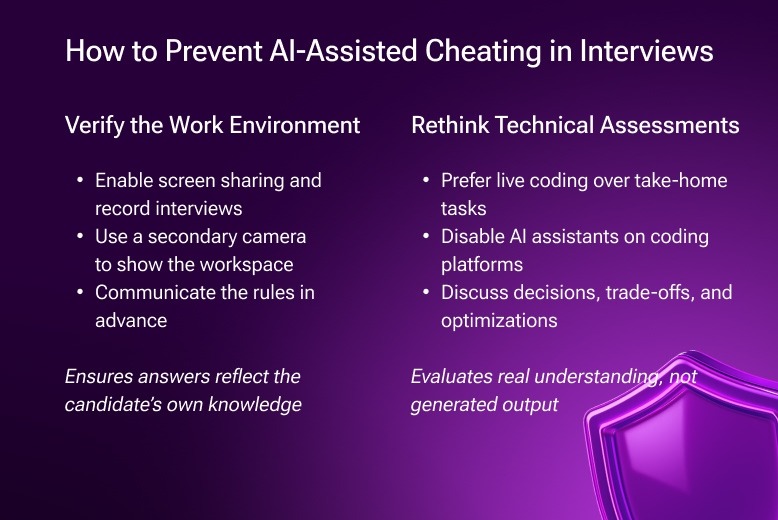
In 2025, many companies have adapted their interview formats for technical roles to address the growing use of AI during assessments. EvenBet Gaming has adopted a similar approach: technical interviews are conducted with screen sharing enabled and recorded.
However, screen sharing alone does not fully eliminate the possibility of external assistance. It is technically possible to configure screen sharing so that only selected windows are visible.
To address this, we use additional measures:
- The candidate joins the interview from a phone as a secondary device.
- The phone camera is positioned to show the full workspace.
- We recommend using small in-ear headphones — or no headphones at all — as large over-ear models can conceal additional devices.
These steps are not about distrust. They are about ensuring that the evaluation reflects the candidate’s own knowledge and skills.
The Downsides
- This approach inevitably makes the hiring process more complex. Coordinating devices and setup requires additional effort from both sides.
- There is also a reputational risk. Some candidates may perceive these measures as intrusive or humiliating and choose to withdraw from the process.
The Upsides
At the same time, there are clear benefits.
- Dishonest candidates are filtered out at early stages and do not occupy interview slots.
- Honest candidates move through the process faster because the funnel is not distorted.
- The company protects itself from investing time and salary resources in hires based on misrepresentation.
We inform candidates about this procedure and explain the reasons behind it at an early stage of the hiring process, so it does not come as an unpleasant surprise.
In practice, we have encountered understanding from candidates. So far, these measures have not led to refusals to continue the hiring process.
Rethinking Technical Assessments
Traditional take-home test assignments are gradually becoming less central in technical hiring. There are multiple reasons for this shift, and the rise of AI tools is one of them.
The focus is increasingly moving toward live coding sessions.
We use specialized live coding platforms during technical interviews. Many such platforms include built-in AI assistants — which we disable. Instead of asking candidates to simply solve a task, we present code and ask them to:
- identify mistakes,
- suggest improvements,
- explain optimization strategies,
- justify architectural decisions.
This format makes real-time external assistance significantly harder. More importantly, it evaluates depth of understanding rather than the ability to produce a polished final answer.
Another approach we may use is a short coding task (up to two hours). During the following technical interview, the team lead discusses the submitted solution with the candidate. Questions may include:
- Why was this approach chosen?
- How could this be optimized?
- What trade-offs were considered?
This conversation quickly reveals whether the candidate genuinely engaged with the task — or relied on a chatbot’s output and presented it as their own solution.
AI for Employee Learning and Development
AI is not only reshaping recruitment — it is also opening new opportunities in employee development.
At EvenBet Gaming, we have recently launched a pilot English language course powered by an AI-based learning platform. The program is designed to help participants reach a C1 proficiency level. At this stage, the course involves a limited group of employees who have not yet achieved this level.
The initiative is experimental by design. If the results prove successful, we plan to expand the platform to additional learning tracks and scale the program to a wider group of employees.
One of the planned directions includes using AI-powered tools to deepen employees’ understanding of poker and technical terminology in English. For team members who work in product, development, or client-facing roles, mastering industry-specific language is essential.
AI platforms offer several advantages in this context:
- personalized learning pace,
- adaptive content based on individual progress,
- real-time feedback,
- and the ability to simulate professional communication scenarios.
Rather than replacing traditional training formats, AI acts as an accelerator. It allows employees to practice consistently and receive structured support without requiring constant instructor supervision.
As with recruitment tools, the goal is not automation for its own sake. It is about using technology where it adds measurable value — supporting professional growth while maintaining high learning standards.
And Finally, Are We All About to Be Replaced by Robots?
This question appears in almost every discussion about artificial intelligence: will AI eventually replace people?
In theory, junior-level roles are the most exposed. Positions where employees execute clearly defined tasks under the guidance of more experienced colleagues are, by their nature, easier to automate. When work follows structured instructions and predictable patterns, AI tools can replicate large parts of it. This may particularly affect roles such as Customer Support, junior QA, or sourcing and research positions, where a significant portion of tasks involves structured, repeatable processes.
The labor market already reflects this shift. Demand for junior specialists in certain technical fields is declining. There are many reasons behind this trend — economic cycles, market saturation, changing business priorities — but the rapid development of AI is undoubtedly one of the contributing factors.
And yet, this does not mean that junior professionals will disappear.
Organizations still need mid-level and senior experts. Those experts do not emerge fully formed; they grow through hands-on experience. Without opportunities at the junior level, the professional pipeline would simply collapse. For this reason alone, companies will continue hiring early-career specialists — not only to fill immediate needs, but to develop future experts who understand the company’s product, culture, and processes from the inside.
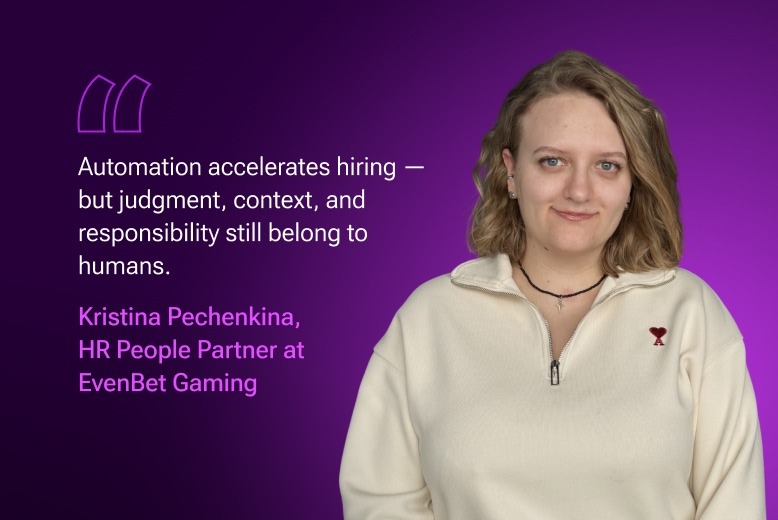
Research and industry voices suggest a more nuanced story. Many HR professionals view AI as an enabler rather than a replacement for human judgement.
No matter how advanced AI becomes, it still requires oversight. An AI system may generate code, draft documentation, analyze data, or propose solutions — but someone with domain expertise must evaluate whether the output is correct, relevant, and aligned with business goals. Professional judgment does not disappear in an AI-driven environment; it becomes even more critical.
In many ways, the role of employees is shifting rather than vanishing. Instead of performing routine execution, professionals increasingly guide, refine, and validate AI-generated outputs. The skill set evolves from “doing the task” to “understanding the task deeply enough to supervise intelligent systems.”
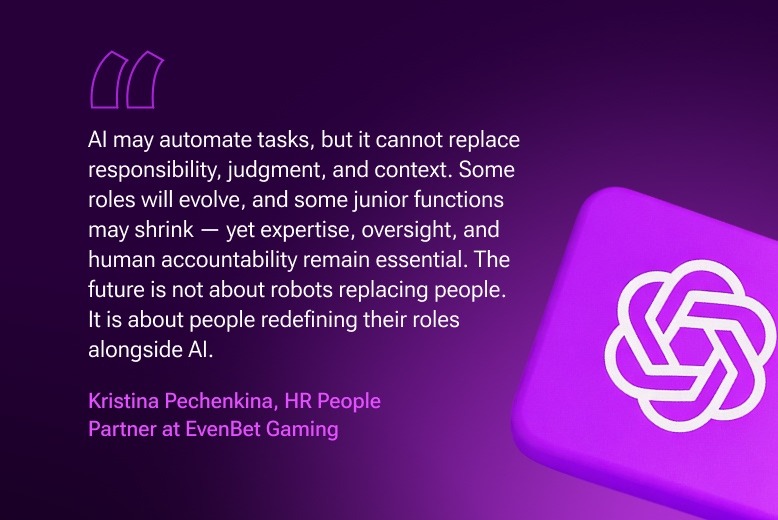
From this perspective, widespread replacement seems unlikely in the foreseeable future. For companies, it is often more rational to retrain and upskill employees than to remove them. AI functions best as a multiplier of human capability — not as an independent decision-maker.
The conversation, therefore, may be framed differently.
The real question is not whether AI will replace people. It is how people will redefine their roles in a world where AI becomes part of everyday work. While routine tasks may diminish, higher-order skills like creativity, problem-solving and interpersonal leadership are becoming more valuable as AI becomes a workplace partner rather than a competitor.
FAQ: AI in HR
What is AI in HR?
It refers to the use of intelligent systems to support and automate human resources processes. Artificial intelligence in HR can help with resume screening, chatbot communication, interview assessments, analytics, and employee learning. In practice, artificial intelligence in HR is not a single tool but a set of technologies that enhance how companies attract, assess, and develop talent.
How to Use AI in HR
Common applications include candidate filtering, automated scheduling, technical pre-screening, and AI-powered learning platforms. The combination of AI and HR works best when automation supports human expertise rather than replaces it.
How to Use AI in HR Effectively
Understanding how to use AI in HR starts with identifying repetitive and structured tasks where automation saves time and improves consistency. Artificial intelligence in HR should assist decision-making, while final hiring and evaluation decisions remain human-led.
How to Implement AI Responsibly in HR
Responsible implementation requires transparency, bias monitoring, and human oversight at critical stages. Companies should clearly communicate when AI is involved and ensure that automated systems are regularly reviewed and adjusted.
How Do Enterprises Implement AI in HR Processes?
Enterprises typically introduce AI gradually through pilot projects, often starting in recruitment or employee development. They integrate AI into existing systems, measure impact, and scale solutions that demonstrate efficiency gains without compromising fairness or accountability.
Conclusion
Artificial intelligence is already reshaping HR — from resume screening and chatbots to learning platforms and technical assessments. It helps automate routine tasks, structure processes, and reduce operational load. Used thoughtfully, it can make recruitment faster, more scalable, and in some cases, more objective.
At the same time, every technological advantage introduces new risks: algorithmic blind spots, candidate frustration, and even AI-assisted cheating. As tools become more sophisticated, so must hiring processes. Companies are learning not just how to adopt AI — but how to supervise it, question it, and build safeguards around it.
AI may assist in recruitment. But hiring is still — and will remain — a human decision. Technology can filter, analyze, and generate. Only people can interpret context, assess character, and take responsibility for the final choice. In the end, recruitment is not just about matching skills to tasks — it is about trusting someone to become part of your team.