
 13 August 2026
  25 min
  12 views
 Adding poker to an established casino does not necessarily require a new platform, a new player database, or a complete migration. If your casino already has a PAM, wallet, payment infrastructure, bonus engine, responsible gambling tools, and reporting, these systems can remain at the center of your operation. A poker platform can connect to them through APIs and single sign-on, while handling the parts that are specific to poker: tables, tournaments, game logic, and network liquidity.
This makes poker API integration a practical way to expand an existing casino without rebuilding its core. The key is to decide which parts of the poker experience should live inside the poker platform and which should continue to rely on your existing casino infrastructure.
How Poker Fits into an Existing Casino
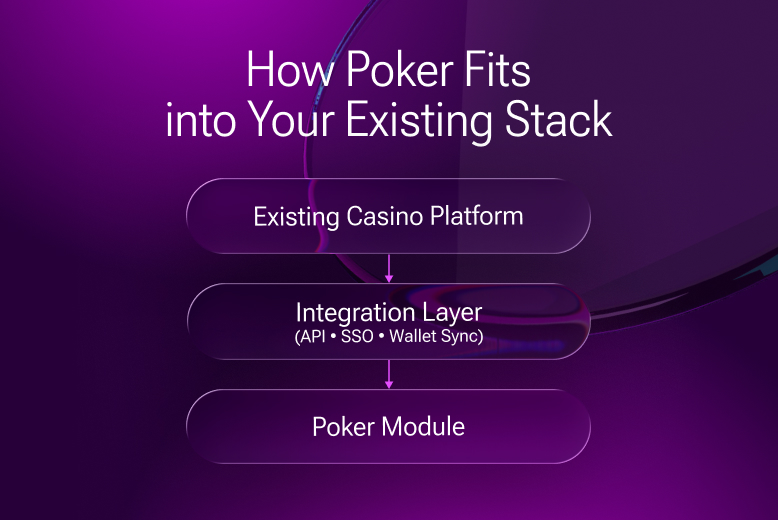
A typical online casino already has several systems working together. The PAM manages player accounts, identity, KYC information, limits, and responsible gambling status. The wallet handles balances and financial transactions. A bonus engine manages promotions and loyalty programs, while reporting and back-office tools collect information across the operation. Poker can connect to this existing stack as a new product.
The poker platform then focuses on poker-specific functionality, including cash games and tables, tournaments, player seating and game state, poker network and liquidity management, as well as poker-related events and activity. The casino continues to manage the account, balance, and player relationship. A simplified architecture looks like this:
PAM → SSO → Poker Platform
Wallet ↔ Poker Platform
Bonus Engine ← Poker Events
This model is at the heart of poker software integration for an existing casino. The poker product gets access to the services it needs without requiring the operator to duplicate the systems it already has.
Choosing an Integration Model
There are several ways to approach poker when planning to integrate poker into a casino platform. One option is to run poker as a separate platform with its own PAM and wallet. Another is to connect a B2B poker supplier to the casino’s existing infrastructure. A third is to move to a broader iGaming platform that includes poker as one of its products.
For an operator with an established casino, connecting a poker supplier to the existing stack can be a practical route. The operator keeps its existing account and financial infrastructure, while the poker supplier provides the specialized poker environment.
This also gives the operator access to the supplier’s poker network and poker liquidity integration, which can be an important part of launching cash games and tournaments with an active player pool. Depending on the operator’s goals, this can mean integrating a full poker platform or adding a lighter poker product. For example, Spins Poker offers short-format games that can be added without launching a full poker room, while One Click Poker brings multiplayer cash games directly into the casino lobby.
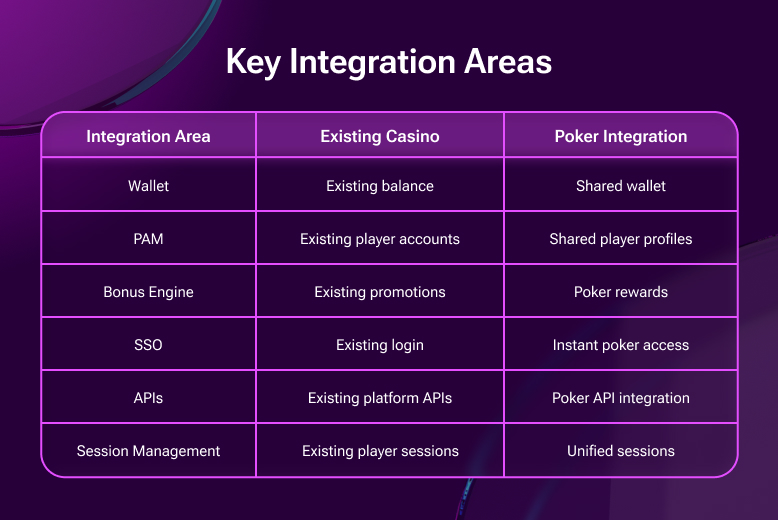
The integration itself can then be built around a few key connections:
- SSO connects the existing casino account with the poker lobby.
- Wallet APIs handle poker-related financial transactions.
- Session management keeps the poker experience connected to the player’s casino account.
- Event callbacks send poker activity to bonuses, loyalty, analytics, and reporting.
- Responsible gambling controls continue to work through the operator’s existing account infrastructure.
The result is a poker product that fits into the casino’s existing ecosystem.
What the Operator Keeps
The main advantage of this approach is that the operator can continue using the infrastructure it has already built. The PAM remains responsible for the player account. The wallet remains the source of truth for the player’s funds. Existing KYC, AML, responsible gambling, and payment processes can continue to serve the player across casino and poker.
This matters for both operations and the player experience. A player can use one account across the casino and poker, move between products without creating another profile, and see their balance through the same account. At the same time, the poker platform can handle the real-time demands of the game without putting the poker logic into the casino’s core systems. That separation is useful when the operator wants to add poker to the casino while keeping its existing platform stable.
What Needs to Be Connected
A poker integration does not require every system in the casino to communicate directly with the poker engine. The key connections are:
- Player and session: the casino authenticates the player and provides a secure session, allowing them to enter poker without a separate registration or login.
- Wallet: poker can request funds and settle player balances through the operator’s existing wallet, with every poker-related transaction remaining traceable.
- Player activity: events such as tournament registrations, buy-ins, rake, and completed sessions can feed the casino’s bonus, loyalty, analytics, and reporting systems.
- Responsible gambling: poker follows the same account restrictions and responsible gambling rules as the rest of the casino, with status changes reaching active poker sessions when needed.
These connections form the foundation of a poker API for an online casino. The next major decision is how the wallet should work, as this determines how funds move between the casino and poker.
Wallet Integration: Seamless vs Transfer
The wallet is one of the most important parts of poker software integration because poker needs to work with the same player funds used across the rest of the casino. There are two common ways to connect the poker platform to the operator’s wallet: transfer and seamless.
Transfer wallet
With a transfer model, the player moves funds from the casino wallet to a separate poker balance when they enter the game. For example, a player with $500 in their casino account might transfer $100 to poker. That $100 is then managed by the poker platform while the player is playing. When the player leaves, the remaining amount is transferred back to the casino wallet. This model gives the poker platform more control over its internal balance, but it also creates another balance that the operator needs to track and reconcile.
Seamless wallet
With a seamless wallet, the player’s funds remain in the operator’s central wallet. Poker requests the financial operations it needs through the API, while the casino wallet remains responsible for the actual balance.
A typical flow is straightforward:
Casino account → poker buy-in → poker session → final settlement → casino balance
A player buys into a cash game, for example, and the poker platform requests the required amount from the casino wallet. When the player leaves the table, the final amount is settled back through the same wallet connection. This model is particularly useful for shared wallet poker integration because the player can use one balance across casino and poker. The player experience is simple: there is no separate poker balance to manage and no need to move money manually between products.
What happens when something goes wrong?
The wallet connection also needs to account for failed requests, connection problems, and unfinished sessions. If a transaction is sent but the response is lost, the system should be able to recognize whether the transaction was already processed.
Unique transaction IDs and idempotency help prevent the same debit or credit from being applied twice. The same applies when a player disconnects during a game. Their poker session and wallet transactions need to remain linked so that the final balance can still be settled correctly. This is why wallet integration should be designed together with session management rather than treated as a separate technical task.
Keeping the Casino Wallet at the Center
For an existing casino, the main benefit of a shared wallet is consistency. The operator can continue using the same wallet for:
- casino games;
- poker;
- deposits and withdrawals;
- bonuses and rewards;
- financial reporting.
The wallet remains the central record of the player’s funds, while poker manages the game itself. This also makes it easier to connect poker activity with the rest of the casino. Once the financial flow is established, the operator can connect poker events to its bonus, loyalty, and reporting systems without creating a separate financial layer for the new product.
The exact wallet model will depend on the poker supplier, game types, and operator’s existing architecture. What matters is defining the flow clearly before implementation begins.
PAM, SSO and Session Management
Once the wallet connection is defined, the next part is the player session. An established casino already has a system that knows who the player is, whether they can play, and what restrictions apply to their account. Poker can use this existing infrastructure through PAM and single sign-on instead of creating a separate account system.
One account across casino and poker
The PAM remains the main source of player information. It can provide the poker platform with the details needed to start a session, such as the player ID, currency, brand, and relevant account status.
The basic flow is simple:
- The player logs into the casino.
- The casino checks that the account can access poker.
- A secure session token is created for the poker product.
- The player opens the poker lobby without another login.
- Poker uses the session to identify the player and start the game.
From the player’s perspective, nothing special needs to happen. They use the same account they already have at the casino. This is an important part of poker API for online casino integration because authentication, account management, and responsible gambling controls can remain connected to the operator’s existing systems.
Session management matters more in poker
Poker sessions can remain active for much longer than a typical casino game round. A player can sit at a cash table for hours or stay in a tournament from registration until the final stages. The poker platform therefore needs to keep track of the player’s active session, table, tournament, and game state.
The integration also needs to handle everyday situations such as:
- a player closing the browser;
- a temporary network connection loss;
- reconnecting to an active table;
- a session timing out;
- logging in from another device.
The exact rules depend on the operator and poker platform, but the important part is keeping the session connected to the player’s casino account.
What happens after a disconnect?
Suppose a player loses their connection in the middle of a cash game. The poker platform can keep the seat available for a defined period and give the player an opportunity to reconnect. If they return, the game state can be restored and play can continue according to the poker rules. If they do not return, the poker platform follows the relevant table or tournament rules and closes the session when appropriate.
The wallet connection needs to remain consistent throughout this process. A connection problem should not create a second transaction, leave funds permanently locked, or make it unclear which session a transaction belongs to. This is why session IDs and transaction records need to be connected.
Responsible gambling during an active session
Responsible gambling rules also need to work throughout the session, not only when the player first opens poker. If a player’s account status changes while they are playing, the casino needs a way to communicate that change to the poker platform.
For example, if a player becomes self-excluded or reaches a relevant account restriction, the poker session may need to be closed. Any remaining funds then go through the normal wallet settlement process. Keeping these checks connected to the existing PAM helps the operator apply the same account rules across casino and poker.
Connecting Poker Activity to the Rest of the Casino
The poker platform also produces information that can be useful outside the game itself. A tournament registration, cash-game session, rake activity, or completed tournament can become an event for other parts of the casino platform. The bonus engine can use these events for promotions and loyalty programs. Reporting can use them for player activity and financial analysis. CRM systems can use them to understand how players move between casino products.
For example, a poker tournament registration could contribute to a campaign that rewards players for participating in a certain number of tournaments. Rake activity could also be used as part of a loyalty or VIP program.
The poker platform does not need to run a separate bonus system for this. It simply provides the relevant activity to the operator’s existing services. That keeps the integration focused: poker manages poker, while the casino continues to manage the wider player relationship.
API Integration: Connecting Poker to the Casino Stack
Once the player, wallet, and session flows are defined, the API layer brings them together. A poker API integration does not need to connect every part of the casino directly to the poker engine. The goal is to create a small number of reliable connections between the systems that need to exchange information. For most operators, these fall into three main areas: player and session information, wallet transactions, and poker activity and events.
Wallet API
The poker platform needs to be able to request the financial operations required by the game. Depending on the setup, this can include:
- checking the player’s available balance;
- taking funds for a buy-in or rebuy;
- returning funds after a session;
- reversing a transaction when necessary.
The API structure depends on the supplier, but every transaction should have a unique ID linking it to the player and poker activity. This helps prevent duplicate transactions when requests are repeated after timeouts or connection issues.
Player and session API
The poker platform also needs a reliable way to identify the player and their active session. The casino can provide the information needed to launch poker and keep the session connected to the existing account.
This connection can include details such as player ID, session ID, brand, currency, account status, and relevant restrictions. The poker platform can then use this information throughout the player’s poker session.
Poker events
The connection works in the other direction too. Poker produces events that can be useful to the rest of the casino. These might include tournament registrations, buy-ins, re-entries, completed sessions, or rake activity. The operator can use these events in its existing bonus, CRM, loyalty, analytics, and reporting systems.
For example, a poker event could trigger progress in a loyalty campaign without requiring the bonus engine to understand the details of the poker game itself. This keeps each system focused on its own role.
What Makes an API Integration Reliable?
A good poker software integration needs to account for normal operations as well as things that go wrong.
The most important areas are:
- Unique transaction IDs make it possible to trace each financial operation.
- Idempotency prevents a repeated request from charging or crediting the player twice.
- Clear error handling tells the poker platform what to do when a wallet request cannot be completed.
- Transaction logs give the operator a record that can be used for reconciliation and dispute resolution.
- Secure authentication protects communication between the poker platform and casino services.
These details may sit behind the scenes, but they have a direct impact on the player experience. A duplicate wallet transaction or an unresolved session can quickly become a player support issue.
The Role of an Integration Layer
For operators working with multiple game suppliers, it can also make sense to place an integration or adapter layer between the casino platform and external providers. Instead of building a completely different connection for every supplier, the operator can define its own internal format and let the adapter translate provider-specific requirements into that format. This can make future integrations easier as the casino expands into additional products.
For poker, the same layer can connect the poker platform to the existing PAM, wallet, bonus, and reporting services while keeping the provider-specific details in one place. The result is a cleaner architecture and fewer dependencies inside the casino’s core systems.
What to Check Before Integration
Before starting a poker API for an online casino project, operators should agree on the main integration rules with the supplier.
Questions worth answering include:
- Which wallet model will be used?
- How is the player’s session created and closed?
- Which poker events are available?
- How are failed and repeated transactions handled?
- How are unfinished sessions settled?
- How quickly can account restrictions reach poker?
- Which data is available for reporting and reconciliation?
- How does the poker network handle liquidity and player pools?
Having these answers before development starts can prevent a lot of rework later. The technical connection is only one part of the project. The other major consideration is the poker network itself, especially how players access tables, tournaments, and shared liquidity as the product grows.
Poker Liquidity Integration
Liquidity is one of the practical considerations when choosing a poker platform. In casino games, a provider can usually supply a game and the operator can make it available to its players. Poker has an additional network dimension: players need other players to create active cash tables and tournaments. This is why poker liquidity integration matters when adding poker to an existing casino.
A poker supplier can connect the operator to an existing poker network or player pool, giving players access to games with participants from the wider network. The operator can then focus on its own brand, player experience, payments, and account management while the poker platform handles the network environment.
Why shared liquidity matters
A larger player pool can make it easier to keep cash tables active and tournaments populated. For an operator launching poker, this can be particularly important at the beginning. A small standalone player pool may struggle to create enough activity across different stakes, game types, and tournament schedules.
Shared liquidity can give players access to a broader selection of games without requiring the operator to build that player base from scratch. The exact model depends on the supplier and the markets involved. Operators should therefore look at liquidity alongside the technical integration when evaluating poker software for existing casino operations.
Important questions include:
- Which markets and player pools are available?
- Which cash games and tournament formats are supported?
- How are players and liquidity shared across brands or operators?
- What happens to liquidity when the operator expands into new markets?
- How are player balances and transactions kept separate between brands?
- Which reporting is available for network activity?
Liquidity also needs to fit the operator’s regulatory and commercial model. The technical connection may be straightforward, but the way players, brands, currencies, and markets interact with the poker network needs to be clear from the start.
Poker as a New Casino Vertical
Adding poker to an existing casino is ultimately an integration project. The operator can keep its existing PAM, wallet, bonus engine, responsible gambling tools, and reporting infrastructure. The poker platform connects to those systems through APIs and SSO, while providing the functionality that makes poker different from other casino products.
The key integration points are:
- PAM and SSO connect the existing player account to poker.
- Wallet integration keeps funds connected to the operator’s central balance.
- Session management keeps long-running poker activity tied to the player’s account.
- Events and APIs connect poker activity to bonuses, loyalty, analytics, and reporting.
- Liquidity integration gives players access to an active poker network.
For operators looking to add poker to the casino, this approach provides a way to expand the product offering while keeping the existing platform at the center of the operation. With the right poker API integration, poker can become another part of the casino ecosystem: connected to the same account, wallet, and player infrastructure, while retaining the specialized technology needed to run the game.
Poker Solutions for Existing Casinos
Operators can choose a poker format that fits their existing product and audience. Spins Poker offers short 5–7 minute Spin & Go-style games and can be integrated into an existing casino without launching a full poker room. For a more seamless casino experience, One Click Poker puts multiplayer cash games directly into the casino lobby, allowing players to start playing with a single click. It is designed specifically for casino audiences and supports 40+ poker variants. Both products show how poker can be introduced as an additional casino vertical without requiring operators to build a full poker ecosystem from scratch.
Want to add poker to your existing casino? EvenBet Gaming provides poker software integration that connects with your existing PAM, wallet, bonus, and player management systems, helping you add poker without replacing your core infrastructure.
FAQ
How can I add poker to an existing online casino?
Start by choosing a poker supplier that can connect to your existing infrastructure. The integration typically covers your PAM, wallet, SSO, responsible gambling tools, and reporting.
Can poker be integrated into an existing casino platform via API?
Yes. A poker platform can connect to the casino through APIs without replacing the existing core systems. This allows poker to use the same player accounts, wallet, and other services already running on the platform.
What is a poker API?
A poker API is a connection between the poker platform and the casino’s existing systems. It can handle player sessions, wallet transactions, and poker activity such as tournament registrations or completed sessions.
How long does poker integration take?
The timeline depends on the existing architecture, integration model, and project scope. A supplier can provide a more accurate estimate after reviewing the casino’s current setup and integration requirements.
Can casino and poker use the same player account and wallet?
Yes. With SSO and a shared wallet, players can access poker using their existing casino account. Their balance can also remain connected to the same central wallet.
Does an online casino need its own poker liquidity?
Not necessarily. A poker supplier can provide access to an existing poker network and shared player liquidity. This can give players access to active cash games and tournaments without the operator building its own player pool from scratch.
What should operators consider before adding poker to their casino?
Operators should look at the wallet model, API requirements, SSO, responsible gambling, reporting, and poker liquidity. It is also important to make sure the integration fits the casino’s existing architecture.
Can poker be integrated without building a separate poker platform?
Yes. An operator can connect a B2B poker platform to its existing casino infrastructure instead of building a poker platform from scratch. The supplier can handle the poker-specific functionality while the operator keeps its existing core systems.