
 23 June 2026
  14 min
  149 views
 Gen Z is rewriting poker’s rulebook, dragging the game out of its grinder-heavy, marathon-session past and into something that moves at mobile-game speed. This generation carries its social-app instincts straight into poker apps — instant gratification, frictionless onboarding, that constant hum of social presence — and expects platforms to deliver on all three. Market research keeps confirming the shift: younger players are measuring poker apps against TikTok, against Discord, against whatever casual mobile hit currently owns their attention span, and poker is scrambling to keep pace as part of the future of online poker.
Why Gen Z matters
Gen Z already shows unusually high engagement with digital gambling and adjacent gaming behaviors, making them one of the most influential groups of young poker players operators need to understand. A 2024 NerdWallet survey cited by multiple industry sources found that 69% of Gen Z adults had gambled in the previous 12 months, the highest share among measured age groups, while the average annual spend reached $1,885. Separately, TransUnion data cited in the same reports said Gen Z betting activity grew by 34% in 2025, the fastest increase among all generations. That does not mean Gen Z already dominates online poker volume. YouGov analysis published in 2025 said the largest share of online poker players still falls in the 35–54 age group, at 44%.
From grind to instant experience
Young online poker players are rapidly losing patience for theory-heavy marathon sessions. Recent industry coverage shows a clear trade-off: fast, stimulating gameplay now wins over slow-burn strategy. Poker, however, continues to lag behind, with product innovation failing to match how digital-native audiences engage with entertainment today.
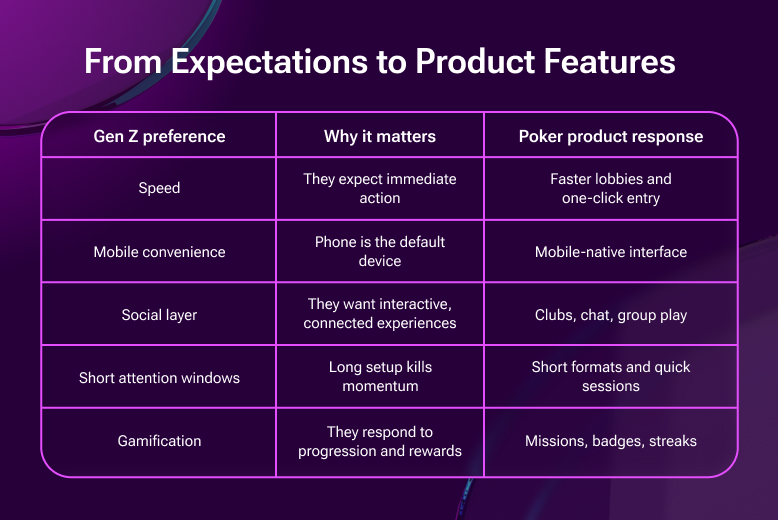
That generational impatience translates directly into format design. Fast poker formats such as fast-fold tables, lottery sit-and-goes, and hyper-turbo structures answer the call by stripping out downtime and compressing decision cycles into something resembling the rhythm players already know from everywhere else in their digital lives. Industry commentary suggests that fast-fold formats can improve retention by reducing downtime and making the game feel more immediate.
Mobile-first is no longer optional
Mobile emerges as the clearest signal across the research. One 2025 TransUnion-based report found that Gen Z and Millennial segments showed the highest mobile gambling app usage, which supports the idea that younger audiences are more likely to engage with gambling products on smartphones and tablets. Additional market commentary also notes that Gen Z players tend to prefer mobile play, especially when apps offer faster formats and frictionless access.
That preference quietly resets the bar for what counts as acceptable UX and raises expectations around the overall poker app experience. Younger users expect one-tap actions, onboarding that takes seconds rather than minutes, table layouts that breathe, and payment flows as smooth as the consumer apps already running their daily lives.
Social features are becoming product infrastructure
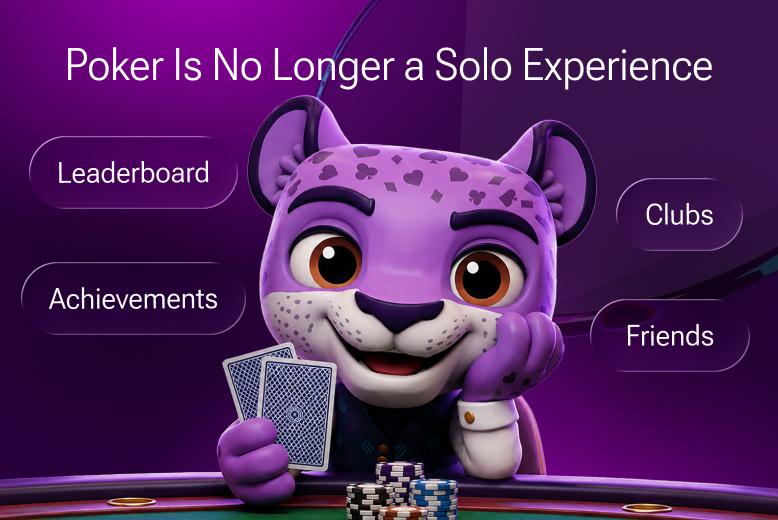
Recent coverage keeps circling back to one point: social tools aren’t garnish, they’re retention infrastructure. Industry sources highlight private games, chat, clubs, and community play as ways to inject back some of the interpersonal energy that standard online poker tends to strip out — a gap that lands harder for young poker players, who typically discover and discuss games through creators, peer networks, and social content long before they touch the game itself.
The product logic underneath is simple. Every extra reason players have to come back with friends, or interact between hands, pulls poker further from a solitary wagering product and closer to a networked entertainment platform, the same social mechanics already running the show everywhere else younger players spend their time. For many Gen Z poker players, community features feel less like optional extras and more like part of the core product.
Product examples worth citing
GGPoker offers some of the clearest examples of product design aligned with younger-player expectations. Its product mix includes Rush & Cash for fast-fold gameplay, Spin & Gold for lottery sit-and-go action, All-In or Fold for simplified preflop decisions, and SnapCam for short video reactions at the table, all of which support a faster and more expressive user experience tailored to young online poker players. GGPoker has also leaned heavily into missions, giveaways, and event-based engagement, including a 2026 New Year campaign built around daily missions and leaderboard activity.
PokerStars shows the same direction through a different lens: UX modernization and social layering. PokerStars highlighted its Next Gen mobile app as a cleaner, more intuitive environment for mobile users, and later introduced social features such as The Rail and Throwables to create a more personalized, expressive in-product experience. Even though some of these features are not new, they are useful examples of how major operators have tried to make poker feel less static and less transactional.
What this means for operators
The implication here cuts deeper than “make poker faster.” It means shrinking the distance at every single stage — discovery, registration, deposit, first hand, social interaction, return sessions — because each one is a spot where a young poker player can quietly vanish if the path feels even slightly longer than expected. Platforms built around long sessions, dense desktop interfaces, and thin social layers can keep serving their legacy regulars just fine, but converting younger recreational users at scale calls for a different set of design assumptions altogether.
For operators, that means the useful KPI mix is drifting away from pure volume metrics and toward engagement signals instead: session frequency, first-session completion, mobile conversion, retention by format, depth of social interaction. The broader trend sitting underneath all of this is hard to miss. Online poker is increasingly built as a mobile entertainment product with competitive elements layered on top, shaped by the same expectations governing every other app currently fighting for the same fifteen minutes of someone’s attention.
Transparency, trust, and fair play still matter
Speed and entertainment get younger players through the door, but they don’t keep them in the room. Players who arrive through casual or mobile-first formats still expect the product underneath to feel fair, legible, and safe — and that expectation runs straight into a category where bots, collusion worries, solver-driven play, and opaque mechanics can erode confidence fast, especially among users who don’t yet have the context to separate a normal bad beat from something actually wrong.
For operators, that means trust signals need far more visibility than older poker products ever bothered giving them. Clear communication about game integrity, easy access to support, plain-language explanations of features, visible player protection measures — each one chips away at hesitation during onboarding, reducing churn at the exact moment a new user is still deciding whether the platform has earned their continued attention. A smoother UX does real work on its own, but it compounds considerably once paired with integrity messaging that’s actually legible and product logic that never asks the player to take anything on faith.
Payments and convenience shape retention
Transactional simplicity is another habit young online poker players bring over from mainstream apps. When it comes to sign-up, payment, and access, users have been trained to expect all three in a handful of taps, which means a long cash-in flow or a delayed withdrawal feels wildly out of proportion to whatever entertainment the session actually delivered. In poker specifically, casual and first-time users carry far less patience for a process-heavy cashier journey than seasoned grinders, who made peace with that friction years ago.
The implication is direct: payment UX is part of the product itself, not some back-office detail tucked behind the game. Operators chasing younger users need fast deposits, familiar payment rails, mobile wallet support wherever regulation allows it, and a clean, short path from registration to first hand. If the first real-money action feels slower than everything else in the app, retention takes the hit before game quality even gets a chance to enter the conversation.
How the product roadmap is changing
Taken together, these threads are reshaping the online poker roadmap in fairly concrete ways. Product teams are leaning into shorter game loops, more prominent mobile design, stronger progression systems, and short poker formats — all of which pull poker closer to a networked entertainment app than a traditional card room. Classic multi-table cash games and long-form tournaments still hold their ground with established regulars, even as they fade as the default front door for an audience that needs an entirely different on-ramp.
Three product priorities rise above the rest:
- Faster access to action — fast poker formats, lighter onboarding, fewer dead moments stretched between decisions
- More expressive gameplay — reactions, table interactions, creator content, clubs, shareable hand moments that give the game texture beyond the cards themselves
- More guided progression — missions, rewards, interfaces that walk newer users through what to do next without sending them off to some outside learning resource
Poker is increasingly borrowing from the broader playbook of game design here. The products winning this audience are asking how to make every minute of the user journey feel active, legible, and worth sticking around for — turning the wait between hands into part of the experience rather than dead air the player has to sit through.
What operators should do next
For operators and platform suppliers, this shift in audience expectations needs to land as specific roadmap choices, not another round of generic “appeal to Gen Z” messaging. The practical goal is stripping out friction, shortening time-to-fun, and building more reasons for players to return between the big tournament moments.
A useful checklist looks something like this:
- Audit mobile onboarding and registration for any step that doesn’t need to be there
- Prioritize quick-entry formats built to work inside 5- to 15-minute sessions
- Add social mechanics that give players room to express themselves without disrupting core gameplay
- Build progression loops for early-stage users, not just VIPs and high-volume regulars
- Surface trust, fairness, and responsible gaming signals more clearly inside the product itself
- Measure success through retention, repeat sessions, and mobile conversion — not just liquidity or average session length
The lesson is simple: young poker players are asking poker products to finally catch up with the usability, speed, and social energy they already get from everything else they touch online. Their expectations are already shaping the future of online poker and accelerating broader online poker trends across the industry.
Conclusion
The next generation of poker players is not rejecting poker itself. They are rejecting friction, waiting, and outdated product design. Speed, intuitive mobile UX, social engagement, and trust are becoming baseline expectations rather than differentiators, fundamentally reshaping the poker app experience. For operators, the opportunity lies in adapting early. Platforms that align product strategy with changing player behavior will be better positioned to attract and retain younger audiences in an increasingly competitive market.
Looking to build a poker platform designed for modern player expectations? EvenBet Gaming B2B poker software with mobile-first architecture, various game formats, and engagement tools designed to improve retention. Whether you’re launching a new room or upgrading an existing product, EvenBet Gaming helps operators stay ahead of where online poker is heading.
FAQ
What do young players expect from online poker?
Most young online poker players expect fast access, simple UX, and a mobile-first experience. They usually want to start playing quickly, with minimal friction, and they respond better to poker formats that feel immediate and easy to understand.
Why is Gen Z changing online poker?
Gen Z is changing online poker because their habits are shaped by mobile apps, short-form content, and social platforms. They are less interested in long grinding sessions and more interested in faster, more interactive experiences.
What makes online poker appealing to Gen Z?
Online poker appeals to Gen Z when it feels fast, social, and easy to access. Features like quick game formats, in-app interaction, and mobile-friendly design make the product feel more natural to this audience.
How can online poker attract Gen Z?
Online poker can attract Gen Z by reducing friction and making the product feel more like a modern entertainment app. That means faster onboarding, smoother payments, shorter formats, and stronger social features.
What are the best features for young online poker players?
The best features for young online poker players are fast-fold formats, mobile-first UX, social interactions, and simple rewards or missions. Anything that makes the experience quicker, smoother, and more engaging is likely to work well.