

 24 March 2026
  Upd: 27 March 2026
  20 min
  964 views
 The rise of AI search is triggering growing concern among iGaming affiliates, particularly those relying on scale-driven SEO models. As user behavior shifts and clicks become less predictable, the stability of traditional acquisition strategies is being questioned.
This change is part of a broader transformation in how businesses approach discovery, marketing, and conversion. What used to be a clear path from search result to website visit is now increasingly shaped by AI-generated answers, recommendations, and summaries. For companies exploring AI for affiliate marketing, this creates new opportunities — but also new dependencies on platforms that increasingly control visibility.
In iGaming, the effect is especially sharp. Affiliates have long depended on search traffic as the foundation of their business model, and AI-driven interfaces are starting to compress that funnel. At the same time, the wider adoption of AI tools for affiliate marketing is accelerating content production, campaign execution, and competitive pressure across the market.
So what is actually changing — and how serious are the risks?
Let’s take a closer look at how the affiliate landscape is evolving, what concerns are justified, and where the real risks lie.
How the Affiliate Model Traditionally Worked
For years, the iGaming affiliate ecosystem was built on a simple and highly effective mechanism: capture user intent in search, convert it into traffic, and monetize that traffic through operator partnerships.
At the core of this model was SEO. Affiliates competed for high-intent queries such as “best online casino,” “top betting sites,” or “fast payout sportsbooks.” These searches signaled a user ready to choose a platform, making them extremely valuable. The role of the affiliate was to intercept this demand and guide users toward specific operators.
The typical funnel looked like this:
- Ranking — a page appears in Google search results for a relevant query
- Click — the user visits the affiliate website
- Comparison — the user reviews offers, bonuses, and features
- Conversion — the user registers with an operator via an affiliate link
Revenue was generated through CPA (cost per acquisition), revenue share, or hybrid models. The more qualified traffic an affiliate could attract, the more predictable and scalable their business became.
This model worked particularly well in iGaming for several reasons.
- The industry is highly competitive, and operators rely heavily on affiliates for user acquisition. This created strong monetization incentives and relatively high payouts compared to other verticals.
- Users often needed guidance. Choosing an operator involves multiple factors — licensing, payment methods, bonuses, withdrawal speed — and affiliates positioned themselves as trusted intermediaries that simplify this decision.
- Search engines acted as the primary discovery channel. Before AI-driven answers, users typically explored multiple websites before making a decision. This gave affiliates ample opportunity to capture attention, build trust, and influence choice.
As a result, success in affiliate marketing was largely a function of three variables: search visibility, content coverage, and conversion optimization. Scale mattered. Affiliates expanded by creating large portfolios of landing pages, targeting different geographies, game types, and user intents.
For more than a decade, this system remained stable. While algorithms evolved and competition increased, the underlying logic — rank, get clicks, convert — did not fundamentally change.
That is precisely what makes the rise of AI search so disruptive: it challenges the very first step of this funnel.
The Rise of AI Search in Affiliate Marketing
Search is no longer just a list of links. It is increasingly becoming a system that provides direct answers.
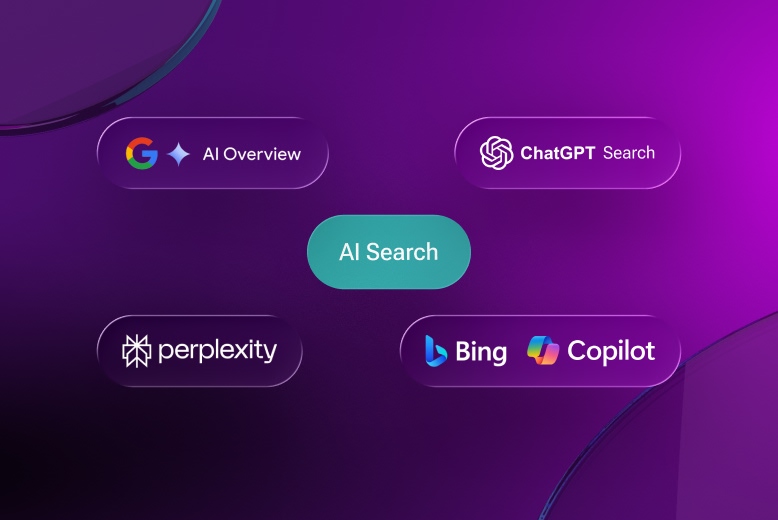
Over the past two years, major platforms have introduced AI-driven search experiences: Google AI Overviews, ChatGPT Search, Bing Copilot, and AI-first engines like Perplexity. Instead of sending users to websites, these tools generate structured answers directly in the interface — often with summaries, comparisons, and recommendations.
This fundamentally changes user behavior. Instead of browsing multiple pages, users can get what they need in a single interaction. In many cases, the decision-making process happens before any click occurs.
For affiliates, this is a critical shift. The traditional entry point — organic search traffic — is no longer guaranteed, even for high-ranking pages.
In other words, search is evolving from a navigation tool into a decision-making layer. And that puts pressure on the entire affiliate funnel.
The “Zero-Click” Problem for Affiliates
One of the most immediate effects of AI search is the rise of “zero-click” interactions — when users get the information they need without visiting a website.
AI-generated answers often include summaries, rankings, and recommendations that previously required users to open multiple affiliate pages. Now, much of this decision-making happens directly in the search interface.
For affiliates, this breaks the first step of the traditional funnel. Even if a page ranks well, it may no longer receive the same level of traffic. The impact is already visible — but not uniform across the market. Studies consistently show a decline in organic click-through rates, though the scale varies by niche and query type.
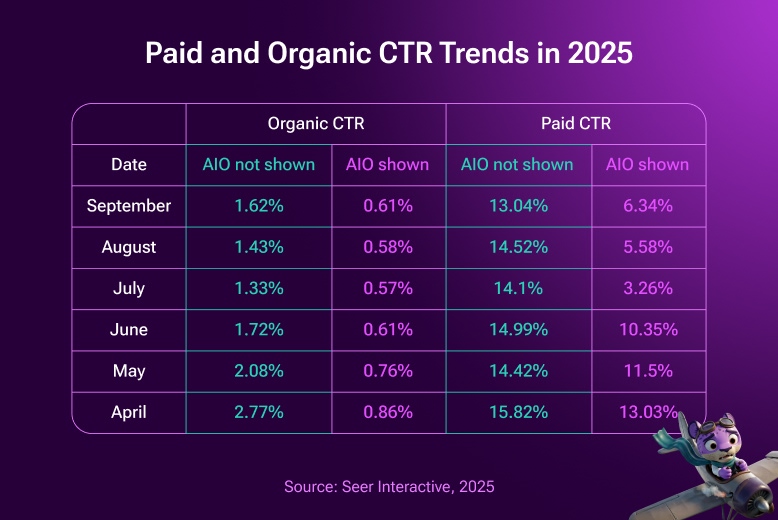
For example, Seer observed CTR dropping by more than half in some cases (from 1.41% to 0.64%), along with significant year-over-year declines. Other analyses report different ranges, which suggests that while the downward trend is clear, its magnitude is not universal.
The impact is already visible:
- fewer clicks from search results
- lower predictability of SEO performance
- increased competition for visibility inside AI-generated answers
This does not mean that search traffic disappears entirely. High-intent users still click — especially when they want to verify information or explore options in more detail.
However, the funnel is becoming shorter and more selective. Instead of capturing broad traffic, affiliates increasingly compete for fewer, but higher-intent clicks.
In this new environment, visibility alone is no longer enough. The key question becomes: is your content being used — and trusted — by AI systems in the first place?
How Affiliates Are Adapting to AI Search (GEO)
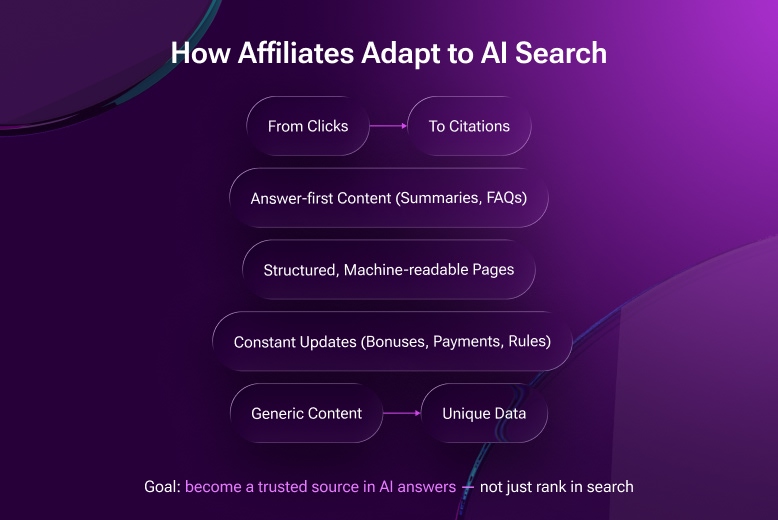
As AI search changes how information is surfaced, affiliates are rethinking not just how they rank, but how their content gets used. The goal shifts from “get the click” to “be the source AI systems rely on.”
This is where Generative Engine Optimization (GEO) comes in — a set of practices aimed at making content easier to extract, verify, and cite in AI-generated answers.
In practice, this leads to a few clear shifts:
- Answer-first structure. Pages increasingly start with direct summaries — “best X for Y,” short rankings, or FAQ blocks — instead of long introductions. This makes content easier for AI systems to pick up and reuse.
- Machine-readable formatting. Structured data (FAQ, Review, Article schema) and clean content hierarchy help models understand entities, relationships, and key claims on the page.
- Constant updates. In iGaming, details like bonuses, payment methods, or licensing status change frequently. Affiliates that keep pages fresh are more likely to be trusted and cited.
- Original data and proof points. Generic content is easy to replicate. What stands out are unique inputs — payout speed comparisons, UX analysis, local payment availability, or real product screenshots.
The underlying shift is simple: affiliates are no longer competing only for rankings. They are competing to become reliable sources inside AI-generated answers — where visibility does not always require a click.
How AI Is Changing Affiliate Operations
AI is no longer limited to content generation or search — it is becoming a core layer of business operations. From marketing to analytics and execution, companies are actively integrating AI in business operations to increase speed and efficiency. According to research from Wharton, businesses are embedding AI into core workflows — from decision-making to process automation — rather than treating it as a standalone tool.
In affiliate marketing, this shift is especially visible, but it reflects a broader trend across industries: AI for operations is replacing manual workflows and reducing dependence on large teams. What once required dedicated specialists — writers, analysts, media buyers — can now be executed faster and at a much larger scale using AI tools for affiliate marketing and automation.
As a result, competition is intensifying not only in affiliates, but across the entire iGaming landscape, where AI for marketing and sales is accelerating execution and raising the baseline for performance.
Content Production at Scale
The biggest impact is in content production. Affiliates use AI to generate briefs, outlines, and first drafts, localize content for different markets, and update large portfolios of pages in a fraction of the time.
This makes it easier to maintain coverage across thousands of keywords and geographies — something that previously required significant resources.
Programmatic SEO and Page Generation
Programmatic SEO is becoming more sophisticated. Instead of manually building pages, affiliates generate structured landing pages at scale — for specific sports, leagues, payment methods, or user intents — using consistent templates and data inputs.
This allows for rapid expansion without proportional growth in teams.
Conversion Optimization and Intent Mapping
AI also improves how affiliates work with user intent. Pages can be aligned more precisely with specific needs — whether it’s fast withdrawals, certain bonus types, or local payment methods.
As a result, funnels become more tailored, and internal linking more strategic.
Media Buying and Faster Testing
On the paid side, AI accelerates media buying. Generating ad creatives, testing variations, and refining audience hypotheses takes less time, which shortens experimentation cycles — especially in ecosystems like Bing and Copilot.
Operations, Monitoring, and Risk
There is also a growing use of AI in operational processes. Affiliates use it to detect anomalies in conversion rates, monitor changes in operator terms, and identify potential fraud patterns.
The net effect is clear: AI lowers the cost of execution, but raises the level of competition. Producing more content is no longer a differentiator on its own — the advantage comes from combining speed with accuracy, compliance, and real value for the user.
Budget Shifts in Affiliate Marketing
As AI changes how traffic is generated and consumed, it also reshapes how affiliates allocate their budgets. The old model — scale content, capture traffic, convert — is becoming less predictable, forcing a rethink of where to invest.
One of the clearest shifts is toward authority and credibility. Affiliates are increasingly investing in PR, expert authorship, and proprietary research — not just to rank, but to build signals that AI systems recognize as trustworthy.
This is where a more structural change emerges: some affiliates are moving beyond traditional SEO-driven sites and developing media-like assets.
In practice, this includes:
- launching editorial-style platforms with expert content and industry coverage
- acquiring or partnering with established media outlets
- building content hubs that go beyond reviews into news, analysis, and data
The reasoning is straightforward. AI systems are more likely to cite sources that appear consistent, reputable, and information-rich — rather than thin affiliate pages optimized purely for conversions. Industry media, in particular, tend to carry stronger authority signals due to structured content, identifiable authorship, and broader topical coverage.
Subscribe now: weekly iGaming insights + a free Poker Marketing Guide
As a result, some affiliates are effectively repositioning themselves as hybrid players — part affiliate, part media company.
At the same time, the return on pure SEO volume is becoming less reliable. Publishing more pages no longer guarantees proportional traffic growth, as AI answers can intercept demand before it reaches affiliate sites.
Another emerging layer is distribution. Some AI-driven platforms are experimenting with publisher partnerships and revenue-sharing models, which could create alternative monetization paths beyond traditional affiliate funnels.
The overall direction is clear: affiliates are shifting from traffic arbitrage toward authority arbitrage, where value comes from being a trusted source — not just a traffic intermediary.
Regional Dynamics: Latin America and Southern Markets
While the impact of AI search is global, its effects are not uniform. In fast-growing regions like Latin America, it overlaps with another major shift — rapid market expansion and ongoing regulation.
What makes this region particularly important is that AI search is already relevant here. Google has been actively expanding AI Overviews across markets and languages, including Spanish and Portuguese, making AI-driven search results a reality in Latin America since 2024–2025.
This means that affiliates in the region are not operating in a “lagging” environment — they are already exposed to the same structural changes in search as more mature markets.
At the same time, countries like Brazil, Mexico, and Colombia continue to grow quickly, with affiliates playing a central role in user acquisition. In many cases, they remain a primary entry point for new users. However, this growth is happening alongside tightening regulation.
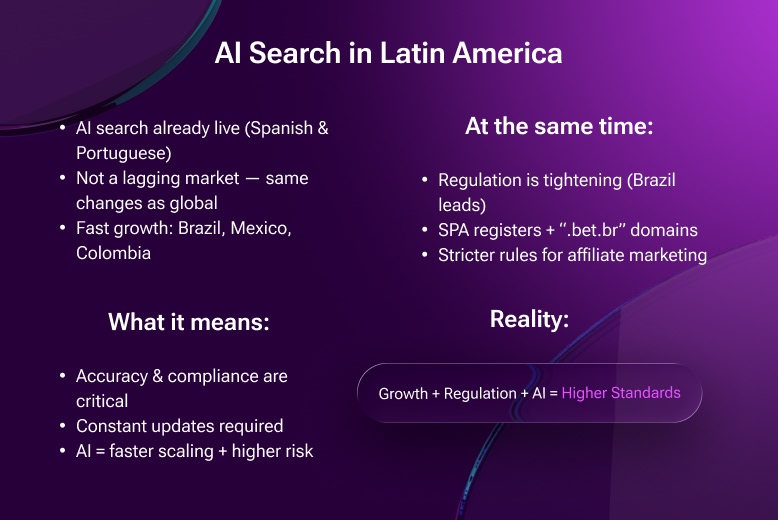
Brazil is the most prominent example. As the market transitions toward a licensed framework, scrutiny over advertising and affiliate activity is increasing — including how operators are promoted, how bonuses are communicated, and how user-facing information is presented.
At the same time, Brazil’s regulatory framework is becoming more formalized. Official registers and updates from the Secretariat of Prizes and Betting (SPA) track authorized operators, while domain requirements such as the use of “.bet.br” help distinguish licensed platforms. Advertising rules introduced through regulatory ordinances (Portarias) also extend to activities carried out via affiliates and third parties, increasing expectations around the accuracy and verifiability of marketing communications.
For affiliates, this creates a more complex operating environment.
Content must now be:
- accurate and verifiable (e.g., licensing status, terms and conditions)
- regularly updated to reflect regulatory changes
- carefully reviewed, especially when AI-generated, to avoid misleading claims
AI amplifies both sides of this equation. It enables faster scaling and localization of content, but also increases the risk of inaccuracies if not properly controlled.
As a result, affiliates in Latin America are navigating two shifts at once: the transition to regulated markets and the rise of AI-driven search. Together, these forces are pushing the industry toward higher standards of transparency, accuracy, and trust.
AI Assistants and Illegal Operators: A New Risk Layer
The rise of AI-driven discovery introduces a new type of risk for the iGaming ecosystem — one that sits outside the traditional control of affiliates and operators.
A recent investigation by The Guardian found that popular AI assistants, in some test scenarios, directed vulnerable users to offshore or unlicensed casinos and even suggested ways to bypass restrictions. While the investigation focused on the UK, it highlights a broader structural issue: AI systems do not always distinguish between licensed and unlicensed operators with the same rigor as regulated ecosystems do.
While this issue is global, it creates a particularly complex set of risks in regions like Latin America.
This includes:
- users arriving already influenced by AI-generated recommendations — including those outside the legal framework of a given country
- increased regulatory scrutiny, as AI blurs how gambling content is discovered and distributed
- stricter requirements from licensed operators, who will assess traffic not only by conversion, but also by compliance, source transparency, and content accuracy
In this environment, risk management becomes part of affiliate strategy. In practice, this means introducing clear guardrails into content:
- explicitly stating the legal status of operators in each country
- linking to official regulators or public license registers where relevant
- avoiding language or instructions that could be interpreted as bypassing restrictions
- applying stricter human review to AI-generated content
In fast-developing regions like Latin America, these measures are not just about compliance. They help future-proof content against regulatory changes and increase trust — both from users and from the systems that increasingly mediate discovery.
The Future of Affiliate Marketing in the AI Era
AI search does not eliminate affiliate marketing — but it fundamentally changes how value is created.
The traditional model was built on access to traffic. Affiliates competed for rankings, scaled content, and monetized clicks. In an AI-driven environment, this logic weakens: visibility no longer guarantees traffic, and traffic no longer guarantees influence.
What replaces it is a different kind of competition — for trust, authority, and inclusion in AI-generated answers.
Several shifts are already becoming visible.
- Generic, scalable content becomes less effective. As AI systems prioritize reliable and distinctive sources, thin pages and templated reviews lose their competitive edge.
- Content moves closer to the decision layer. Instead of acting as an intermediary between search and operator, affiliate content becomes part of the decision-making infrastructure — either as a cited source or as supporting evidence in AI-generated responses.
- Brand and reputation become measurable assets. Affiliates that invest in editorial quality, expert positioning, and proprietary data are more likely to be recognized as trustworthy — both by users and by AI systems.
At the same time, the funnel becomes shorter and more selective. Fewer clicks do not necessarily mean less value — but they increase the importance of high-intent traffic and conversion efficiency.
In parallel, new monetization models may emerge. As AI platforms experiment with publisher partnerships and attribution models, affiliates could gain alternative ways to capture value beyond traditional referral links.
Taken together, these changes point to a clear direction. Affiliate marketing is moving away from a model based on traffic arbitrage toward one based on authority and influence.
In practical terms, the winners are likely to be those who:
- produce original, verifiable, and regularly updated content
- build recognizable brands rather than anonymous SEO assets
- operate within clear compliance frameworks, especially in regulated markets
- combine AI-driven efficiency with human oversight and expertise
The role of affiliates is not disappearing — but it is becoming more demanding. In the AI era, success depends less on how much traffic you can generate, and more on whether your content is trusted enough to shape decisions before the click even happens.