

 4 December 2025
  Upd: 27 March 2026
  23 min
  1183 views
 Running a successful online poker room is not just about liquidity and rake — it’s about building a balanced, long-lasting ecosystem where both recreational and pro players can coexist. That balance doesn’t happen by itself — it requires thoughtful design, careful control, and the right set of tools.
In this article, we’ll explore practical, field-tested methods that help operators manage player dynamics, reduce skill imbalance, and maintain game flow. You’ll find actionable ideas to apply in your room, whether you’re just launching or scaling up.
Poker Ecosystem and Player Types
Poker is a social game — its very nature depends on the presence and diversity of players. But in managing a poker room effectively, it’s not just about the number of players. Who these players are plays a critical role in shaping the room’s long-term sustainability.
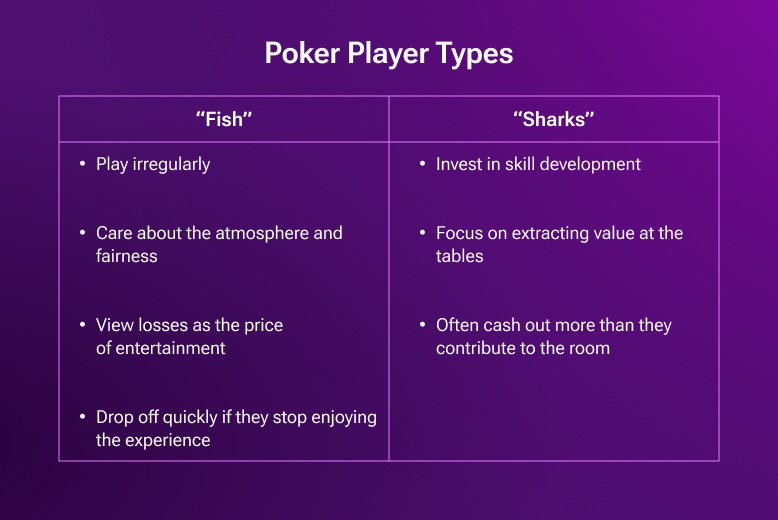
Within the online poker ecosystem, operators often distinguish multiple player segments — recreational players, amateurs, semi-professionals, high-volume grinders, VIPs (or “whales”), and even advantage-seeking users. For the purpose of understanding poker ecosystem, however, two groups matter most:
Recreational Players (“Fish”)
These are casual users who play for fun, emotion, and the social experience. Winning is welcome, but it’s often secondary to the excitement of the game. Many care more about enjoying the moment — or telling the story of a win — than maximizing earnings. They typically:
- Play irregularly
- Care about the atmosphere and fairness
- View losses as the price of entertainment
- Drop off quickly if they stop enjoying the experience
Winning or Professional Players (“Sharks”)
These players treat poker as a source of income. They consistently study the game, develop strategies, and play with a clear profit motive. For many, poker is a routine — a form of work rather than entertainment. They:
- Invest in skill development
- Focus on extracting value at the tables
- Often cash out more than they contribute to the room
The balance between these two segments is what defines the poker ecosystem. A healthy ecosystem relies on maintaining diversity — especially the presence of engaged recreational players. Without them, the game not only becomes unsustainable, but also suffers from liquidity loss.
Regional Variations in Poker Room Management
Experts disagree on the ideal balance between recreational and skilled players, but most suggest a 3:1 or 4:1 ratio favoring casual users. Some operators aim for two regulars per every three or four low-skill players — a setup that helps preserve liquidity and ensure a positive player experience.
This balance isn’t static and varies significantly by region:
- Europe and North America: A mature poker culture and widespread access to training resources result in a larger share of skilled and professional players. As a result, maintaining the poker ecosystem is more challenging, and poker room managers must actively counterbalance skill-heavy tables.
- Asia-Pacific: Poker adoption here is relatively new, meaning player pools are filled with true beginners. This creates a naturally softer environment, making it easier to manage poker tables and retain recreational traffic. However, such conditions are also highly attractive to “sharks,” so operators in the region should proactively consider how to protect their player base and maintain long-term engagement.
- Latin America: The region is experiencing a poker boom, fueled by local streamers and public interest in homegrown poker champions. As a result, many poker rooms here benefit from a high volume of new and casual players.
In general, in jurisdictions with strict advertising limitations, maintaining a healthy player mix becomes harder. With fewer new casual users entering the ecosystem, poker rooms may skew toward over-skilled populations, harming long-term sustainability.
It’s also important to note that player composition can vary greatly depending on the operational model. Large multi-brand poker networks may show different ecosystem dynamics compared to standalone rooms with a localized user base. Similarly, projects using alternative business models — such as sweepstakes poker — often attract different types of players with different motivations, which directly impacts how balance is achieved and maintained.
The Business Case for Poker Ecosystem Management
At its core, the goal of maintaining a healthy poker ecosystem is simple: to maximize long-term revenue for the operator. A sustainable poker room isn’t just about offering a good product — it’s about ensuring that money keeps moving across the tables, driving consistent rake generation without prematurely draining the liquidity pool.
Some tools aimed at improving player experience — such as emojis, throwables, video chat, and post-loss consolation bonuses — help retain recreational players by softening frustration and increasing engagement.
These features are valuable, especially in attracting users who play for fun. But they don’t solve the root problem.
The Problem: One-Way Value Drain
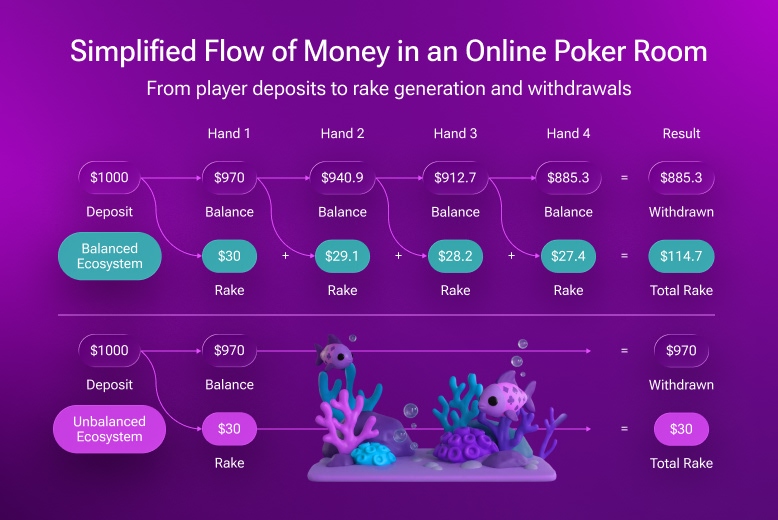
A poker room earns revenue from each hand played — every hand is a micro-transaction that generates rake. That model depends on one condition: players must have money at the tables. If their funds disappear too quickly, or concentrate in too few accounts, the flow stops — and so does the income.
This is where balance between amateurs and pro players becomes critical. When a poker room has too many strong, experienced players — especially those who treat poker as a job — they quickly extract funds from casual users. These professionals rarely play against each other, preferring soft tables with recreational opponents they can consistently beat. Once they’ve won, they often withdraw the funds immediately.
As a result:
- New and casual players lose quickly and leave after a poor experience.
- Skilled players follow — there’s no one left to profit from.
- The tables stop running.
- The room stops earning.
The Cost of Unbalanced Play
There’s also a financial angle tied to payment infrastructure. In many markets, poker operators cover the fees charged by payment providers. Imagine a player deposits funds, loses everything in the first hand to a regular, and that regular immediately cashes out. The poker room may have earned rake from only one hand — a fraction of the deposit — while still absorbing full payment processing costs. In some cases, this results in a net loss.
The Goal: Maximize Value Circulation, Not Withdrawal
To manage your poker room efficiently, it’s not enough to generate activity. The key is to keep funds circulating — gradually turning player deposits into rake over many hands, rather than losing them instantly. Ideally, money moves between players many times, with each transaction contributing to room revenue through rake.
A healthy online poker ecosystem doesn’t just retain players — it retains their bankrolls in motion, ensuring that the room monetizes activity over time. The more hands played, the more sustainable the operation becomes.
How to Maintain Balance Between Amateurs and Pro Players: The Core Principle
As we’ve seen, the tension between recreational and pro players stems from a difference in skill level — but also in how each group approaches the game. Poker room management has no control over whether casual players study strategy, memorize ranges, or spend hours grinding training tools. Nor can it force pro players to “go easy” or play purely for fun.
But there is one thing operators can influence: the size of the advantage that high skill provides.
Skill Matters — But Shouldn’t Dominate
It’s important to be clear: poker is, at its core, a game of skill. If you remove that element entirely, it stops being poker. Eliminating skill expression would alienate your pro player base and flatten the dynamics that make the game compelling.
From an ecosystem perspective, pro players are essential not only because they bring challenge, but because they provide stability. They play consistently — often daily — and generate high volume, which helps maintain liquidity across tables.
Recreational players often log in based on mood, free time, or social context, which makes their presence unpredictable. In rooms composed solely of casual users — especially those operating in a single time zone or limited geographic area — liquidity can fluctuate sharply throughout the day. You may see peak activity during local evening hours, followed by long periods of inactivity. Without a steady base of committed, high-frequency users, it’s difficult to ensure that games are running around the clock.
To keep the poker room active around the clock, you need a reliable base of regulars. They keep the tables running, ensure games are always available, and help create the critical mass needed to attract and retain new players. Without them, even the most engaging features won’t stop the ecosystem from stalling during off-hours.
So the point is not to push out pro players. The point is balance.
A sustainable poker environment doesn’t suppress skill, but controls how much it affects short-term outcomes. The goal is to reduce the gap between top players and everyone else — not by weakening the game, but by designing systems that keep play competitive, dynamic, and entertaining for all types of users. This principle underlies many of the tools used in modern poker management software.
In the following sections, we’ll explore practical methods poker operators can use to maintain a healthy ecosystem — from structural tools to gameplay features.
Restricting Player Stats Collection to Preserve Ecosystem Balance
In poker, detailed statistics about individual opponents — such as their betting patterns, fold frequencies, or pre-flop tendencies — can offer a strategic edge. Skilled, high-volume players know how to collect and use this data effectively. Recreational users, on the other hand, often ignore this layer of gameplay entirely — either because they don’t know how it works or because they’re not interested in studying the game at that level.
To level the playing field, most poker rooms now prohibit the use of third-party tracking software. These tools automatically collect in-game data, build opponent profiles, and surface insights that favor experienced players. Casual users rarely install or understand these tools — and that puts them at a disadvantage.
To address this imbalance, operators have introduced two key restrictions:
- Ban on external tracking tools: Poker room software now actively detects and blocks common HUDs (heads-up displays) and stat-trackers.
- Limits on hand history export: Sharing or analyzing raw game data is becoming harder. This makes it more difficult to build long-term stat profiles and discourages intense study routines — something most casual players would never do anyway.
Together, these changes help reduce the skill gap between pro and recreational players, making the experience more fair.
In-Game Stats: A Balanced Middle Ground
Some modern poker management systems — including features like In-Store as seen in EvenBet Gaming products — offer players the option to purchase basic opponent statistics during live games. These stats are simplified, limited in scope, and designed for instant use, not long-term analysis. They don’t allow deep modeling or exploitative play, but they give all players — even beginners — a chance to make more informed decisions.
Matchmaking: Balancing Skill Through Automated Seating
Matchmaking is a system that removes manual table selection and assigns players automatically based on predefined logic. Instead of choosing a table, the player selects comfortable limits and clicks “Play” — the system handles the rest.
There are three main approaches to matchmaking configuration:
- Skill-based separation: strong players are matched with other strong players; weaker players play among themselves.
- Balanced distribution: each table includes a mix — for example, no more than one strong player per recreational opponent.
- Pure randomization: Players are seated randomly, regardless of skill. Even without skill-based controls, this approach prevents pros from scanning the lobby and selectively targeting weaker opponents, which alone makes it harder to exploit the ecosystem.
Different poker rooms apply different strategies based on their goals and player base. In modern poker management software, players often have two options: either choose a table manually or start a game via quick entry. The latter reduces table targeting by pro players and helps preserve the poker ecosystem, while also making entry easier for casual users.
Anonymous Tables: Limiting Targeting Through Hidden Identities
Many modern platforms — including those built on EvenBet Gaming technology — offer anonymous tables, where player nicknames and avatars are hidden during the session.
This setup removes a key tool for pro players: the ability to recognize opponents by name and selectively target weaker users. Even if a regular manages to run third-party tracking software, its value drops significantly — any statistics gathered apply only to the current session and disappear afterward.

In effect, anonymous tables reduce long-term profiling and level the playing field. All players must rely solely on real-time observation, a skill accessible to both pros and casual users.
Low-Skill Formats: Giving Casual Players a Fairer Shot
Classic Texas Hold’em is a skill-heavy format. While casual players may win a few hands through luck, over time they tend to lose their entire stack when facing pro players. This long-term imbalance makes it harder to retain recreational users and sustain liquidity.
To support the poker ecosystem and improve overall player experience, many operators introduce alternative game formats where the influence of skill is reduced. These games increase variance and give newcomers a better chance to enjoy the game, stay longer, and return more often.
Many of these formats have been successfully implemented in partner projects powered by EvenBet Gaming — and they’ve delivered strong results. You can explore one such example in our case study on the success of 1win Poker.
Next, we’ll look at specific format types that help improve poker room balance and promote sustainable operation.
Omaha: More Variance, Less Predictability
Omaha is a well-known alternative to Texas Hold’em and one of its closest competitors. In the classic version, each player receives four hole cards and must use exactly two of them to build a hand. The number of possible outcomes is significantly higher than in Hold’em, often resulting in more dramatic turns and surprises.
For poker room operators, Omaha offers a key advantage: increased variance. With more cards in play and more hand combinations to consider, it becomes harder for pro players to consistently outplay casual opponents. The game feels more unpredictable — and fairer — for newcomers.
Higher-variance versions such as Omaha 5 or Omaha 6 take this even further, offering even more volatility and engagement.

Spin & Go: Fast-Paced and Casual-Friendly
Spin & Go is a hyper-turbo tournament format with short stacks and rapidly increasing blinds. Sessions last just a few minutes, giving pro players very limited time to apply deep strategies or leverage long-term edge. Players are seated randomly, which means they can’t choose opponents based on skill level — another factor that levels the playing field. As a result, the odds of winning for casual players increase significantly.
This format aligns perfectly with a broader iGaming trend: faster, simplified gameplay. Spin & Go tournaments are highly engaging, easy to understand, and well-suited for mobile users and time-constrained players.
For operators, they offer an added benefit — Spin & Go can be integrated as a standalone product within a casino or sportsbook environment, without requiring a full-scale poker room.

All-in or Fold: Maximum Pressure, Minimal Complexity
All-in or Fold is a high-adrenaline format where players have only two options: go all-in or fold. There’s no room for gradual strategy or positional play — every decision is binary and immediate.
This structure removes the layers of control that pro players typically rely on, limiting their ability to dominate. For casual users, the simplicity and intensity make the format highly entertaining and easy to grasp, even with no prior poker experience.

It’s a powerful tool to attract new players, increase engagement, and add variety to your poker ecosystem without increasing the skill barrier.
Bomb Pot: Forced Action, More Action
Bomb Pot is a poker variation where, with a certain probability, the hand begins with all players automatically placing an equal forced bet — typically a multiple of the big blind — instead of following the standard small/big blind structure. Participation is mandatory in these hands.
This mechanic removes the pre-flop phase, eliminating the opportunity for pro players to apply their usual edge through hand selection or positional aggression. In Bomb Pot hands, everyone sees the flop — which blurs the skill gap and levels the field for casual users.
From the operator’s perspective, Bomb Pot delivers two strong advantages:
- Larger pots mean more rake per hand
- The unexpected action adds entertainment value, making games feel more exciting and unpredictable
It’s a simple way to increase player engagement while improving the poker ecosystem health and enhancing the overall poker site management strategy.
VPIP Restriction: Filtering Players by Play Style
VPIP (Voluntarily Put Money In Pot) measures how often a player adds chips to the pot — excluding forced bets like blinds or special formats like Bomb Pot. In simple terms, it reflects how actively a player engages with hands.
Pro players usually keep their VPIP low, choosing to enter pots only with high-equity hands. Recreational players, by contrast, prefer to “see the flop” more often and play loosely, resulting in a much higher VPIP.
This makes VPIP a convenient metric for segmenting your audience. Operators can configure tables to allow only players within a certain VPIP range — enabling more casual, action-oriented games without the risk of tight pro players dominating the field. It’s a simple yet effective way to support the poker ecosystem and make gameplay more enjoyable for recreational users.
Limiting Multi-Tabling: Slowing Down the Grinders, Boosting the Experience
Many online poker platforms offer players the ability to join multiple tables at once. For example, EvenBet Gaming’s software imposes no hard limits — operators can configure the system to allow as many simultaneous tables as they wish. In practice, advanced users may play dozens of tables in parallel, while recreational players typically stick to just one or two.
Heavy multi-tabling leads to two key issues:
- Pros extract funds too efficiently.
- Gameplay slows down for everyone else, as multi-tablers often use their full time banks, making opponents wait and reducing overall engagement.
To counter this, many poker rooms now limit the number of tables a player can join — often to four, sometimes just two. We see this trend growing across the poker industry, as well as in specific feature requests from EvenBet partners.
Restricting multi-tabling has a dual effect:
- It filters out high-volume grinders who are overly optimized for profit extraction.
- It encourages deeper engagement from remaining regulars — more focused play, more social interaction, and a better experience for everyone at the table.
Anti-Fraud Systems: Essential for Fair Play and Room Integrity
The fastest way to “win” at poker is to cheat — and unfortunately, some players take that route. Common threats include collusion (coordinated play between multiple users) and the use of bots to automate decision-making. These practices damage the experience for honest players, harm the room’s reputation, and lead to direct financial losses.
That’s why having an advanced anti-fraud system is not optional — it’s a mandatory baseline for sustainable operation. Fraud prevention is not just about protecting revenue; it’s about maintaining a trustworthy environment where players feel safe, respected, and motivated to return.
Conclusion
Maintaining a healthy poker ecosystem is a continuous process — one that requires strategic control over player dynamics, game formats, and technical infrastructure. From balancing skill levels to improving session flow and fairness, each tool covered in this article plays a role in long-term sustainability.
At EvenBet Gaming, we’ve spent over 20 years developing poker software for iGaming operators worldwide. Our platform includes a rich set of features designed to help you manage your room more effectively, optimize performance, and deliver an engaging, fair player experience — all while supporting the kind of balanced ecosystem that keeps the game thriving.