


 17 March 2026
  28 min
  15 views
 Many iGaming operators have tried launching poker rooms at least once — and many of them eventually faced the same result: a poker room failure.
The tables stayed empty, marketing campaigns didn’t deliver the expected results, and liquidity never reached a sustainable level. Poker disappeared from the product lineup, reinforcing a common conclusion: the vertical simply doesn’t work.
In reality, poker rarely fails because of the product itself. More often, the problem lies in how the poker room is launched and managed. Poker follows a different set of operational rules than casino or sportsbook products, and overlooking these differences can quickly undermine even a promising project.
In this article, we break down the most common management mistakes that cause poker rooms to struggle — and what operators can do differently if they decide to give poker another chance.
Mistake #0: Launching Poker When Your Business Doesn’t Actually Need It
Online poker can be a powerful vertical in iGaming. When managed correctly, it supports player retention, strengthens the product ecosystem, and creates long-term revenue streams.
But poker is not universally beneficial. In the wrong business model, it can just as easily become a distraction — consuming resources without delivering the expected results.
The difference usually comes down to strategic fit.
Poker is fundamentally a long-term ecosystem product. Unlike casino games, where liquidity is built into the mechanics of the game itself, poker requires a stable player pool and sustained traffic to function properly. Building that environment takes time.
If an operator approaches poker with the expectation of immediate returns, the vertical often disappoints.
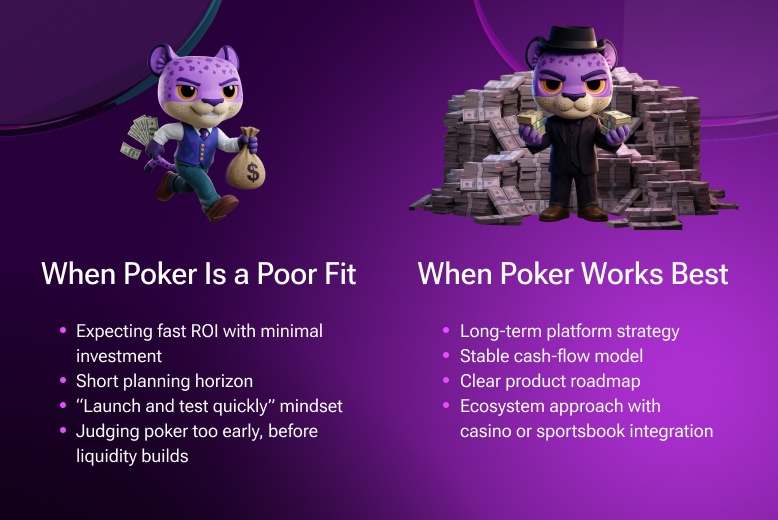
When Online Poker Is a Poor Strategic Fit
Poker rarely works well for businesses that are built around:
- Minimal upfront investment with immediate ROI expectations
- Very short planning horizons
- Aggressive “launch and test quickly” tactics without long-term ecosystem building
In these cases, poker tends to be judged too early. Tables look quiet during the first months, and the conclusion is simple: poker doesn’t work.
In reality, the problem is not the product — it is the timeline.
When Poker Becomes a Strategic Advantage
Poker performs best when it is treated as part of a long-term platform strategy rather than a short-term experiment.
Operators typically succeed with poker when their business strategy includes:
- Long-term development, with a clear roadmap and realistic growth horizon
- Stable cash flow strategy, rather than quick transactional wins
- An interconnected ecosystem, where poker supports and is supported by other verticals such as casino or sportsbetting
In these environments, poker often becomes one of the most powerful retention tools in the entire platform.
Players stay longer, communities form around tables, and the product begins to generate network effects that casino games alone cannot create.
Put simply: if your business strategy is built around hit-and-run launches, poker will likely frustrate you.
Mistake #1: Treating Poker Like a Casino Game
One of the most common management mistakes in poker operations is surprisingly simple: operators approach poker the same way they approach casino games.
This happens for a practical reason. Most companies entering poker come from the casino side of iGaming. Their operational playbook is built around casino logic: launch the product, configure bonuses, run marketing campaigns, and wait for players to arrive.
With casino games, this approach often works. With poker, it usually doesn’t.
The Key Difference: Liquidity
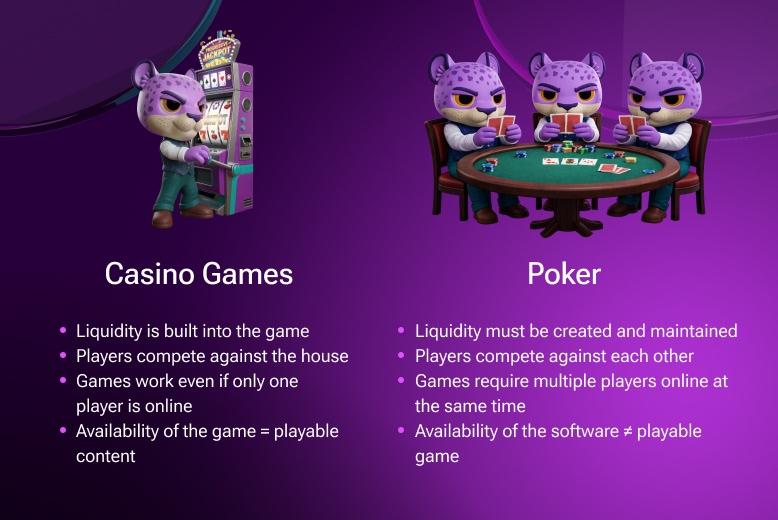
Casino games come with built-in liquidity. If the game is technically available, players always have content to play.
Imagine a hypothetical scenario. A random player lands on an online casino website where, for some reason, nobody else is currently playing. That player will still be able to spin a slot or play blackjack without noticing anything unusual. The game works perfectly because the house is the opponent.
Now imagine the same situation in a poker room. If that player is the only one online, the tables remain empty. The game is technically available — but practically unplayable.
This is the fundamental difference between the two verticals. In poker, it is not enough for the software to be available 24/7. Players must also have someone to play against at any time.
In other words, a poker room must create and maintain a self-sustaining player ecosystem. Building that ecosystem is a complex operational challenge — and one that many operators underestimate.
Why Liquidity Becomes the Decisive Factor
Without a critical mass of players, games do not start. Without active tables, players leave. And once liquidity begins to decline, the process can quickly become self-reinforcing.
This dynamic has contributed to the decline of several poker platforms over the years. For example, the Microgaming Poker Network (MPN) closed in 2020 after a prolonged drop in traffic and increasing operational challenges, including liquidity fragmentation and ecosystem issues.
The lesson is simple: poker is not a content product — it is a liquidity product.
A Practical Solution: Joining a Poker Network
Building liquidity from scratch is difficult, especially for new operators. In fact, based on industry experience, it is arguably the most common reason poker rooms struggle or shut down.
There are ways to address this challenge. One practical approach is joining a poker network as a skin.
In a network environment, multiple operators share a single player pool. This means your players can compete not only with each other but also with players from other partner platforms.
The trade-off is that networks impose certain limitations on customization and operational control. However, they significantly reduce the hardest problem in poker — generating liquidity. Even if only a handful of your own players are online, they will still find active tables and opponents.
Beyond providing access to a shared player pool, poker networks also help operators attract and retain players through tools such as freerolls, achievement rewards, and network-wide promotional events.
In other words, the network doesn’t just provide liquidity at launch — it creates the conditions for sustainable growth.
Of course, joining a poker network does not mean someone else will build your poker business for you. But it does mean you are no longer solving the hardest problems alone.
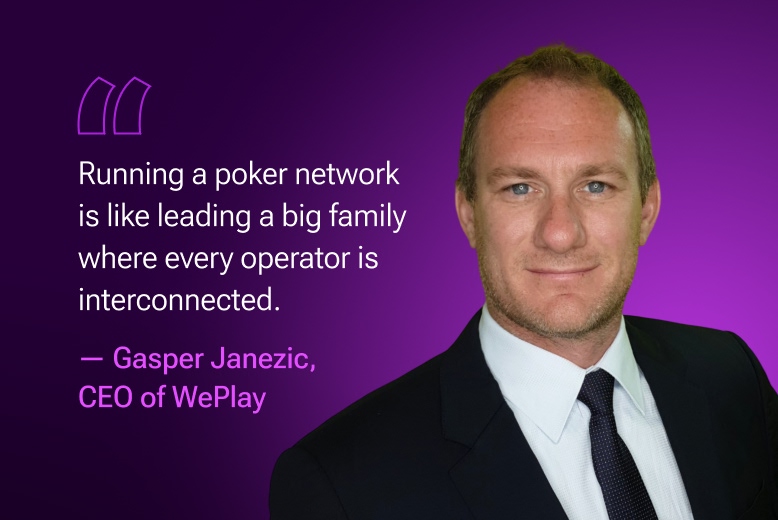
Gasper Janezic, CEO of WePlay Poker Network:
Running a poker network is like leading a big family where every operator is interconnected. Success depends on everyone moving in the same direction, working together and maintaining a healthy ecosystem for players and partners alike. When both the network and its operators invest in ecology and growth, the entire system becomes stronger and more sustainable.
The WePlay Poker Network, built on the technology platform of EvenBet Gaming, is one example of this approach in practice. You can explore how the network expanded its player ecosystem in 2025 in the following case study.

Mistake #2: Treating Casino Players Like Poker Players
If the first mistake is gradually becoming less common thanks to industry education, this one is still widespread. Many operators launch a poker room and immediately try to sell poker to their existing casino audience.
At first glance, the idea seems perfectly logical. You already have a database of gambling players and have invested significant resources in acquiring them. Why not cross-promote poker to this audience and use it to bootstrap liquidity?
When this strategy fails, operators often reach the same conclusion: poker simply doesn’t work anymore.
In reality, the issue is more subtle.
Casino audiences are not inherently unsuitable for poker — but they usually respond differently to the product than traditional poker players do. When operators approach this audience with the same formats and expectations used in classic poker rooms, conversion tends to be very low.
The mistake, therefore, is not relying on your casino audience. The mistake is treating casino players as if they were already poker players.
Why Casino Players Rarely Convert to Poker
Player motivations in casino and poker are fundamentally different.
Casino players are typically looking for:
- Instant gratification
- Short gaming sessions
- Minimal learning curve
Poker offers almost the opposite experience. It requires patience, decision-making, and time at the table. Sessions tend to be longer, and the outcome depends partly on skill. For players accustomed to slots, crash games, or fast casino formats, poker can feel slow, complex, and demanding. As a result, conversion rates from casino to poker are often surprisingly low.
This mismatch leads many operators to misdiagnose the problem. They assume poker as a vertical is declining, when the real issue is audience fit. Fortunately, there are two viable ways to approach this challenge.
Solution #1: Use Casino-Friendly Poker Formats
Operators can introduce poker formats specifically designed for casino audiences. In recent years, several poker solutions have appeared on the market with exactly this goal: lower the barrier to entry and simplify the poker experience.
These formats reduce complexity, shorten sessions, and remove elements that intimidate newcomers. In essence, they deliver a poker-based experience that feels familiar to casino players.
One Click Poker
One Click Poker removes many of the traditional poker interface elements that can overwhelm beginners.
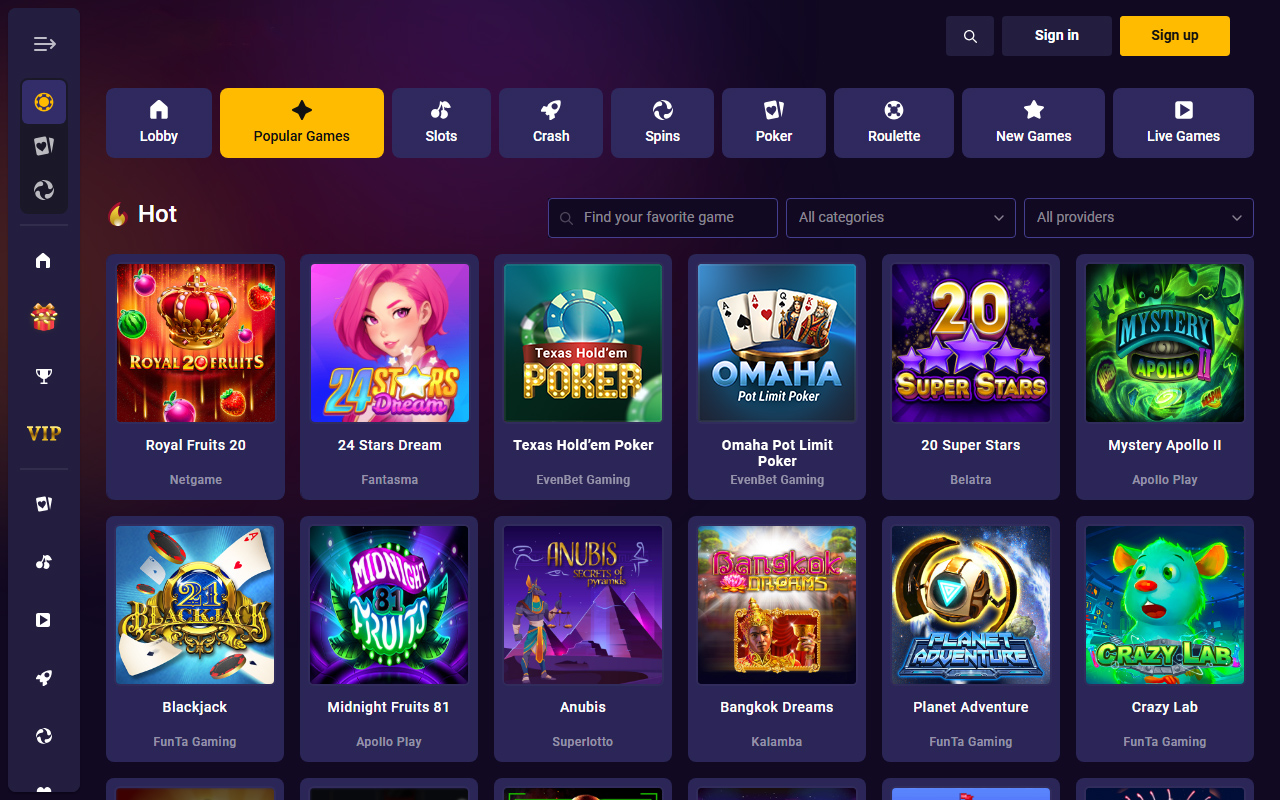
There is no complex lobby or tournament grid. Players simply select a game and stake level and are automatically seated at a table.
Spins Poker
Spins Poker goes even further in aligning poker with casino-style expectations. This format resembles the fast-paced logic of casino games while still preserving the competitive core of poker.
Players instantly enter short Spin & Go-style tournaments, where:
- seats are assigned randomly
- blind levels increase quickly
- sessions typically last only a few minutes
The fast structure reduces the risk of professional players dominating the ecosystem while delivering the quick-session gameplay that casino audiences expect.
Solution #2: Rethink Poker’s Role in Your iGaming Ecosystem
While casino players rarely migrate to poker in large numbers, the opposite often works much better. Poker players convert to casino games far more easily.
This creates an interesting strategic opportunity. Player acquisition in poker is typically cheaper than in casino, because the market is less saturated and the competition for traffic is lower. Once these players enter the ecosystem, many of them eventually explore other verticals.
In this model, poker becomes more than just another game category. It becomes a player acquisition engine.
A well-managed poker room can:
- attract new players at relatively low cost
- build community-driven engagement
- increase overall player lifetime value (LTV)
- create cross-selling opportunities across casino and sportsbook products
In implementing this strategy, casino side games can be particularly useful. Available directly within the poker client, they allow players who have folded early in a hand to quickly play a short casino-style game — such as Baccarat — without leaving the poker table.
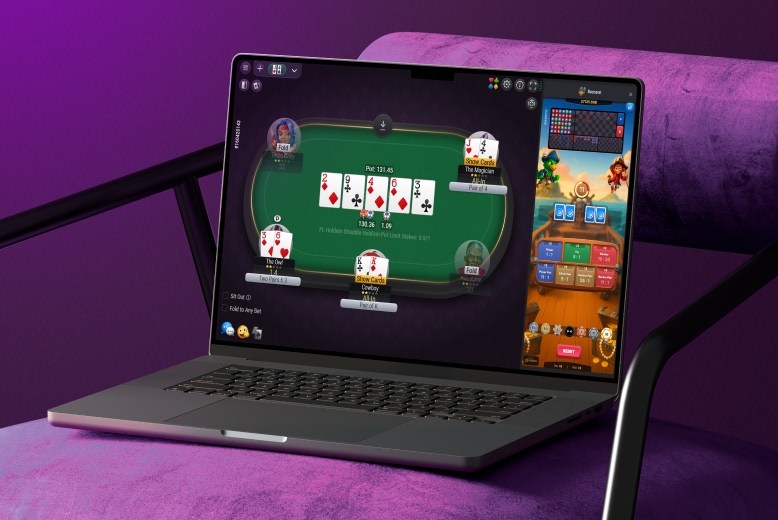
In this way, side games are not only an additional revenue stream. They also act as a natural conversion funnel, gradually introducing poker players to casino-style gameplay.
In other words, poker becomes not just a product — but a strategic growth channel.
Which Approach Should You Choose?
The right strategy depends on how you see poker within your business.
Traditional poker ecosystems are best suited for operators who:
- want to unlock the full ecosystem benefits of poker
- plan to build a long-term poker product
- are ready to invest in expertise and community development
Casino-friendly poker formats, on the other hand, are a good fit for operators who:
- view poker primarily as an additional revenue stream
- want to diversify their content offering
- prefer to test the poker vertical with lower risk and smaller investment
Both strategies can work. The key is understanding that poker and casino attract fundamentally different player behaviors. Trying to force one audience into the other rarely produces the results operators expect.
And misunderstanding player behavior leads to the next critical mistake poker operators make.
Mistake #3: Running Poker “Out of the Box”
In some ways, this mistake is a variation of the first one. It stems from the assumption that technology alone can generate revenue.
In casino operations, that assumption sometimes works. You launch a game, bring in traffic, and the mechanics of the game itself generate activity. Poker doesn’t behave that way.
A poker platform is not a finished product the moment it goes live. It is a framework that must be carefully configured and adapted to a specific player audience.
Why One-Size-Fits-All Poker Rarely Works
Poker culture varies significantly from one region to another.
Player behavior differs across markets in several important ways:
- preferred game formats and stakes
- daily activity patterns and peak traffic hours
- tolerance for skill-based competition
- popularity of tournaments versus cash games
- expectations around bonuses, gamification, and rewards
Ignoring these differences can lead to a situation where the product is technically correct but misaligned with the local market.
For example, tournament-heavy schedules may work well in some regions, while others are dominated by cash games or fast formats. Some audiences prefer deep-stack strategic play, while others respond better to faster, more casual formats.
Modern poker platforms provide a wide range of configuration tools precisely for this reason. They allow operators to fine-tune the room for a specific market and optimize player acquisition, retention, and overall profitability.
When these tools are ignored and the room launches with default settings, the result is often disappointing. Players simply don’t find the environment engaging enough to stay. And once engagement drops, liquidity follows.
The Practical Solution: Work With Experienced Poker Specialists
The good news is that operators don’t have to solve this problem alone. If you are working with a poker technology provider that has experience in your target market, the simplest step is often the most effective one: ask for guidance before launch.
Established providers typically accumulate a significant body of knowledge about regional poker behavior — what works, what doesn’t, and which pitfalls are common in specific markets.
At EvenBet Gaming, for example, more than two decades of experience delivering online poker software across global markets have made one lesson clear: launching a successful poker room requires preparation.
That is why experienced providers often take a proactive role in helping operators prepare for launch — from configuring tournament grids to advising on formats, features, and ecosystem strategy.
Mistake #4: Choosing Software That Cannot Grow With Your Poker Room
When operators evaluate poker software, they often focus on the obvious criteria: stability and visual design. Both are important, of course. No one wants a poker client that crashes during a tournament or looks outdated compared to modern casino products. But in poker operations, software quality goes far beyond stability and aesthetics. Flexibility and customization are just as critical.
The Hidden Risk of “Fast Launch” Poker Solutions
The market is full of turnkey poker solutions designed for fast deployment. These products allow operators to launch quickly, minimize upfront investment, and start accepting players almost immediately. If the platform runs reliably and the operator can bring in enough traffic, such setups can generate solid revenue in the early stages.
The problems usually appear later.
As the poker room grows, operators inevitably face new challenges:
- expanding into new markets
- adjusting formats to match local player behavior
- responding to changes in the competitive landscape
- experimenting with promotions, tournament structures, and gamification
At that point, many operators discover that their platform simply doesn’t provide the tools needed to adapt. Without flexible configuration options, even small changes can become difficult or impossible. Scaling the business becomes constrained by the technology itself.
In other words, the poker room stops evolving while the market around it continues to change.
A Practical Approach to Evaluating Poker Software
There is no single perfect platform for every operator. Choosing the right solution requires careful evaluation.
However, a few questions can quickly reveal whether a platform will support long-term growth:
- Does it offer flexible configuration of games and tournaments, including multiple poker variations and formats?
- Can the operator customize the client experience, including branding and interface design?
- Does the platform include engagement tools such as promotions, missions, and player interaction features?
- Does the back-office support reporting, payments management, and player segmentation?
- Can the infrastructure scale and integrate with other iGaming services?
If these capabilities are limited, the operator may eventually find themselves locked into a product that cannot evolve with the business.
That situation is far more expensive to fix than choosing the right technology from the start.
 Windows
  macOS
macOS  iOS
iOS  Android
 And yes, we could simply say: “Use EvenBet Gaming software.” But that would sound a little too convenient. Instead, we recommend starting with a structured evaluation of the available solutions.
Our Smart Poker Software Checklist can help operators assess platforms based on the factors that truly matter for long-term poker operations. Subscribe to our newsletter to receive it.
Just enter your email
Mistake #5: Underestimating Poker Fraud and Game Integrity
In some ways, this mistake is also an extension of Mistake #1 — treating poker like casino games. Fraud prevention in casino products is relatively straightforward. A well-configured incident detection system can identify suspicious betting patterns or bonus abuse. Poker fraud is much more complex.
Why Poker Fraud Is Harder to Detect
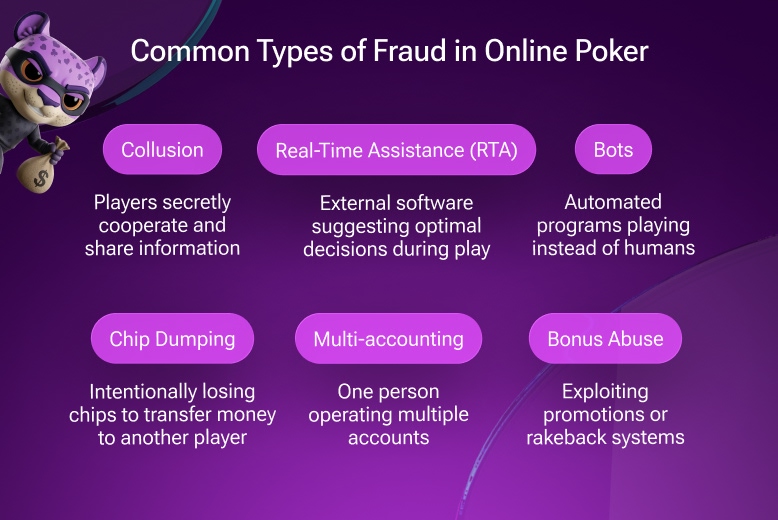
One of the most common forms of poker fraud is collusion. In collusion schemes, multiple players coordinate their actions at the table and share information about their cards. This gives them a significant advantage over honest players and allows them to extract money from the ecosystem.
Detecting such behavior can be extremely difficult. Colluders often attempt to disguise their actions, and identifying suspicious patterns requires both advanced analytics and human expertise.
If operators fail to address these risks effectively, the consequences appear quickly. Poker players are highly sensitive to fairness. Once the community begins to suspect that games are compromised, trust collapses rapidly — and liquidity follows.
The Other Side of the Problem: False Positives
Fraud detection in poker also has another challenge. Because fraudulent behavior can be subtle and complex, anti-fraud systems inevitably generate false positives. Honest players may be flagged or even banned by automated systems.
If these cases are not reviewed carefully, the operator risks damaging their reputation just as severely as if fraud had gone undetected.
Maintaining game integrity therefore requires a careful balance between automation and expert review.
The Core Solution: Strong Anti-Fraud Infrastructure
For operators entering the poker vertical, anti-fraud capabilities should be a key consideration when choosing a software provider. Modern poker platforms increasingly rely on AI and machine learning technologies to detect suspicious patterns, analyze player behavior, and identify potential collusion networks.
But technology alone is not enough. Successful poker operations treat game integrity as a dedicated operational function, often supported by a specialized team that reviews incidents and investigates suspicious behavior.
What If Your Team Lacks the Resources?
In practice, smaller operators sometimes struggle to process every incident quickly. Reducing the sensitivity of the anti-fraud system is not a good option — it simply creates more opportunities for fraud.
In such situations, operators can temporarily reduce fraud risks through ecosystem management decisions.
For example:
- Adjusting the lobby offering. Collusion is typically easier at cash tables than in tournaments, and high-stakes tables tend to attract more fraudulent activity. Temporarily reducing the availability of such formats can lower the risk while the anti-fraud process is improved.
- Promoting formats that limit collusion opportunities. Game formats with automatic random seating significantly reduce the ability of coordinated players to sit at the same table.
Two examples of such formats include One Click Poker and Spins Poker, both mentioned earlier in this article. Because players cannot deliberately choose the same table, collusion becomes far more difficult to organize.
The same logic also reduces the effectiveness of other types of fraud, including certain forms of bot activity.
In poker operations, maintaining trust is not optional. Without strong integrity management, even the most successful poker room can quickly lose the one asset it depends on most: player confidence in fair games.
FAQ
Why do poker rooms struggle with liquidity?
Problems with poker room liquidity usually occur when there are not enough players online at the same time. Effective poker room management requires building and maintaining a balanced player ecosystem so games run continuously and players always find active tables.
Why does a poker room fail?
A poker room failure often happens when operators treat poker like a casino product. Without proper liquidity strategy, fraud prevention, and the right poker room software, even a technically stable room can quickly lose players and traffic.
What common mistakes do poker room operators make?
Some of the most common mistakes include relying on casino players to fill poker tables, launching with default settings, underestimating fraud risks, and choosing inflexible poker room providers that limit customization and growth.
What makes a poker room profitable?
A profitable poker room combines strong liquidity management, reliable poker room software, and long-term ecosystem strategy. Working with an experienced poker room provider can also help operators configure the platform, attract players, and maintain a healthy game environment.
Conclusion: Poker Is an Ecosystem, Not Just Another Game
Many operators who tried launching poker and later removed it from their product lineup share the same story: the launch seemed simple, but the results never matched expectations. Tables stayed empty, liquidity never stabilized, and the project quietly disappeared.
In most cases, the problem wasn’t poker itself. It was the assumption that poker works like other iGaming products. Casino games can generate revenue as soon as traffic arrives. Poker is different. Without liquidity, trust, and a carefully managed player ecosystem, even a technically solid poker room will struggle.
The mistakes we discussed — treating poker like a casino product, relying on the wrong audience, launching with default settings, choosing inflexible technology, or underestimating game integrity — all stem from the same misunderstanding. Poker is not just another game in the catalog. It is an ecosystem that requires active management.
When that ecosystem is built correctly, poker becomes a powerful driver of engagement, retention, and long-term growth.
In other words, poker rarely fails because the vertical is broken. It fails because it was launched with the wrong expectations.