

 30 April 2026
  Upd: 9 July 2026
  19 min
  257 views
 Nearly all employees and leaders experience miscommunication at least once a week. And poor communication costs businesses over $12,000 per employee annually.
But even these numbers don’t fully capture the real impact. According to research by Grammarly and The Harris Poll, ineffective communication leads to lost productivity, delays, and misunderstandings that affect almost every team. Other studies suggest that companies can lose up to $1.2 trillion annually due to communication issues at scale.
Over the years, working with different teams, I’ve seen how much communication shapes the way we work. In this article, I want to share some of that experience and reflect on what communication really looks like in everyday work.
Why Communication Matters More Than Ever — and Why It Needs to Be Learned
If we cannot communicate, we cannot work together. And if we cannot work together, we cannot deliver projects and achieve results.
I’ve seen how this plays out in practice. There was a situation where I posted a message about an urgent task in a chat with three colleagues. One understood “urgent” as “today.” Another assumed it meant “by the end of the week.” The third thought it wasn’t relevant to them at all.
Nothing was technically wrong with the message. But everything was wrong with how it was interpreted.
This is not about individual mistakes. It is about shared language.
Every team develops its own understanding of words like “urgent,” “soon,” or “high priority.” When that understanding is not aligned, communication becomes unpredictable — and execution becomes unreliable.
This is the point where communication stops being a “soft skill” and becomes a business factor.
Today, communication is not just about how we speak or write. It reflects how a company operates — how decisions are made, how teams align, how quickly problems are resolved.
Saying “communication matters” feels outdated. That was true years ago. Now it’s clearer: communication is the mechanism that determines whether a team can function at all.
Over the past few years, its role has only grown — not because communication itself has changed, but because everything around it has become more complex.
Key Communication Trends
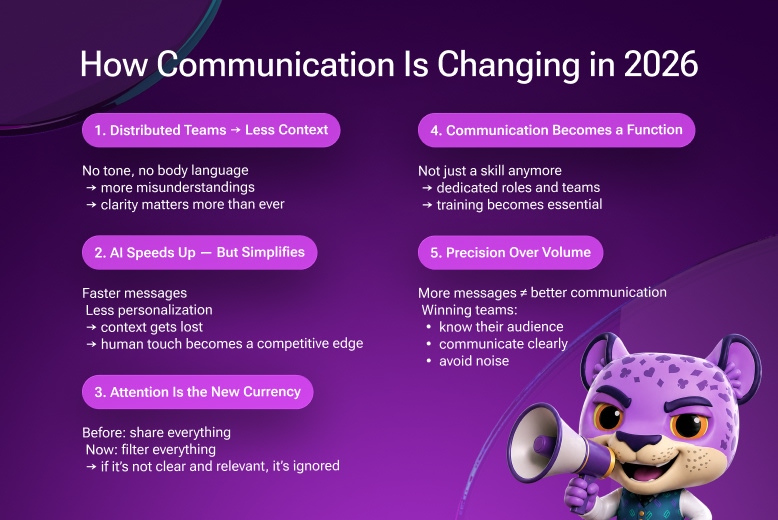
Trend 1: Distributed Teams — Context Goes Missing
Most teams today are distributed or hybrid — and this fundamentally changes how communication works.
Previously, meaning was conveyed not only through words, but also through tone of voice, facial expressions, and body language. These elements helped clarify intent, reduce ambiguity, and speed up alignment.
In a remote environment, these layers are largely missing. As a result, communication becomes more dependent on how clearly a message is formulated. Misunderstandings happen more easily, and even simple tasks may require additional clarification. Remote work hasn’t just changed the format — it has made communication more demanding and effort-intensive.
Trend 2: AI Writes Faster. But Does It Know Your Team?
Artificial intelligence has significantly increased the speed of communication.
It helps structure messages, generate text, and process information faster. But while speed has improved, understanding has become more challenging.
Communication becomes less personalized. In real teams, there are always internal references — shared jokes, informal language, and specific terminology that evolves over time. AI does not have access to this context and cannot fully interpret it.
As a result, communication risks becoming more standardized and less precise in meaning, even if it looks well-structured.
At the same time, this makes the value of a personalized approach even higher — the ability to adapt communication to a specific team, context, and audience becomes a real advantage.
Trend 3: The Attention Economy – Communication’s New Currency
The volume of communication has grown to the point where attention becomes the key constraint.
A few years ago, the goal was to share as much information as possible — to share every update, cover every detail, and make sure nothing was missed. Today, the opposite is true: people actively filter out what they consider non-essential. Notifications are muted. Messages are skipped. Long updates are ignored.
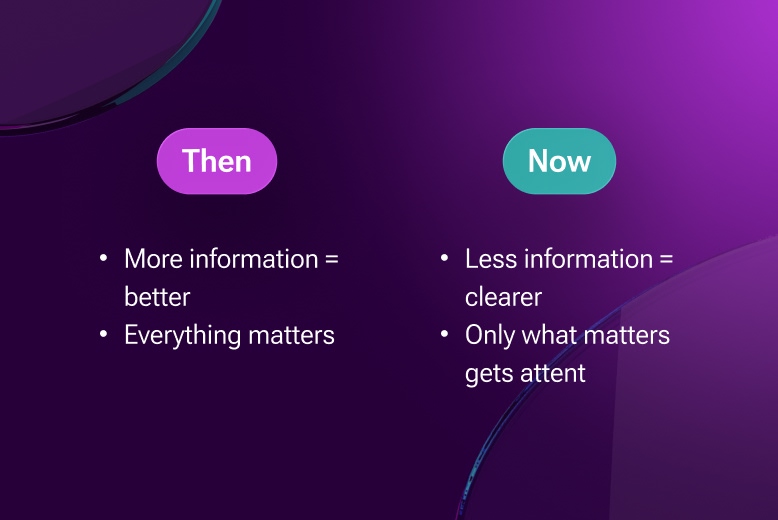
This creates a new challenge. If communication is overloaded with information, people disengage. They start to perceive it as intrusive or unnecessary — and in response, they distance themselves from it.
In internal communication, this is critical. Once attention is lost, both alignment and overall culture begin to break down.
Trend 4: Precision Becomes a Competitive Advantage
In this environment, effective communication is no longer about volume. It is about precision.
The teams that succeed are those that:
- understand their audience
- communicate clearly and intentionally
- filter out unnecessary information
In 2026, communication is not just a supporting skill. It is a core capability that directly impacts how teams operate and deliver results.
Trend 5: Communication Is Becoming a Dedicated Function — Not Just a Skill
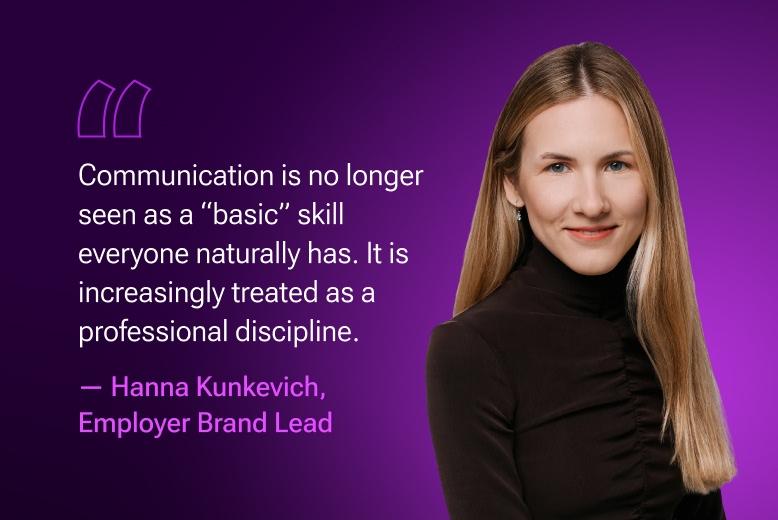
Another important shift is that communication is no longer seen as a “basic” skill everyone naturally has. It is increasingly treated as a professional discipline.
Five years ago, in mid-sized companies, roles focused specifically on internal communication were almost non-existent. In larger organizations, it was often just one specialist. Today, this is changing rapidly.
In companies with 1,500+ employees, it is common to see entire teams — sometimes 5–7 people — dedicated to communication. Even in teams of around 200 people, there is often at least one person responsible for structuring and managing internal communication.
As businesses continue to scale, this shift reflects the growing understanding that strategic communication is not just a “nice-to-have,” but a key driver of organizational success, especially in hybrid and remote work environments.
At the same time, more companies are investing in communication training to ensure their teams can handle the complexities of modern workplace communication. This may sound surprising — after all, communication is something we all learn early in life. But in a professional environment, it turns out to be much more complex. It requires structure, clarity, empathy, and the ability to adapt to different audiences and contexts.
I recently had a conversation that illustrates this well.
A former colleague of mine, a senior designer, told me about a challenge in her team. On paper, her role is highly technical, and you wouldn’t necessarily expect communication to be the main issue.
But in reality, it is.
Her junior team members — mostly under 25 — often come to her whenever they need to discuss something with the team or a client. Not because they lack expertise, but because they struggle to articulate problems, ask the right questions, or structure a conversation in a way that leads to a clear outcome.
They are good at what they do. But without communication skills, they cannot fully translate that expertise into results.
And this is exactly why communication is becoming a separate focus area.
It is no longer enough to assume that people will “figure it out.” Companies are starting to recognize that without intentional work on communication — at both individual and organizational levels — even strong teams can underperform.
Communication as a Reflection of Corporate Culture
Corporate culture is often described as a set of values or principles. But in reality, culture is not what is written down — it is how a company lives and communicates every day.
You can create as many guidelines and playbooks as you want. But if they are not reflected in real behavior — especially at the leadership level — they simply don’t work.
Communication is where culture becomes visible. There are a few key areas where this is especially noticeable.
Leadership Behavior Sets the Tone
Leaders are the primary carriers of culture. How they communicate defines what is acceptable for everyone else. How they run meetings, share company updates, and respond to questions — all of this is closely observed and replicated.
One question I always find important: can a leader answer uncomfortable questions?
Daria Fot, HR Director at EvenBet Gaming:
Open dialogue with the team is not just about transparency — it’s about creating a space where people feel safe to speak up, ask questions, and challenge ideas.
If communication is open, transparent, and respectful at the top level, this behavior naturally cascades to middle management and then to the rest of the team. If it is not — no amount of written values will compensate for that.
Can You Share Your Failures?
Another important aspect is how teams communicate about outcomes.
Can a team openly say: “We worked on this, and it didn’t succeed”? Can leaders acknowledge mistakes without shifting responsibility?
If the answer is no, communication becomes selective. People start filtering information, avoiding difficult conversations, and focusing only on positive outcomes. But this creates a distorted picture of reality — and ultimately slows down learning and decision-making.
A mature communication culture allows both success and failure to be discussed openly and constructively.
How You Share Good News Matters Too
Interestingly, positive news also requires careful communication.
It is easy to share good news in a generic way — using phrases that could apply to any company if you just replace the name. In this case, the message exists, but it doesn’t resonate.
But when communication is personalized, it creates a different effect. People understand why this news matters, how it connects to their work, and what role they played in achieving it. This turns communication into recognition — not just information.
A Shared Language and Tone of Voice
At a broader level, communication within a company is about creating a shared language.
This includes not only terminology, but also tone of voice — how messages are structured, how direct or formal they are, and how meaning is conveyed.
When this language is aligned, communication becomes predictable and easier to navigate. When it is not, even simple messages can be interpreted differently by different people.
This shared language is reinforced not only through words, but also through symbolic and visual elements. Short phrases and slogans can help anchor meaning, while visual cues — such as mascots, logos, or product elements — create consistency and recognition across different touchpoints.
In this sense, corporate culture is not just supported by communication — it is built through it.
Simplicity Over Complexity in Communication Guidelines
When building communication guidelines, there is a natural temptation to cover everything — to create detailed rules for every possible situation. In practice, this rarely works.
The more complex and exhaustive the guidelines are, the less likely people are to actually use them. Communication does not happen in controlled scenarios, and no document can anticipate every edge case.
What works better are a few core principles — simple, clear, and applicable in most situations. These principles should not dictate exact behavior. Instead, they should help people understand the underlying logic of communication: how to be clear, how to adapt to context, how to think about the audience.
When people understand this “why,” they can apply it even in situations that are not formally covered by any guideline. It becomes less about following rules — and more about developing judgment: for example, choosing an appropriate tone (formal or informal, such as using first names), deciding to discuss sensitive or controversial issues in a 1:1 conversation rather than in a group setting, or adapting the format of communication to the context.
Rituals That Spark Communication Culture
Another important element is rituals. Unlike guidelines, which define expectations, rituals make communication part of everyday behavior.
At EvenBet Gaming, for example, we have internal mechanisms that support this. Employees can thank each other for demonstrating company values, making recognition visible and consistent. We also have the opportunity to ask our CEO questions during town halls — both anonymously and openly.
These may seem like small things, but they play an important role. They create safe and repeatable formats for communication. They encourage openness, recognition, and dialogue — not as one-time initiatives, but as ongoing practices.
And over time, it is these small, consistent actions that shape how communication actually works inside a company.
Three Lessons of Personal Communication
Over time, I’ve come to see personal communication not as a soft skill, but as a daily practice that directly affects results. It shapes how we collaborate, how quickly we align, and how comfortable people feel asking questions or raising concerns.
While every situation is different, there are a few lessons that I’ve learned through experience — and keep coming back to.
Lesson 1: Take Responsibility for Being Understood
The key idea for me is simple: communication is your responsibility. When you send a message, your goal is to make sure the meaning is clear to the people receiving it.
This requires more than just choosing the right words. It means considering context, aligning with company culture, and adapting to the people you are communicating with. The same message can be interpreted very differently depending on background, expectations, and communication style.
Lesson 2: Appreciation Is Part of Communication
Another important lesson is that communication is not only about tasks and decisions — it is also about recognition. “Thank you” is a simple phrase, but it is often undervalued. In practice, it should appear much more often. If someone helped you, shared feedback, or even pointed out a small mistake, it is worth acknowledging.
For some people, this does not come naturally. That is why it is important to support this behavior at the company level.
At EvenBet Gaming, we have an internal initiative called Little Big Thanks, where employees can publicly thank each other for specific contributions.
These moments may seem small, but they make communication more human — and more meaningful.
Lesson 3: Stay Inside the Dialogue
The third lesson is about how we receive communication. Understanding a message is not only about processing information. It is about being present in the dialogue.
When someone writes to you, it is important to understand the intention behind them — what they are trying to say, why it matters, and what kind of response is expected.
Sending a message requires responsibility. Receiving a message requires attention.
When both sides are engaged, communication becomes clearer, faster, and more effective.
Some Practical Communication Tips
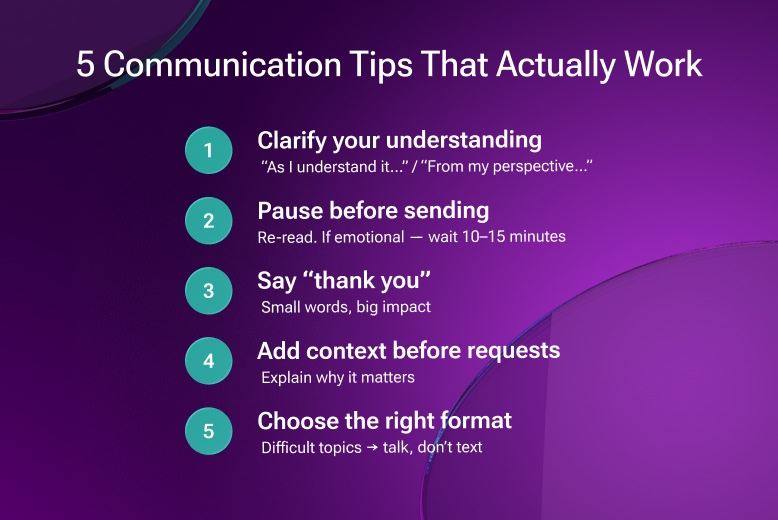
Communication doesn’t improve through theory alone. In most cases, it comes down to small, repeatable habits. Here are a few simple practices that help avoid misunderstandings and make everyday communication more effective:
- Clarify your understanding. Use phrases like “As I understand it…” or “From my perspective…”. This helps align expectations early and reduces the risk of conflict.
- Take a moment before sending your message. Re-read it to catch ambiguity, tone issues, or missing context. If the message feels emotional, pause for 10–15 minutes — this helps you respond more clearly and constructively.
- Say “thank you” more often. Appreciation is a small effort with a strong impact on communication and relationships.
- Provide context before making a request. Before asking someone to do something, explain why it matters. This makes your request easier to understand and prioritize.
- Choose the right format for difficult conversations. If a discussion is likely to be complex or sensitive, move it to a live conversation — a call or a meeting. Tone of voice and non-verbal cues can make a significant difference.
Three Books on Communication Worth Reading
There are many books about communication, but a few stand out because they help you understand how communication actually works in real situations — not just in theory. Here are three that I personally find especially useful.
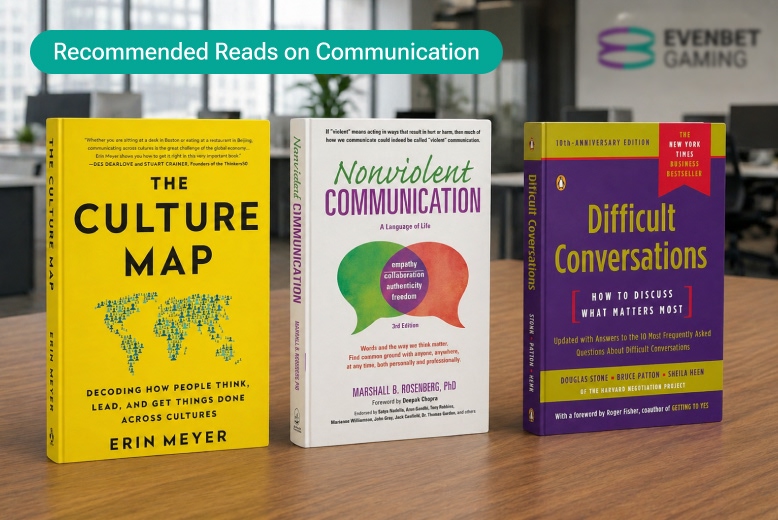
The Culture Map — Erin Meyer
The Culture Map explores how people from different cultures perceive communication, feedback, leadership, and decision-making.
It offers a practical framework for understanding why the same message can be interpreted in completely different ways across cultures.
This is especially relevant for international teams, where miscommunication often happens not because of language barriers, but because of different cultural expectations.
Nonviolent Communication — Marshall Rosenberg
Nonviolent Communication focuses on empathy as the foundation of effective communication.
Marshall Rosenberg introduces a structured approach to expressing thoughts and feelings clearly, without judgment, and to understanding others on a deeper level.
It is particularly helpful for navigating конфликтные ситуации and building more constructive dialogue.
Difficult Conversations — Douglas Stone, Bruce Patton, Sheila Heen
Difficult Conversations is about handling conversations we tend to avoid.
The authors explain why these conversations are challenging and provide a framework for approaching them with clarity and openness.
One of the key ideas is that every difficult conversation operates on three levels: facts, emotions, and identity — and all three need to be addressed for real understanding to happen.
Together, these books cover different aspects of communication — culture, empathy, and complexity — and offer a more complete perspective on how to communicate effectively in modern teams.
Conclusion
Communication is often perceived as something intuitive — something we “naturally” know how to do. But in reality, it is a skill that requires constant attention, reflection, and adjustment.
It shapes how teams align, how decisions are made, and how people experience their work. And as work environments become more complex — distributed teams, AI tools, information overload — the cost of miscommunication only increases.
From what I’ve seen, effective communication is not about saying more. It is about being precise, intentional, and aware of the people you are communicating with. And in the end, strong teams are not defined only by expertise, but by their ability to understand each other — clearly, consistently, and without unnecessary noise.