

 27 April 2026
  Upd: 28 April 2026
  22 min
  322 views
 Launching an online poker platform in 2026 requires more than just software and traffic. The market has matured: regulation is stricter, players expect seamless UX, and competition is driven by retention, not just acquisition.
At the same time, new opportunities have emerged. AI-powered fraud detection, fast-play formats, and global liquidity networks make it possible to enter the market faster and scale smarter.
This guide breaks down how to launch an online poker platform step by step — from licensing and tech stack to liquidity and retention strategy, helping operators start online poker business with a clear execution plan.
Legal Requirements for Online Poker Platforms
Compliance defines whether your platform survives beyond launch. Unlicensed operators face payment blocks, limited GEO reach, and low player trust. Choosing the right jurisdiction affects everything: costs, timelines, and scalability.
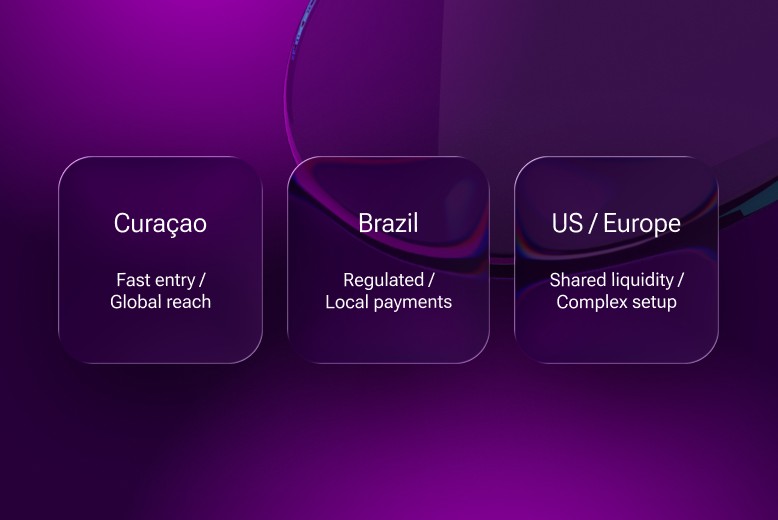
Curaçao Licensing in 2026
Curaçao remains one of the fastest entry points, but it’s no longer “easy mode.”
Recent reforms introduced:
- stricter AML and KYC requirements
- direct oversight by the regulator
- mandatory ownership transparency
It works best for:
- crypto-friendly platforms
- startups testing new formats
- global (non-restricted) audiences
Brazil as a High-Growth Market
Brazil is now one of the most attractive regulated markets.
Key requirements:
- local entity registration
- payment compliance (PIX, fiat rails)
- responsible gambling controls
Poker is often treated as a skill-based game, which simplifies positioning, but compliance is strict and ongoing.
Shared Liquidity Markets (US and Europe)
In regulated markets, poker liquidity is often fragmented by borders. Players are split across jurisdictions, which reduces table availability, slows down game flow, and limits tournament scale.
Shared liquidity solves this problem by pooling players from multiple regions into a single network. This increases table fill rates, speeds up matchmaking, and enables larger tournaments.
- In the US, online poker operates under a state-by-state model. There is no federal license, so operators must first obtain approval in each individual state. After that, they can join interstate agreements like MSIGA, which allow player pools to be combined across participating states. This makes shared liquidity possible, but adds significant regulatory and technical complexity.
- In Europe, the approach is different. Instead of a unified system, countries form bilateral or multi-country agreements. These agreements are limited to specific regulated markets. Southern European markets are the most active example, where regulators coordinate to allow cross-border play while maintaining local compliance requirements.
From a technical perspective, shared liquidity requires:
- precise geolocation (to ensure players are in allowed regions)
- certified RNG and compliance audits
- dynamic player routing between pools
- synchronized AML and data-sharing frameworks
These systems are not plug-and-play. They require alignment across regulators, infrastructure, and legal frameworks.
Bottom line: shared liquidity is a powerful growth lever, but it comes after licensing, not before. Operators must first secure approval in each target jurisdiction, then expand into cross-border pools as a second-stage scaling strategy.
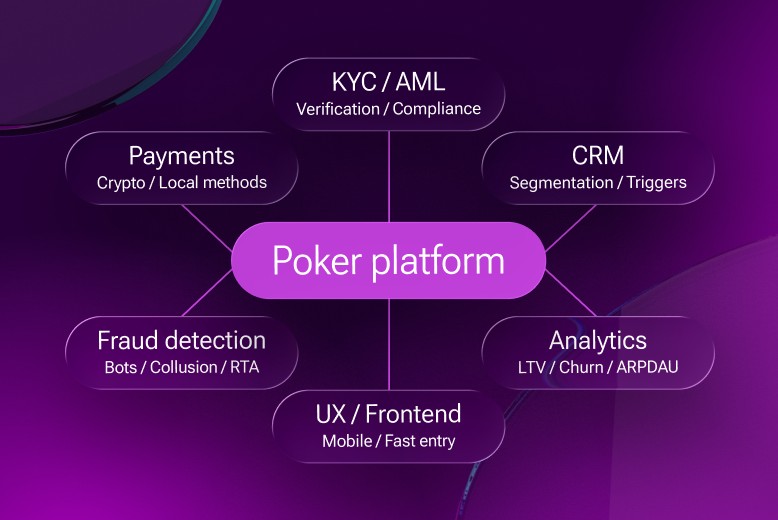
Poker Platform Tech Stack in 2026
Technology is no longer just infrastructure, it directly impacts retention and revenue. Modern online poker software development focuses on performance, scalability, and real-time responsiveness across devices.
AI Fraud Detection and Game Integrity
The biggest threats today:
- RTA tools (real-time assistance)
- bots and collusion
- chip dumping
Modern platforms use AI to detect:
- abnormal hand patterns
- behavioral anomalies
- session irregularities
Strong detection systems can flag suspicious activity in real time, protecting both players and revenue.
UX and Mobile-First Design
In 2026, most poker traffic is mobile. Players expect instant entry into the game, especially on mobile, where most interactions happen. For teams looking to create poker game online, reducing friction at every step becomes a core product priority. A first hand time of around 30 seconds is a strong benchmark. Anything slower drives early drop-off. The core shift is from navigation to immediacy.
Instant seat entry replaces traditional table selection. Players tap “Play Now” and get matched by stake and skill in seconds. This removes decision fatigue and speeds up conversion.
Fast-fold formats keep the session moving. Folding instantly moves the player to a new hand, which can significantly increase the number of hands played per hour. This fits short, repeat sessions and increases overall activity.
Interface design follows mobile behavior. Portrait mode dominates, with one-handed play, large touch targets, and minimal UI layers. Most players never switch to landscape, so the primary experience is built vertically.
Lobby complexity is reduced to a few clear actions: quick play, tournaments, social. Content is dynamic — localized offers, time-based events, and personalized entry points surface automatically.
Social Layer
Poker engagement grows around interaction. Players join private clubs, compete in small groups, and communicate during play. Features like shared chats, reactions, and lightweight competition mechanics increase session frequency.
Daily missions and micro-incentives add structure to behavior. Simple triggers — a few hands played, a small win, a short streak — are enough to keep players returning without heavy bonus pressure.
Streaming and content sharing extend gameplay beyond the table. One-tap sharing of hands or sessions connects poker with creator ecosystems and builds organic reach.
Technical Implementation
Performance directly impacts retention. Cross-platform engines like Unity or WebGL support consistent gameplay across devices. A strong poker app development company will prioritize performance, fast load times, and seamless transitions over visual complexity. Load speed, responsiveness, and seamless transitions matter more than visual complexity.
A/B testing is standard practice. Variations in lobby structure, entry points, and session flow can significantly change engagement metrics. Even small UX changes can lift daily activity.
Key features require dedicated implementation:
- fast-fold mechanics at the engine level
- mobile-first UI redesign
- real-time social systems (chat, groups, events)
Each of these directly contributes to session length and retention.
Payments and Crypto Integration
Payment flow is one of the highest-impact points in the funnel. For any team aiming to start an online poker business, optimizing deposits and withdrawals early directly affects retention and revenue.
Modern platforms support a mix of crypto and local fiat methods. Layer 2 solutions enable near-instant transactions with minimal fees, while local systems like PIX or UPI handle regional volume.
Speed defines user experience. Deposits are expected to be instant, with near-instant withdrawals in supported markets.
The payment flow is streamlined:
- deposit → play without extra confirmation steps
- small withdrawals → auto-approved
- bonuses → activated instantly after deposit
KYC is integrated early but kept lightweight, often triggered at first deposit with automated verification.
Key Performance Metrics
To keep operations stable and scalable, operators need a clear set of metrics that reflect both user behavior and platform performance. These indicators in online poker software development help identify issues early and prioritize improvements.
Payments benchmarks often reveal friction before it shows up in retention or revenue. Failed transactions should generally stay below 2–5%, with top operators closer to 2%. Average deposit size typically falls in the €50–100 range. Payout speed remains a critical factor, with under 15 minutes expected for crypto and local methods, and under 24 hours overall.
Core business metrics (approximate industry targets) provide a broader view of performance and growth dynamics:
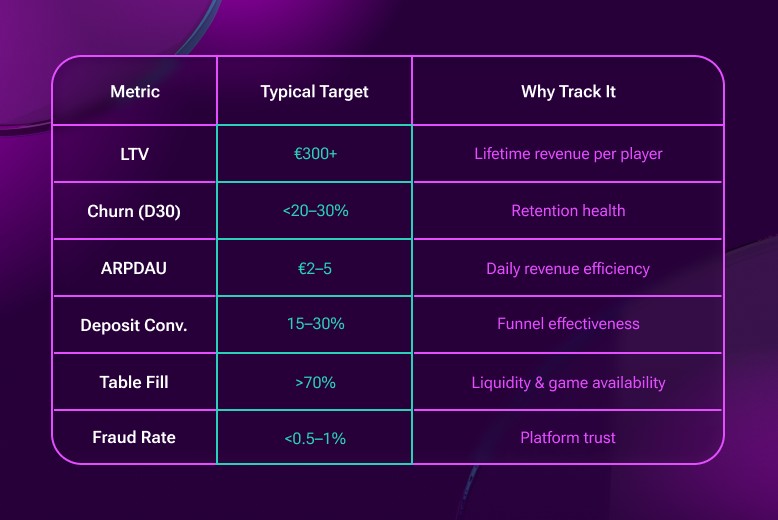
In practice, these metrics are most valuable when tied to action. A drop in ARPDAU often points to liquidity or UX issues, while a spike in churn may signal problems in payments or CRM flows. The goal is to use these signals to guide decisions and fix bottlenecks before they impact growth.
Liquidity Strategy: The Core Growth Driver
Liquidity is the hardest problem in poker. No players → no active tables → no retention. Dead tables kill momentum instantly. Players open the app, see no action, and leave. Many don’t come back. Liquidity shapes everything: how fast games start, how long sessions last, how often players return, and how much they spend.
There are three main approaches.
Proprietary liquidity gives full control over the ecosystem — player mix, economy, and branding. Growth is slow and expensive. Building traffic from zero requires heavy acquisition, often exceeding €1M before tables start filling consistently. Early-stage platforms risk looking empty for too long, which directly increases churn.
Network liquidity solves the cold start problem. Many best poker software providers 2026 offer access to shared player pools, allowing operators to launch with active tables from day one. This removes the “empty lobby” risk and stabilizes early retention. The trade-off is revenue share and less control over player distribution.
Shared liquidity combines players across multiple jurisdictions into a single pool. More players means faster matchmaking, larger tournaments, and fewer dead hours. The complexity sits in compliance — licensing, geolocation, and cross-border regulation — so it’s typically used at the scaling stage.
Practical Strategy
Most platforms combine models instead of relying on one. Network liquidity covers the launch phase, ensuring players always see active tables. This protects early retention and prevents first-session churn.
As the platform grows, operators build their own player base and gradually move traffic into proprietary pools. This reduces dependency on external networks and allows tighter control over the in-game economy. The goal is to reach a point where liquidity sustains itself.
At around 1,000 concurrent users, many rooms begin to feel more stable:
- tables fill without delay
- sessions extend naturally
- churn drops as players consistently find games
Below that threshold, growth feels forced. Above it, momentum builds on its own.
Step-by-Step Launch Plan
A realistic timeline is 6–9 months.
Month 1–2: Market Positioning
Define:
- target audience (casual vs. pro)
- core formats (NLHE, PLO, fast-fold)
- monetization model (rake, tournaments, VIP)
Avoid building “everything for everyone.”
Month 2–4: Licensing and Setup
- register legal entity
- apply for license
- prepare AML/KYC policies
Parallel track: start vendor selection and evaluate each poker app development company based on scalability, integration speed, and support.
Month 3–5: Software Integration
Typical setup includes a custom or ready-to-integrate poker platform delivered by a poker app development company, along with payment providers, KYC tools, and CRM systems.
Also required:
- RNG certification
- back-office analytics
Month 4–6: Testing and Localization
This phase is about adapting the platform to real market conditions. The goal is to validate core functionality across regions and identify friction points early through controlled user testing.
- translate platform (key GEOs)
- add local payment methods
- run beta with 300–500 users
Focus on:
- stability
- session length
- onboarding friction
Month 6–7: Soft Launch
At this stage, the platform moves into live traffic with controlled scaling. Early acquisition channels and partnerships help test growth mechanics while keeping performance measurable.
- affiliate traffic
- streamer partnerships
- early incentives
Track:
- ARPDAU
- retention
- conversion rates
Month 8+: Full Launch
Scale what works:
- increase traffic
- optimize CRM
- refine bonus mechanics
Retention Strategy for Poker Platforms
Acquisition gets players in. Retention builds the business. In poker, revenue depends on how often players return and how long they stay active. One-time deposits don’t scale. Repeated sessions do. LTV grows through consistent engagement over time.
Retention is shaped by how well operators manage the player lifecycle. This includes onboarding flows that reduce early drop-off, reactivation campaigns that bring players back after inactivity, and CRM systems that adapt incentives based on behavior rather than broad bonus distribution.
For teams looking to create poker games online, integrating CRM logic at the product level allows faster response to player behavior and more precise retention control.
More advanced setups rely on churn prediction models, VIP segmentation, and personalized missions tied to deposit and play patterns. Tournament reminders and time-based triggers help re-engage users at the right moment, while fast formats support more frequent entry points.
Together, these systems turn retention into a structured process, one that continuously reinforces player activity instead of relying on one-time incentives.
What Actually Works
Personalized Incentives
Generic bonuses fade into background noise. Players respond to triggers that match their behavior.
Targeted missions tied to real activity perform better:
- session-based (“play X hands”)
- outcome-based (“win X pots”)
- time-based (“play today”)
Relevance drives action. Timing increases conversion, especially when offers appear during or immediately after a session.
Light Formats
Session length is decreasing. Frequency is increasing. Quick formats reduce friction and increase frequency. Operators that create poker games online with quick-entry mechanics see higher engagement and more repeat sessions. Players return more often when there is no waiting and no setup friction.
More sessions → more touchpoints → stronger retention and higher LTV.
Community Mechanics
Poker engagement grows around interaction. Players who are part of a group show more stable activity patterns. Clubs, leaderboards, and shared challenges introduce light competition and social pressure. This increases stickiness and reduces churn without relying on aggressive bonuses.
CRM as a Revenue Engine
In online poker software development, CRM becomes a core system that directly influences revenue and shapes player behavior in real time.
Modern platforms:
- segment players by activity, spend, and patterns
- trigger offers at the right moment
- optimize bonus efficiency based on response
The focus shifts from sending more bonuses to making each one perform better. A simple, well-timed trigger often outperforms large generic rewards: “Play 10 fast-fold hands → get €10 bonus” — with a clear condition, immediate reward, and minimal friction — often outperforms large generic offers.
Common Mistakes to Avoid
Weak KYC
Incomplete or poorly implemented KYC leads to more than compliance issues. It results in payment blocks, higher fraud exposure, and penalties from regulators. It also limits access to reliable payment providers, which directly impacts deposits and withdrawals.
No Fraud System
Poker is highly vulnerable to bots, collusion, and RTA tools. Without a proper detection system, suspicious behavior spreads quickly. Players notice it fast, trust drops, and high-value users leave first.
Empty Tables
Liquidity gaps are visible immediately. Players open the app, don’t find a game, and exit within seconds. First-session experience defines whether they return, so even short periods of low activity can create long-term churn.
Slow Withdrawals
Payout speed is one of the strongest retention drivers. Delays create friction, support load, and negative sentiment. Players who experience slow cashouts are far less likely to deposit again.
These are not edge cases. These are core failure points that directly affect revenue and retention.
Final Thoughts
Launching an online poker platform in 2026 goes beyond software and traffic. Success depends on how well operators handle compliance, solve liquidity early, and shape player behavior through UX and CRM. Successful platforms make it easy to start playing: players enter quickly, find an active table right away, and come back because the experience feels smooth and predictable.
The EvenBet Gaming ecosystem is built around these fundamentals: instant network liquidity, anti-fraud system designed to combat AI-powered poker bots and fraud, mobile-first UX, and integrated CRM. This combination allows operators to launch with active tables from day one and maintain stable retention as they scale.
Building everything from scratch slows down time to market and increases risk. Partnering with a reliable poker app development company provides a tested foundation and faster launch.
Ready to launch? Contact the EvenBet team for a demo and see how a modern poker platform performs in real conditions.
FAQ
Do I need a license to start an online poker platform?
Yes, a gaming license is mandatory for legal operation, player trust, and payment processing in 2026. Unlicensed platforms face immediate blocks from banks/PSPs, geoblocking by Apple/Google stores, and zero credibility with serious players.
Choose based on your GEO:
- Curaçao: Fastest (4-6 months, €30-60k), crypto-friendly, global reach.
- Brazil: Local entity + PIX compliance for 50M+ market.
- US MSIGA states: Per-state licenses first, then interstate pools.
Without one, you’re limited to gray markets with high churn and legal risk. Start licensing parallel to software setup, it’s your biggest timeline gate.
What features are essential for an online poker platform?
Modern platforms need these core features to compete on retention and liquidity:
- Mobile-First UX: Portrait mode, instant seat entry (<30s to first hand), fast-fold.
- AI Fraud Detection: Real-time RTA/bot/collusion flagging via behavioral analysis.
- Liquidity Solution: Network integration (e.g., EvenBet) for Day 1 active tables.
- Payments: Layer 2 crypto (<15min), local fiat (PIX/UPI), <24h payouts.
- Social/Retention: Clubs, missions (“Play 10 hands → €10”), personalized CRM.
- Back-Office: BI dashboards, RNG certification, KYC automation.
Skip any, and you lose to established rooms. Focus customization on your niche (crypto, regional variants).