
 22 April 2026
  15 min
  444 views
 Player retention now defines how iGaming products grow and sustain value over time. The cost of acquisition sets the baseline, while loyalty systems determine how much of that value is actually retained.
Player behavior is shaped less by single incentives and more by how the system responds over time. When rewards feel predictable, relevant, and connected to activity, engagement stabilizes, supporting long-term online gaming customer retention.
Rakeback, bonuses, VIP progression, and CRM are most effective when they operate as one system. Together, they influence how players move, return, and stay.
Understanding how these elements interact is key to designing loyalty systems that actually hold player attention and scale over time.
A Simple Model of Loyalty Systems
A strong loyalty system operates across four layers:
- Economic layer, where rakeback returns value
- Behavioral layer, where bonuses drive activity
- Emotional layer, where VIP creates status and attachment
- Execution layer, where CRM connects everything in real time
If one of these layers is missing or disconnected, the system loses efficiency. When they work together, player retention becomes more predictable and scalable.
Rakeback as the Trust Layer
Rakeback is a loyalty mechanism that returns a portion of the fee a player generates while playing. Understanding rakeback meaning helps explain why this model remains one of the most transparent in iGaming. In poker, this fee is the rake taken from each pot or tournament entry. Rakeback gives part of that amount back to the player based on their activity.
In simple terms, the more a player plays, the more they get back.
This makes rakeback one of the most transparent reward systems in iGaming. The value is directly tied to volume, and the logic is easy to follow. Players do not need to interpret complex conditions or wait for one-time bonuses — the system reflects their activity continuously.
Flat rakeback is easy to understand, but progressive models are often more effective in driving engagement. Stake rakeback systems exemplify this flat approach with their simple, fixed percentage model. Progressive rakeback builds on the same logic, adding visible progression and structured rewards instead of a fixed percentage.
In a typical progressive setup:
- players move through tiers, for example 10% → 15% → 20%
- progress is visualized through progress bars, milestones, and level indicators
- higher tiers unlock additional benefits such as cashback boosts, faster withdrawals, or exclusive tables
This turns rakeback from a passive reward into a visible progression system.
Players are more likely to stay active when they can see what comes next. A clear path forward reduces uncertainty and creates short-term goals.
Rakeback also plays a stabilizing role. After a losing session, players are more likely to continue if part of their volume returns automatically. It softens negative variance and reduces early churn.
Used well, rakeback builds trust. It makes the system feel fair and predictable.
Understanding Rakeback Types
Rakeback comes in several formats, each with distinct retention mechanics. Understanding these helps operators match the model to player behavior and business goals.
Flat Rakeback
Flat rakeback offers a fixed percentage (e.g., 20-30%) of all generated rake returned weekly or monthly. Stake rakeback is a common example of this approach, with a fixed weekly return that remains simple and transparent, making it ideal for beginners or low-volume players who value predictability. However, it lacks progression, so it rarely drives increased activity beyond baseline play.
Progressive/Tiered Rakeback
Players advance through levels (e.g., Bronze at 15%, Platinum at 35%) based on volume, hours played, or tournaments entered. Visual progress bars and milestones create goal-driven engagement. This structure expands the basic rakeback meaning by adding progression and visible rewards tied to activity.
EvenBet’s six-tier system (Aluminium to Platinum) shows how time-limited challenges within tiers boost session extension. Best for grinders seeking clear advancement paths.
Dealt Rakeback
Calculates returns based on hands dealt to a player, regardless of pot size or wins. Common in cash games, it rewards table selection and longevity over high-stakes aggression. Fairer for tight players, but less motivating for action-oriented formats.
Contributed Rakeback
Ties rewards directly to rake paid from pots a player contributes to. Encourages multi-tabling and loose games where rake accrual accelerates. High-volume operators favor this for its direct activity correlation, though it disadvantages conservative styles.
Hybrid Models
Combine flat base rates with progressive boosts or dealt/contributed calculations. For example, 25% flat + tiered bonuses for milestones. Most flexible for mixed player bases, balancing simplicity with growth incentives.
Which Works Best?
- Flat suits acquisition, as it is easy to understand and lowers the barrier for new players.
- Progressive excels at retention by adding visible progression and short-term goals that keep players engaged over time.
- Contributed or hybrid models maximize high-volume revenue by directly linking rewards to activity and encouraging more intensive play.
The choice depends on game type, player demographics, and CRM segmentation capabilities.
Bonuses as a Lifecycle Tool
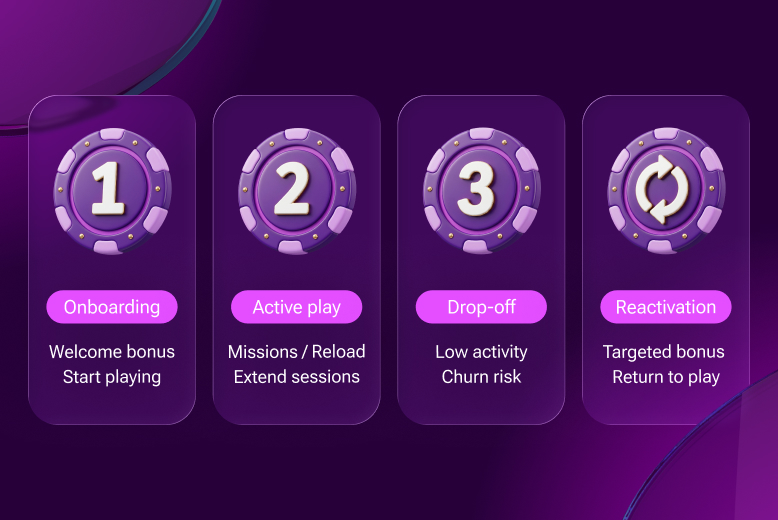
One of the most common mistakes in iGaming CRM is concentrating too much value in the first deposit bonus. That may drive activation, but it rarely builds long-term engagement on its own. A stronger approach treats bonuses as part of a lifecycle system.
Different moments require different incentives:
- Early stage: onboarding bonuses and low-friction rewards
- Active play: missions, streaks, and reload bonuses
- Drop-off risk: reactivation offers and balance-triggered bonuses
- Engagement boost : tournament tickets and freerolls
For example:
- A player inactive for 3 days receives a targeted reload bonus with a cap.
- A balance dropping below a threshold triggers a small instant reward to continue the session.
- Repeated short sessions trigger mission-based progression to extend play.
Gamified rewards are especially effective because they shift the experience from transactional to interactive. Missions, streaks, and challenges give players something to complete, not just something to claim.
Tournament tickets and freerolls add aspirational value. They allow casual players to access higher-stakes experiences without a financial barrier, which increases engagement without increasing risk.
Bonuses drive activity. But without progression, activity does not convert into loyalty.
VIP Programs as Status Systems
VIP programs add a different layer: emotional engagement that strengthens player retention over time.
Players respond to recognition, progression, and status.
Tiered systems such as Bronze, Silver, Gold, and Platinum work because they create a visible hierarchy. Progress is easy to track, and each level signals advancement.
At higher tiers, VIP logic increases switching costs. Typical benefits may include:
- Personal account managers
- Faster withdrawals
- Exclusive promotions
- Higher rakeback percentages
These benefits are practical, but their impact is also psychological. Players feel invested in the system.
Personalization makes this layer significantly stronger.
If a player prefers Omaha, sending Hold’em rewards reduces perceived relevance.
If a player prefers short sessions, long tournament incentives miss the mark.
VIP systems become more effective when rewards reflect actual behavior.
Status without relevance feels artificial, while status aligned with behavior creates attachment.
CRM Makes Loyalty Work
Rakeback, bonuses, and VIP tiers only function as a system when connected through CRM.
Without segmentation and automation, even well-designed mechanics become inefficient.
A modern CRM setup should:
- Segment players by behavior, value, and risk
- Trigger rewards based on real-time actions
- Adjust communication across channels such as in-app, email, and push
- Maintain consistency between rewards and player preferences
Different player types require different logic:
- Casual users respond to fast entry and low-friction rewards
- Regular players engage through progression and consistency
- Dormant users require targeted reactivation
- High-value players expect personalized incentives
Sending the same bonus to everyone quickly turns into background noise. When incentives match player behavior, they actually get noticed and used. At that point, retention starts to look less like marketing and more like system design.
Loyalty systems are also moving toward real-time adaptation. Instead of scheduled campaigns, rewards can adjust dynamically based on:
- Session length
- Loss patterns
- Engagement frequency
AI-driven CRM pushes this further by predicting behavior:
- Identifying churn risk before inactivity
- Suggesting optimal incentive timing
- Adjusting reward size based on response probability
A mature CRM setup aims to intervene before churn occurs.
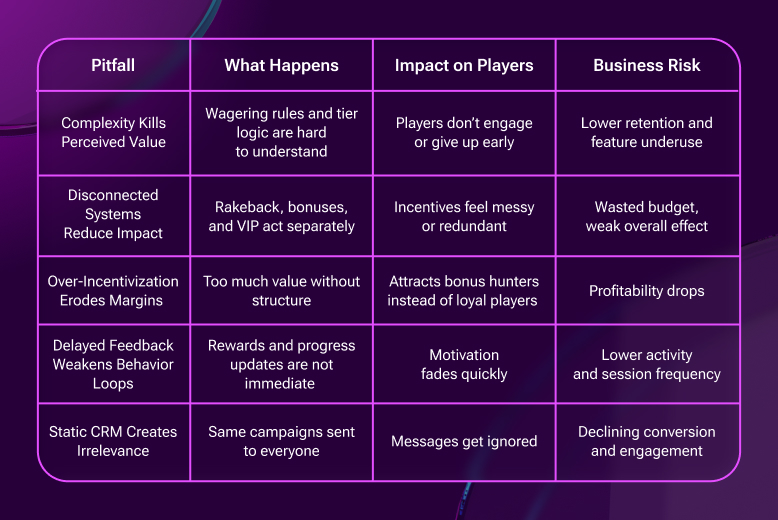
Common Pitfalls in Loyalty Design
Even generous loyalty programs fail when execution is weak.
How to Measure Success
Online gaming customer retention should not be evaluated by GGR alone.
A more complete framework includes:
- Churn rate, showing whether players stay active
- Lifetime value (LTV), reflecting long-term return per player
- Active days per month, indicating behavioral depth
- Bonus cost ratio, measuring the efficiency of incentives
Cohort analysis is especially useful. It shows how different player segments behave over time and whether loyalty mechanics improve retention curves.
A strong system:
- Increases repeat engagement
- Extends session frequency
- Improves value per player
- Avoids dependency on constant promotions
The goal is to shape how players interact with the product over time. Bonuses are just one of the tools, and their impact depends on when and how they are used. What matters more is whether the system encourages repeat sessions, builds habits, and keeps players engaged in a way that feels natural rather than forced.
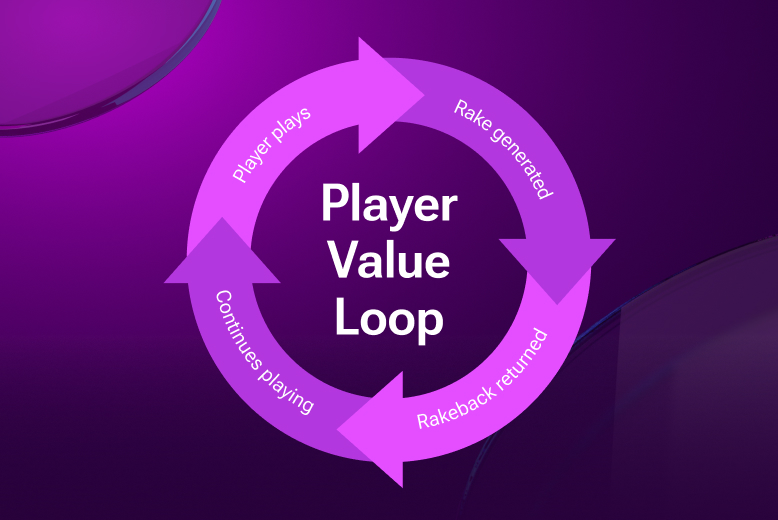
Loyalty as a Feedback Loop
Rakeback, bonuses, VIP programs, and CRM together shape long-term online gaming customer retention.
- Rakeback builds trust through transparent value return
- Bonuses drive activity with precise behavioral triggers
- VIP programs create attachment via status and personalization
- CRM makes everything adaptive and real-time
When these elements work together, loyalty evolves from isolated promotions into a feedback loop: player behavior → system response → increased engagement → stronger retention.
EvenBet’s Progressive Rakeback exemplifies this approach, blending tiered progression, gamified milestones, and configurable rewards to turn passive cashback into active player commitment.
Ready to implement retention that works? Partner with EvenBet for turnkey poker software and other solutions to transform players into loyal revenue drivers.
FAQ
What is rakeback in online gaming?
Rakeback is a loyalty mechanism where platforms return a percentage of the house commission (rake) generated from a player’s activity, typically in poker or certain casino games. This definition captures the rakeback meaning in practice: rewarding players based on the volume they generate. It rewards volume directly, higher play generates more rakeback credit. Flat rakeback offers a fixed rate like 20%, while progressive versions use tiers (e.g., 10% to 25%) with visual progress bars to encourage sustained engagement.
Which bonuses are most effective for keeping players engaged?
Reload bonuses, mission-based rewards, and tournament tickets tend to outperform one-time welcome offers for long-term retention. Reloads target inactive players with timed triggers (e.g., after 3 days of dormancy), missions add gamification through achievable goals like streaks, and freerolls provide aspirational value without financial risk. Effectiveness comes from behavioral timing over bonus size.
What is a VIP program and how does it work?
A VIP program is a tiered status system (e.g., Bronze to Platinum) that rewards high-value players with escalating benefits like higher rakeback, personal managers, faster withdrawals, and exclusive promotions. Players progress through levels based on activity or spend, creating switching costs and emotional attachment. Personalization via CRM ensures rewards match preferences, such as game-specific tickets.
How do platforms measure retention success?
Platforms track churn rate, lifetime value (LTV), active days per month, and bonus cost ratio alongside GGR. Cohort analysis reveals how player groups behave over time, showing if loyalty improves retention curves without promo dependency. Success means higher repeat engagement, extended sessions, and better LTV, not just short-term revenue spikes.