

 14 April 2026
  23 min
  659 views
 The online poker market in Canada can be considered relatively mature. It is supported by a long-standing poker culture, a well-developed iGaming ecosystem, and a player base that is both experienced and consistent in its behavior. This maturity brings a degree of stability and predictability: demand patterns are well established, player expectations are clearly defined, and the market is less volatile than in emerging regions.
At the same time, maturity does not make Canada an easy market to operate in. Its fragmented regulatory structure, constrained liquidity, and diverse player segments require a nuanced approach. Success depends not on rapid expansion, but on the ability to navigate these complexities and adapt product, strategy, and operations to the specific conditions of each province.
The iGaming Market in Canada and the Role of Poker
Canada’s iGaming market is large, but structurally uneven. It is not a single national ecosystem, but a collection of provincial markets — each with its own regulatory model, level of competition, and product dynamics.
Ontario provides the clearest benchmark. In fiscal 2024-25, the province reported:
- CAD 2.9 billion in total gaming revenue
- CAD 82.7 billion in wagers
- 2.6+ million active player accounts
Casino dominates the market:
- Casino: CAD 2.71 billion
- Sports betting: CAD 129 million
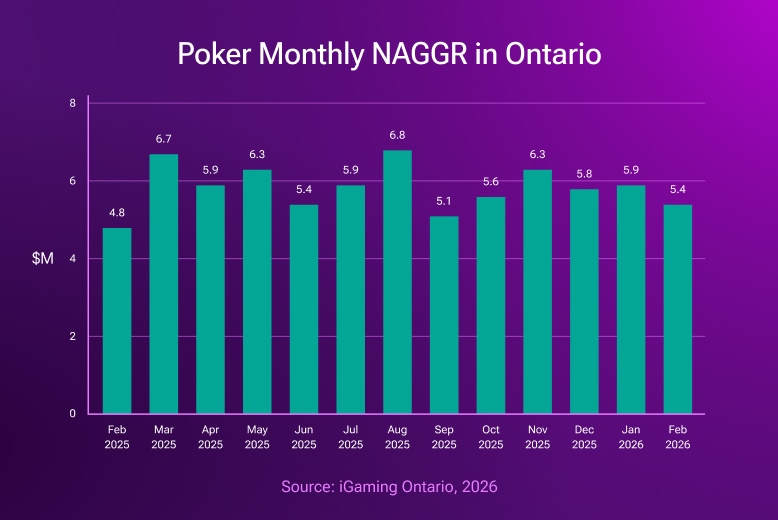
- Poker: CAD 59 million (~2%)
This distribution reflects a broader global pattern. Casino scales easily and monetizes faster, while poker depends on liquidity and player concurrency — which naturally limits its revenue share.
Poker Is a Small Vertical — But Not a Minor One
Despite its relatively small share, poker plays a distinct strategic role.
Compared to other verticals, poker typically delivers:
- Longer session times
- Higher engagement depth
- Stronger player retention
- Community-driven behavior
This makes poker less of a revenue driver and more of a retention and differentiation tool — especially in competitive, mature markets like Canada.
A Secondary Behavior Across Provinces
Data outside Ontario is less transparent, but available research confirms the pattern.
In Québec, for example:
- 77% of online gamblers play lottery products
- 27% play slots
- 16% bet on sports
- 12% play online poker
Poker is present, but clearly secondary to mass-market verticals.
Regulatory Landscape and Provincial Models
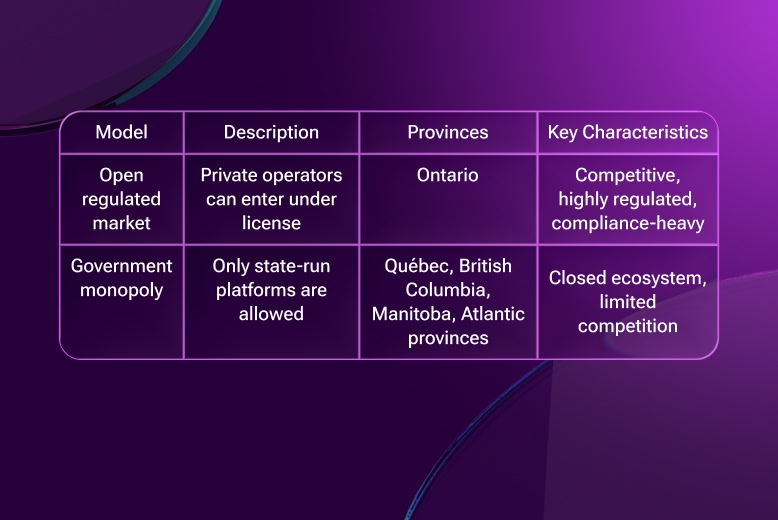
Canada’s iGaming regulation is defined at the provincial level. There is no unified national framework for online poker or gambling. Instead, each province sets its own rules, licensing approach, and market structure.
This results in a fragmented regulatory environment where operators must treat each province as a separate market.
Ontario: Regulated Open Market
Ontario is the only province that has introduced a fully regulated competitive iGaming market (launched in April 2022).
The market is overseen by:
- iGaming Ontario (iGO) — conducts and manages the market
- Alcohol and Gaming Commission of Ontario (AGCO) — regulator
Key regulatory features:
- Private operators must register with AGCO and partner with iGO
- Strict requirements for:
- KYC (Know Your Customer)
- AML (Anti-Money Laundering)
- responsible gaming
- Mandatory local incorporation or partnership structure
- Full compliance with Canadian data and consumer protection laws
Implications:
- High barrier to entry
- Clear legal framework and long-term stability
- Strong oversight and reporting requirements
Ontario is currently the closest Canada has to a “European-style” regulated market.
Other Provinces: State-Controlled Models
Outside Ontario, Canada’s iGaming market is largely built around government-run monopolies. Provinces such as Québec, British Columbia, Manitoba, and the Atlantic region operate through state-owned platforms, where all online gambling activity is centralized under a single operator.
These models are characterized by:
- no licensing pathways for private operators
- limited product innovation and slower development cycles
- strong focus on regulation, consumer protection, and control
In practice, this creates closed ecosystems with little room for external participation. While these platforms maintain a stable user base, poker is typically not a priority vertical and receives limited strategic investment.
Alberta remains the main exception to watch. While it currently operates a government-run platform (Play Alberta), the province is actively exploring a transition toward a regulated open market. If implemented, this could create new entry opportunities for private operators in the future.
Implications:
- no direct B2C entry in most provinces
- limited strategic relevance for poker-focused operators
Alberta: Transition to a Regulated Open Market
Alberta is the key province to watch in the Canadian iGaming landscape. With the adoption of the iGaming Alberta Act (Bill 48) in 2025, the province is moving from a government monopoly toward a regulated open market.
Regulatory model
- Ontario-like framework
- Oversight by AGLC and Alberta iGaming Corporation
- Licensed private operators allowed
Timeline
- Framework in development
- Market launch expected on July 13, 2026
Why it matters
- Large share of offshore activity
- Shift toward channelization and regulation
Implications for operators
- Rare new market entry opportunity
- Early-mover advantage in a regulated environment
A Legally Grey Layer: Offshore Operators
Across all provinces, a share of players continues to access offshore platforms.
From a regulatory perspective:
- These operators are not licensed locally
- Enforcement varies by province
- Players are generally not penalized
However, in regulated markets like Ontario, the situation is more nuanced. According to Ipsos research, the majority of players have shifted toward regulated platforms:
- 83.7% of online gamblers reported playing on regulated websites
- 16.3% reported using only unregulated platforms
Market Entry Opportunities for Foreign Poker Operators
For foreign companies looking to launch an online poker room in Canada, regulatory access is the key consideration. The market is structured at the provincial level, which means operators cannot enter independently without authorization or a formal partnership within an approved framework.

At present, Ontario provides the only established pathway for private operators. While entry is tightly controlled, it offers a clear and transparent regulatory environment for those willing to meet the requirements.
Dmitry Smirnov, Senior Lawyer at EvenBet Gaming:
Even in Ontario, getting licensed is far from trivial. Applicants must pass rigorous vetting, comply with anti-money laundering and consumer protection requirements, and operate within a tightly controlled system where the province retains significant oversight.
Market access for foreign operators is limited and highly regulated. Canada is open in terms of player access, but quite restrictive when it comes to who can legally operate.
Despite these challenges, industry interest in the Canadian market remains strong — albeit cautious. Since the launch of the regulated market in Ontario in 2022, a number of international operators have successfully entered the province, adapting their products to ring-fenced, Ontario-only liquidity and continuing to operate under the local framework.
This interest is supported by several structural advantages:
- Clear and transparent regulation, providing predictable rules and legal protection for operators
- A mature and relatively affluent player base, with well-established behavior patterns
- A strong overall iGaming market, enabling effective multi-vertical strategies where poker complements casino and sports betting
Audience and Behavioral Patterns
The Canadian online poker audience is relatively mature, both in terms of experience and expectations. Unlike emerging markets, where growth is driven by new users, Canada is characterized by a stable player base that is already familiar with poker and often engages with multiple iGaming verticals.
A Mixed Audience: Recreational Meets Experienced Players
The market combines two key segments:
- Recreational players, who approach poker as entertainment
- Experienced players, including semi-professionals, who are more strategy-driven
This mix shapes product expectations. Recreational users tend to prefer:
- faster formats
- lower buy-ins
- simplified mechanics
More experienced players look for:
- deeper structures
- competitive environments
- fair rake and game integrity
As a result, a one-size-fits-all product rarely works in Canada. Operators need to balance accessibility with depth.
Poker as Part of a Multi-Vertical Journey
Poker players in Canada are rarely isolated within a single vertical.
Research shows that:
- many poker players also engage with casino and sports betting
- cross-vertical behavior is common, especially in regulated markets
This creates a specific dynamic:
- poker attracts and engages
- casino and betting often drive revenue
In practice, poker works best as part of a broader ecosystem rather than a standalone product.
Format Preferences: Speed vs Skill
Player preferences reflect the dual nature of the audience.
Faster, higher-variance formats tend to appeal to recreational players:
- short-handed games
- fast-fold formats
- lottery-style tournaments
At the same time, there is consistent demand for more skill-based formats:
- multi-table tournaments (MTTs)
- traditional cash games
- structured tournament series
Rather than one dominating the other, both coexist. The key is segmentation — offering different formats to different player groups without fragmenting liquidity too much.
Mobile-First and Convenience-Driven
Like most developed iGaming markets, Canada is increasingly mobile-first.
Players expect:
- seamless mobile gameplay
- quick session entry
- minimal friction in onboarding and payments
This reinforces the popularity of:
- short sessions
- instant-start formats
- simplified UX
A Demanding but Valuable Audience
Canadian players tend to have:
- higher expectations of product quality
- familiarity with international platforms
- lower tolerance for poor UX or limited game availability
This makes the market more competitive — but also more predictable.
Unlike emerging markets, behavior is relatively stable:
- players know what they want
- preferences are already formed
- retention depends on execution, not novelty
Practical Recommendations for Poker Operators
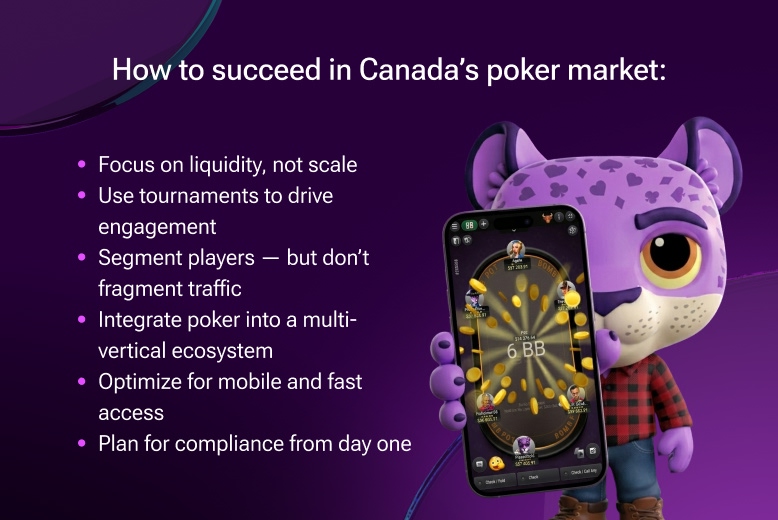
Entering the Canadian poker market requires a different mindset than in high-liquidity or emerging regions. Here, success depends less on scale and more on precision — how well the product is adapted to regulatory constraints, player behavior, and liquidity realities.
Build Around Liquidity, Not Around Features
In Canada, liquidity is limited by design. This means that adding more formats or tables does not automatically improve the product — it can dilute the player pool instead.
Operators should focus on:
- concentrating traffic at specific times
- limiting format fragmentation
- ensuring that core tables are always active
A smaller but consistently active ecosystem is more valuable than a wide but empty one.
Treat Tournaments as a Strategic Core
Given the structure of the market, tournaments are often the most effective way to concentrate liquidity and drive engagement.
Well-designed tournament strategies can:
- create predictable traffic peaks
- increase session time
- build recurring player habits
However, success depends on calibration. Guarantees, buy-ins, and frequency must reflect actual player volume, not optimistic projections.
Segment the Audience — but Carefully
Canadian players are not homogeneous, but segmentation must be handled with care.
Operators should:
- offer both recreational-friendly and skill-based formats
- avoid over-segmentation that splits liquidity
- use clear positioning for each format
The goal is not to offer everything, but to offer the right mix for the available audience.
Integrate Poker into a Broader Ecosystem
Poker performs best in Canada when it is not isolated.
Operators who integrate poker with:
- casino
- sports betting
- shared wallets and loyalty systems
are better positioned to:
- acquire players more efficiently
- increase lifetime value
- balance engagement and monetization
Poker becomes a strategic layer rather than a standalone revenue driver.
Optimize for Mobile and Fast Access
User expectations in Canada are shaped by mature digital products.
This means:
- fast onboarding
- seamless mobile gameplay
- minimal friction between sessions
Formats that support quick entry and short sessions tend to perform better, especially among recreational players.
Plan for Compliance from Day One
Regulation is not just a legal requirement — it is a structural factor that affects product design, operations, and timelines.
Operators entering Ontario in particular should be prepared for:
- complex licensing procedures
- strict AML and KYC requirements
- ongoing reporting and oversight
Early alignment between product, legal, and operational teams is essential to avoid delays and rework.
Where EvenBet Gaming Creates Value for Poker Operators in Canada
The Canadian poker market is not defined by size, but by complexity. Fragmented regulation, limited liquidity, and a mature player base create an environment where standard approaches rarely work. In this context, operators need more than a generic poker solution. They need a platform that can adapt to constraints — and turn them into manageable variables.
 Windows
  macOS
macOS  iOS
iOS  Android
 Product Adaptability
Entering the Canadian market requires more than market access — it requires product adaptation. EvenBet Gaming addresses this with a highly customizable platform that allows operators to:
- adapt game mechanics and configurations to local requirements
- adjust integrations and product setup for different market models
- align the poker offering with broader iGaming ecosystems
In addition, the platform holds international certifications, which:
- simplifies compliance processes
- reduces time to market in regulated environments
This combination of flexibility and regulatory readiness minimizes the need for product redevelopment and allows operators to enter the market more efficiently.
Tools for Managing Liquidity Constraints
Since liquidity cannot be scaled easily in Canada, it must be managed carefully.
EvenBet’s platform supports:
- smart table and traffic distribution
- configurable game formats and limits
- tournament management tools designed for smaller pools
This helps operators concentrate activity and maintain a consistent player experience, even with limited traffic.
Support for Segmented Player Audiences
The Canadian audience is diverse, combining recreational and experienced players.
EvenBet enables operators to:
- offer different game formats for different segments
- adjust game parameters and structures
- balance accessibility with competitive depth
This makes it easier to serve multiple player groups without fragmenting the ecosystem.
Seamless Integration into Multi-Vertical Products
As poker in Canada works best as part of a broader ecosystem, integration becomes essential.
EvenBet Gaming supports:
- integration with casino and sports betting products
- shared wallets and unified player accounts
- cross-vertical engagement mechanics
In addition, EvenBet offers dedicated poker formats such as One Click Poker and Spins Poker, specifically designed for seamless integration into casino and sportsbook environments. These formats lower the entry barrier for new players and align well with fast-paced, casual gaming behavior typical for cross-vertical audiences.
The use of automatic random table seating further simplifies the liquidity challenge by removing friction in table selection and ensuring faster game start times.
This allows operators to use poker as a retention and engagement layer within a larger iGaming strategy.
Scalable Tournament Infrastructure
Tournaments play a central role in the Canadian market, but require careful execution.
EvenBet’s platform allows operators to:
- configure tournament schedules and structures
- manage guarantees and re-entry formats
- scale events based on actual player activity
This reduces operational risk while supporting consistent engagement.
A Platform Built for Mature Markets
Canada is a market where players are experienced and expectations are high.
EvenBet Gaming’s poker solution is designed for:
- stable performance under varying traffic conditions
- flexible customization of UX and gameplay
- long-term product evolution
This makes it suitable for operators targeting not just growth, but sustainability.
FAQ: Online Poker Market in Canada
What is the current state of online poker in Canada in 2026?
Online poker in Canada is a mature and stable vertical within a strong iGaming ecosystem. While it represents a smaller share of total revenue compared to casino and sports betting, it benefits from an experienced player base and well-established demand patterns. Its strength lies in long-term engagement, player loyalty, and its role as a strategic complement to other verticals.
Is online poker legal in Canada in 2026?
Yes, online poker is legal in Canada and operates within well-defined provincial frameworks. Ontario offers a fully regulated environment open to licensed private operators, while other provinces run government-managed platforms. In addition, the presence of offshore platforms highlights the existing demand and scale of the market.
How is online poker regulated across Canadian provinces?
Canada follows a decentralized regulatory model, with each province defining its own approach:
- Ontario operates a regulated open market with licensed private operators
- Québec, British Columbia, Manitoba, and Atlantic provinces use government-run models
- Alberta is moving toward a competitive regulated framework
While this creates a fragmented landscape, it also offers multiple market entry paths and evolving opportunities for operators.
What makes Ontario different from the rest of Canada’s poker market?
Ontario stands out as the most developed and accessible market for private operators. It combines a clear regulatory framework with strong player demand and a competitive environment.
At the same time, its ring-fenced liquidity requires operators to adapt their product and strategy. For those who do, Ontario offers a stable and transparent market with long-term potential.
Is it worth investing in an online poker business in Canada?
Canada presents a compelling opportunity for operators who take a strategic approach. The market offers regulatory clarity, a high-quality player base, and a strong overall iGaming ecosystem.
While success requires adapting to local conditions — including regulatory structures and liquidity constraints — operators who align their product and positioning with these realities can build sustainable and profitable businesses. Emerging markets like Alberta further strengthen the long-term investment case.
Conclusion
The Canadian online poker market is defined less by scale and more by structure. Fragmented regulation, limited liquidity, and a mature, segmented audience create a landscape where traditional growth strategies do not always apply. Poker remains a relatively small vertical in revenue terms, but its strategic importance lies in engagement, retention, and its ability to differentiate operators in a competitive environment.
Success in Canada depends on alignment rather than expansion. Operators need to work within regulatory boundaries, design products around real liquidity constraints, and understand how different player segments interact with poker and other verticals. In this context, execution — from tournament strategy to UX and integration — becomes the key driver of performance.
For operators willing to adapt, Canada offers a stable and predictable market with long-term potential. Whether positioned as a standalone product or as part of a broader offering, poker can deliver meaningful value when it is tailored to the realities of the market.